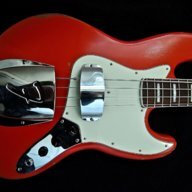
That's a beauty.View attachment 3172049
An 82 Musician, neckthru, switchable active and passive preamp, sounds great as a P or J copy. Plays like butter! Shame it's yellow


TalkBass has been independent since 1998. Add your voice.
Create a free account to reply to discussions, view embedded media, and browse with fewer display ads.
Join free Log in
Want zero display ads or expanded classifieds tools? Compare plans.
That's a beauty.View attachment 3172049
An 82 Musician, neckthru, switchable active and passive preamp, sounds great as a P or J copy. Plays like butter! Shame it's yellow
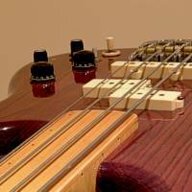
My understanding was that "Roadster" was the mistake, subsequently corrected to "Roadstar"


My favorite bass of all time is a Roadster, RS721, a medium scale wonder. If I ever see any more they will be mine!

 It has been with me since forever, was my only bass for over a decade, and saw me through almost every musical situation imaginable.
Ibanez Roadstar Series II RB850 - 1984
Description: The RB850 is a passiv bass that many people I have talked to like the sound of. This is probably largely due to the two humbucker pickups that it comes equipped with. I think the first version of the RB850 came in 1984 and was available as passive basses until 1987, when a new version with active pickups arrived. But still with passiv blend, volume and tone controls. More about the 1987 model in a later review. These basses were made in Japan.
The body is in basswood with a maple bolt-on neck. 34 inch with 24 frets with a fretboard in rosewood. This model was first available in black, purple, white and red. I have two black 1984s and one red 1987. The 1984 models weigh in at 3.5 kg and has quite a lot smaller body than the other P-bass-like Roadstars and Musician basses. The body shape reminds me of a Spector or some early Warwick basses. The RB850 came with the generally hated boomerang shaped strap buttons. Once you put the strap on, it is nearly impossible to get it back off again.
The pickups and the electronics are special for the model years 1984-1986. It is the Ibanez J6 pickups that look pretty cool, but sound even better. Both the volume and the tone controls are push-pull switches, to change the pickups from parallel to serial (I think). Some people say it makes a big difference, but I think the difference is quite subtle. The RB850 came with fairly boring plastic knobs for the controls.
Sound: This bass has a full tone when you use the neck pickup and a more mid focused sound with good attack with the bridge pickup. But the real thing happens when you mix the pickups. It is a really meaty sound, but still a bit mellow compared to a modern bass. The blend control has a notch at the middle and this is also where the bass has the best sound, according to me. That balance control really gives a nice way to quickly change the sound of the bass, I much prefer it to two volume controls. If I play finger style I generally use the bridge pickup. With a pick I use a more even blend (middle) or even just the neck pickup. (Mix to taste.)
As a passive bass it is, like the MC800 described above fairly noisy. This is a bass I wouldn't mind putting copper foil inside to lessen the influence of electric fields.
Playability: This bass is really light and has a great sound. The neck profile is normal for this periods basses. The neck is varnished, 41 mm wide and 21 mm thick at the first fret. (Love the necks, but then I nearly grew up with this neck profile, so no surprise there.)
Summary: After a few days use I fell for this bass. It is really nice to play and lightweight. This could be my only bass. It has growl and this to me feels like a bass made for rock! I liked it enough that I ended up getting a second one, which probably was a bit mad, but there you are.
Next bass discussed will be the Ibanez Musician MC924.
This is my RB850 - I love it and from time to time I'm gigging with it:
View attachment 3158682
I wired the pickup coils in parallel and replaced the balance-pot with a four-way rotary switch.
In the audio you can hear the four positions:
1. neck PU, both coils
2. neck coils of both pickups
3. all four coils
4. bridge PU, both coils

 A friend who is a much better bass player than I am tried it and said it reminded him of Musicman Reflex basses in passive. Sounds good? Yeah.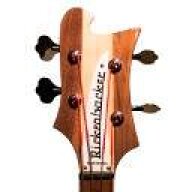
In 1982 the first Musician came with painted body: black or white. This model still had, for its time, a quite advanced preamp, with blend, volume, tone, active/passive switch, active bass, mid and treble controls. Judging by what those that own these bases they have very good tonal variations.
The first Musicians were earlier than 1982, and they weren't painted black or white as far as I know. My 924 is from 1981 and has a transparent finish (probably tinted brown over the body wings, but it looks clear over the neck-through center part). I believe the first year of production was 1979.