• TalkBass has been independent since 1998. Add your voice.
    Create a free account to reply to discussions, view embedded media, and browse with fewer display ads.
    Join freeLog in
    Want zero display ads or expanded classifieds tools? Compare plans.

Ibanez tuned neck inserts? Anyone know about this?

i've had precisely one 34" scale neck in the many I've played over 50+ years that didn't have a deadspot. It's a one piece maple Allparts neck I bought used. It is a very stiff neck

Of the many short scale necks I've played, I've had precisely one that had a small deadspot. The rest of them had none. My SWAG about why is shortscale necks made of the same material as long scale necks are inherently stiffer because they are shorter.
 
  • Like
Reactions: Bill Whitehurst
Then why isn't it used on any of their models now? Many use CF of Ti so it can't be cost.

Ibanez is still using Titanium reinforcement rods to this day AFAIK.

Not on every single model, but instruments in both the Premium & Prestige line have them.

The current Ibanez website lists whether or not the instrument has TR necks.

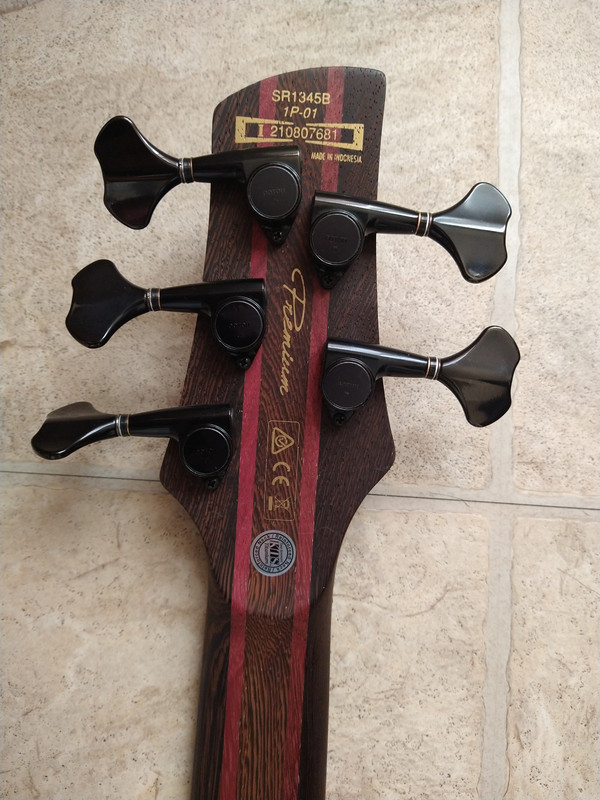
The silver sticker on my made in 2021, SR1345B Premium reads "KTS Titanium Reinforced Neck".

Ibanez-SR1345-B-4.jpg
 
Last edited:
Ibanez is still using Titanium reinforcement rods to this day AFAIK.
You have completely missed the point. Back then they were advertised as being of selected 'tuned' lengths to combat resonance in the neck. These days they do not advertise them as such but as reinforcements for neck stability. Irrespective of the metal used, if they actually had some benefit in resonance control as originally advertised, then they would still be using them as such, making use of the marketing benefit, and presumably other companies copying it (not patented AFAIK). To me, in response to the OP, it's a lot of marketing fluff, and I see zero evidence otherwise.
 
You have completely missed the point. Back then they were advertised as being of selected 'tuned' lengths to combat resonance in the neck. These days they do not advertise them as such but as reinforcements for neck stability. Irrespective of the metal used, if they actually had some benefit in resonance control as originally advertised, then they would still be using them as such, making use of the marketing benefit, and presumably other companies copying it (not patented AFAIK). To me, in response to the OP, it's a lot of marketing fluff, and I see zero evidence otherwise.

Point taken. If it worked as advertised they and other companies would be doing it... assuming the demand was there.
 
You have completely missed the point. Back then they were advertised as being of selected 'tuned' lengths to combat resonance in the neck. These days they do not advertise them as such but as reinforcements for neck stability. Irrespective of the metal used, if they actually had some benefit in resonance control as originally advertised, then they would still be using them as such, making use of the marketing benefit, and presumably other companies copying it (not patented AFAIK). To me, in response to the OP, it's a lot of marketing fluff, and I see zero evidence otherwise.

Sounds good on paper but no discernible value. I had a question regarding tuning necks by adding mass somewhere / anywhere along the length. One of our resident engineers chimed-in with this: think of a bass neck as a properly-tuned marimba tone bar. Mass is manipulated more so at the distal point (there's no headstock) to create the desired response when struck with a mallet. I've always wondered if this would be possible with a conventional bass neck: bolt it down, place it on a 'scope, and strike with a mallet. Manipulate the headstock mass so the tuning or resonant freq falls between in an equally-tempered scale. This, in part, was the rationale behind the TimberTech "shaker table": we know we can't completely eliminate dead spots but we can move them to a less-noticeable location.

Riis
 
  • Like
Reactions: hasbeen
think of a bass neck as a properly-tuned marimba tone bar
My only issue/question with this analogy is that a bass neck is not a percussion instrument that is intended to be struck in order to make a sound. This is my whole argument against the idea of "t*+ewood" in a solid electric instrument.
You don't tune the body and neck to make sound, like a xylophone or marimba. You tune/build it as a support structure for the strings. To make the strings perform and sound good.
 
My only issue/question with this analogy is that a bass neck is not a percussion instrument that is intended to be struck in order to make a sound. This is my whole argument against the idea of "t*+ewood" in a solid electric instrument.
You don't tune the body and neck to make sound, like a xylophone or marimba. You tune/build it as a support structure for the strings. To make the strings perform and sound good.

Yes, it is a strange analogy but not that foreign. We strike the neck to eval the resonant response. We can probably forego the mallet and strike with our fingertips and get a similar outcome...we've done it for years (...or used to!) to evaluate the human thorax. As of late, I've seen videos of violin makers repeatedly percussing the top during the carving process and Susan Lipkins doing the same while choosing bow blanks. Could be a bunch of kool-aid but the objective remains the same: optimize the structure to enhance the interaction with the strings. The argument will arise "Riis...you're addressing acoustic instruments while we're talking solid body basses". True but there are enough shared & overlapping elements which keeps the bass-building evolutionary process running at full steam. Case-in-point: if a bass demo's a dead spot when amplified, it will show the same characteristic when unplugged...although at a lesser volume!

Riis
 
violin makers repeatedly percussing the top during the carving process
That makes perfect sense to me, as it's an acoustic instrument and the wood of the instrument is what is actually amplifying the sound of the strings. The wood is literally making sound.
I don't think certain concepts from the acoustic world are interchangeable with solid wood framed electric instruments that are making their sound with metal strings and magnetic fields.
Granted, there's a lot I don't know and it's more useful for me to simplify the building process and leave out the concepts that I don't feel are relevant to building a good frame. That said, I'd love to hear what some builders are gleaning from tapping/knocking on an unformed blank of dimensioned lumber. I already know that it tells you nothing about what the instrument (solid body) will sound like in it's final form. But if there's some other info you can gather (moisture content? Density? Etc), I'd be interested in learning.
 
I don't think certain concepts from the acoustic world are interchangeable with solid wood framed electric instruments that are making their sound with metal strings and magnetic fields.
Granted, there's a lot I don't know and it's more useful for me to simplify the building process and leave out the concepts that I don't feel are relevant to building a good frame. That said, I'd love to hear what some builders are gleaning from tapping/knocking on an unformed blank of dimensioned lumber. I already know that it tells you nothing about what the instrument (solid body) will sound like in it's final form. But if there's some other info you can gather (moisture content? Density? Etc), I'd be interested in learning.

Which concepts are not shared? Electric instruments can have dead spots as do their acoustic counterparts. You pointed out that that "solid wood framed electric instruments that are making their sound with metal strings and magnetic fields". In the event we encounter a dead spot, which is to blame: the metal strings or pickups?

Riis
 
The piece of wood, be it the body or the neck, will have a resonant frequency. It will absorb certain frequencies of the vibrating strings more than others. That's how you get those dead spots. However, the whole tonewoods as in a mahogany body with an ash top and maple neck with rosewood fingerboard will give you a specific tone... I agree that is all malarky.
 
I've never experienced a dead spot on any of the basses I've played. So, I don't have an opinion on it. I'll have to look it up and see if there's any vids around that demonstrate it.
As for what concepts get conflated:
When making an instrument where the wood is making or amplifying the sound, like a violin, acoustic guitar, marimba, etc, tapping on the wood as it's being shaped, to see how it sounds, makes sense.
Tapping on a wood blank that will be shaped into a solid body or neck of an electric instrument doesn't tell you much (anything?) about what the final sound of the instrument will be. At least as far as I can tell and I've yet to hear an explanation for how that works. At least one that makes sense and is easily digestible. I'm not saying the wood used and how it's constructed doesn't affect the sound, it absolutely does. Just not the same way and for the same reasons that it affects the sound of an acoustic.
My simple and only point is the wood is not producing the sound on a solid body electric, like on an acoustic instrument. So, all the same concepts of tone, resonance, etc, don't interchange. Tapping on a thin top to see what it sounds like and how much more shaping it needs before using it for a violin or acoustic guitar, makes some sense to me. Tapping on a hunk of wood that will be used as a solid body or neck for an electric instrument makes zero sense to me.
What I've noticed about violin, acoustic guitar building is that there are very particular wood choices and design features that are vital for final sound. Electric basses? The choice of woods, materials, design and shapes are all over the place. Yet, they all end up sounding like electric basses. I think that should be a huge clue as to how important all this stuff that we split hairs over, actually is in the solid body electric world.
 
Sounds good on paper but no discernible value. I had a question regarding tuning necks by adding mass somewhere / anywhere along the length. One of our resident engineers chimed-in with this: think of a bass neck as a properly-tuned marimba tone bar. Mass is manipulated more so at the distal point (there's no headstock) to create the desired response when struck with a mallet. I've always wondered if this would be possible with a conventional bass neck: bolt it down, place it on a 'scope, and strike with a mallet. Manipulate the headstock mass so the tuning or resonant freq falls between in an equally-tempered scale.
...

What you really want is to move it beyond the normal operating range. Something below 32Hz for a 4-string (to allow drop-tuning) or below 25Hz for a 5-string. Probably not realistic, given the typical dead-spot is in the 130Hz-150Hz range. But trying to tune to an in-between frequency is also impractical because there is a band of resonance either side of the centre which easily covers a semitone or more. Some note or other will always be affected. So stiffening to damp/control energy-sapping vibrations is the only way, IMHO.
 
  • Like
Reactions: Zooberwerx
What you really want is to move it beyond the normal operating range. Something below 32Hz for a 4-string (to allow drop-tuning) or below 25Hz for a 5-string. Probably not realistic, given the typical dead-spot is in the 130Hz-150Hz range. But trying to tune to an in-between frequency is also impractical because there is a band of resonance either side of the centre which easily covers a semitone or more. Some note or other will always be affected. So stiffening to damp/control energy-sapping vibrations is the only way, IMHO.

IIRC, this was the concept behind the TimberTech in some regard. They'd bolt the component to the table, add sensors, and vibrate (freq & duration?) using the input as guidance. Haven't seen one for a while...okay, I've never seen one. Guess we'll continue to see progress via multi-lams, inserts, alternative materials, etc. It's not a perfect world and I resigned myself to that years ago. Here's a rather in-depth read on the subject provided by Richard / Turnaround..it'll give you a headache!

Riis
 

Attachments

In 50 years of playing, designing amplifiers, strings etc., I've never played a bass the DIDN'T have a dead spot. Do an experiment: Play a bass un-amplified. Put ear plugs in.

Now, play every note on each string, one at a time and SLOWLY. Let the note fade out. Pay very close attention to how the vibration in the neck feels. That's all you're doing in this exercise, is FEELING the vibrations in the neck. On most notes, you'll feel a more uniform vibration up and down the neck. Then, you'll get to a spot where the vibration in the neck will "choke out". As well, you'll feel a corresponding vibration in the bass body that is cancelling out the vibration in the neck.

To zero in on this: Play a bolt-on, 34" scale bass. Do the exercise above. When you get to around the 5th position on the G string, feel how different the vibration feels compared to other notes. Feel how "dead" it is and also try to feel for a more dramatic vibration in the body of the bass, that dies out quickly.

When you've found your dead spot (your bass does have one) for giggles, play that spot/note while using a tuner and see how the tuner reacts.
 
Play a bolt-on, 34" scale bass. Do the exercise above. When you get to around the 5th position on the G string, feel how different the vibration feels compared to other notes. Feel how "dead" it is and also try to feel for a more dramatic vibration in the body of the bass, that dies out quickly.
That's been the case with larger Fender style headstocks, though not always, but not smaller ones like my Ibanezes.

I've also done this test with all my basses, amplified because unamplified is irrelevant, and I have several with no deadspots at all or very minor ones at best, not enough to be worth commenting as no one has ever noticed in normal use.