
Enjoy the benefits of a premium membership!
Upgrade Account
-
TalkBass has been independent since 1998. Add your voice.
Create a free account to reply to discussions, view embedded media, and browse with fewer display ads.
Join free Log in
Want zero display ads or expanded classifieds tools? Compare plans.
You are using an out of date browser. It may not display this or other websites correctly.
You should upgrade or use an alternative browser.
You should upgrade or use an alternative browser.
ID a P Bass
- Thread starter gfnk357
- Start date
More options
Who Replied?
Not a Fender expert but my spidey senses say it's real, that's what i hope anyway!


This is the most important thing;The bass plays well and I love the sound
If your willing / able and have the means to restore it - that alone is reason enough.
On a cursory view; I think you might have something there. There are some authentic looking parts.
(Close up of the pots would be nice)
The control route & the bridge ground looks reminiscent of early Ps.
Not sure where you are located, but I'd take it to someone reputable to have it authenticated.
Here's a guide to the "dowel" marks Jio referred to. I don't know how consistent the placement was, but they're spaced about 10" on my '64


I haven't seen the dowel holes in the back yet but there's still some finish that could be covering them. I did find what looks like two nail holes on the front under the pickguard area. Fender used nails to prop up bodies for drying in the early 60s, but those holes shouldn't have anything in them because the nails were pulled after the paint dried. These holes are filled which seems to rule that out unless the entire body was refinished at some point. The paint in the holes seems to match up with the bottom paint layer rather than the spray paint that was on top.
Attachments


- Jun 30, 2010
- 49,585
- 221,930
- Disclosures
- musician/artist/owner - Gildaxe
It's been rewired - not sure the pots are original. Pick-guard not original for a '63 - 60s pg's have a full aluminum ground-plate.Here are close ups of the pots. Hopefully they have everything you need to see.
Those are filled in 'tug-bar'/finger rest holes ...I haven't seen the dowel holes in the back yet but there's still some finish that could be covering them. I did find what looks like two nail holes on the front under the pickguard area. Fender used nails to prop up bodies for drying in the early 60s, but those holes shouldn't have anything in them because the nails were pulled after the paint dried. These holes are filled which seems to rule that out unless the entire body was refinished at some point. The paint in the holes seems to match up with the bottom paint layer rather than the spray paint that was on top.
Last edited:
Hi, those look more like tug bar mounting holes to me. OOPs..... day late and a dollar short. @JIO already answered. Looks like a diamond in the rough to me!I haven't seen the dowel holes in the back yet but there's still some finish that could be covering them. I did find what looks like two nail holes on the front under the pickguard area. Fender used nails to prop up bodies for drying in the early 60s, but those holes shouldn't have anything in them because the nails were pulled after the paint dried. These holes are filled which seems to rule that out unless the entire body was refinished at some point. The paint in the holes seems to match up with the bottom paint layer rather than the spray paint that was on top.
I'm sure at least one of the pots isn't original, both wouldn't surprise me. Would the cloth pickup wires suggest a vintage P bass or did reissues/newer basses have those as well?
I think you're both right about the tug bar mounting holes. I noticed the tug bar missing when comparing to pictures of other bases but it didn't click that the holes were for that.
I think you're both right about the tug bar mounting holes. I noticed the tug bar missing when comparing to pictures of other bases but it didn't click that the holes were for that.
- Jun 30, 2010
- 49,585
- 221,930
- Disclosures
- musician/artist/owner - Gildaxe
Would have been cloth covered wires originally, and probably on the '80s MIJ RI's as well.I'm sure at least one of the pots isn't original, both wouldn't surprise me. Would the cloth pickup wires suggest a vintage P bass or did reissues/newer basses have those as well?
I think you're both right about the tug bar mounting holes. I noticed the tug bar missing when comparing to pictures of other bases but it didn't click that the holes were for that.

You've saved a King's Ransom on that thing, just THINK what the Fender Custom Shop would charge you to make one look like that !


Given the one-piece maple neck that bass is either a vintage P from the late '50s or a vintage reissue, assuming it's authentic. The refinish, rewiring, and gold tuners are typical of older road-worn basses that were "refreshed" in the '70s or early '80s. The "patina" suggests the finish was applied around that time.
Have nothing to add to this thread other than my admiration for a) the OP who shares his (and the bass') guts and b) the terrific knowledge of everyone posting.
Plus...
The statement that the bass sounds great adds to the sense that a good sounding bass can look like anything.
Thanks for posting.
.
Plus...
The statement that the bass sounds great adds to the sense that a good sounding bass can look like anything.
Thanks for posting.
.

Your bass is very far down the aesthetic spectrum; there are no identifiable marks left that can really be used to authoritatively say anything about it. It's a P bass - who it was made by and when are complete mysteries, other than it was made before today, as it existed yesterday. Whatever you do is not going to destroy any collector value, as it has none, and what it might have had at one point is unrecoverable at this point. Strip it, paint it, mod it however you want - make ii your bass.
If you do strip it, do so slowly, in case there's a point where you say "that looks kinda cool" - sometimes a bass with just the right amount of "visual history" can be cool. As it is now, I'd say it has a bit too much of that. Then again, it's your bass - you get to decide.
If you do strip it, do so slowly, in case there's a point where you say "that looks kinda cool" - sometimes a bass with just the right amount of "visual history" can be cool. As it is now, I'd say it has a bit too much of that. Then again, it's your bass - you get to decide.
I'd just do a setup and new strings and call it a day.

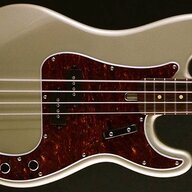

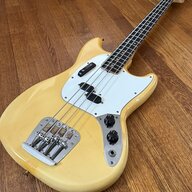
AVRI ‘57 P made between 1982-84 in the old Fullerton factory.I have a P Bass that I picked up about 15 years ago that I'd like to figure out whether it's actually a Fender and if so what year it might be.
The bass has poorly spray painted at some point, both on the body and on the headstock. Lots of the finish has come off and underneath there's weird black markings that almost look like someone took a pencil and ran it back and forth all over the body. The finish that has come off tends to be in big flakes with gray on the bottom, then white, then the dark gray spray paint.
I've always suspected it may be a knockoff due to the condition of the decal, or if it is real it could be cobbled together out of various basses. I can't find any dates on it, but it also has features that look like it might be a 60's P-bass. One of the things that makes me wonder if it is real is actually the decal, because why would anyone bother to paint around the decal if the bass wasn't actually a Fender, and if they were going to put a fake decal on it then why wouldn't they paint underneath it first.
Even though there aren't any dates that I can see, there are some other markings in the neck pocket and under the pickups. I don't know if these are useful. The body appears to be one piece of wood. I don't see any joints but they could be masked by the black underfinish stuff. There was no neck plate (neck held on with wood screws). The tuners have no fender markings, the pickguard may not be original, the pots are mismatched and someone tried putting an XLR jack in the corner of the body at one point. The pickups and bridge look like they could be original fender but I'm sure there are lots of aftermarket parts of knockoffs that looks similar.
The bass plays well and I love the sound, it just looks terrible. At this point I'm thinking of taking the rest of the finish off and either getting it repainted or going with a natural finish depending on how the body looks.
I'd be interested in what everyone thinks about whether this is a real P Bass and what year it might be. I can also take measurements if that would help.
Thanks, can you point out the details that make you think it's a 82-84 reissue vs being vintage or one of the newer reissues?AVRI ‘57 P made between 1982-84 in the old Fullerton factory.
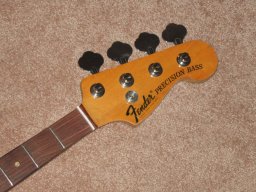
I own a 59-60 Precision and that logo looks like the one on my bass. That body has been modified and heavily finished so that stripping all of that black paint could help get closer to the truth. I would proceed as if it is genuine. Most copies did not bother with the brass grounding plate under the pick up and the bridge looks very close to a 59- 60 item. The right Luthier could probably get the black paint off of the headstock without affecting the logo. I think it could look fantastic with a period correct refinish and the neck restored. You may have a genuine 1959 Precision! The dates on these were placed inside the pick-up cavity in pencil. Good luck with your project.
I got some more of the finish off and it looks like there is a filled screw hole to the right of the control cavity, about where a screw would be for a 10 hole pickguard. The left side of the control cavity is also missing a screw hole that should be there for a 13 hole pickguard. At this point I'm wondering if it originally had a 10 hole pickguard. I've read that fender switched to the 13 hole pickguard in 1960. The 50's reissues would have a 10 hole guard but I haven't been able to find if any other modern P basses would have a 10 hole guard.
Attachments

Latest posts
-

-

-

-
De-fretting - How much fretboard chipping/removal is expected on a Jatoba neck?
- Latest: bass player 53
-
