Have you downloaded the NUX 'IRManager' software from their support site? It lets you apply a LPF and HPF to your IRs

Enjoy the benefits of a premium membership!
Upgrade Account
-
TalkBass has been independent since 1998. Add your voice.
Create a free account to reply to discussions, view embedded media, and browse with fewer display ads.
Join free Log in
Want zero display ads or expanded classifieds tools? Compare plans.
You are using an out of date browser. It may not display this or other websites correctly.
You should upgrade or use an alternative browser.
You should upgrade or use an alternative browser.
Double Bass Impulse Response (IR) Loaders for live DB
- Thread starter tinyd
- Start date
More options
Who Replied?Yes I did - it's quite easy to use. I've just been applying high and low filters directly to the IRs in Audacity but you're right - I could also use the software knobs.
So far I'm very happy with how this is turning out. The worst thing is the hiss I'm getting, but I suppose that's part of using a cheap pedal. It's powered by a battery pack so I don't know what else I can do to get rid of it besides just EQing it out. I love how easily and freely I can sculpt the sound.
So far I'm very happy with how this is turning out. The worst thing is the hiss I'm getting, but I suppose that's part of using a cheap pedal. It's powered by a battery pack so I don't know what else I can do to get rid of it besides just EQing it out. I love how easily and freely I can sculpt the sound.
I've been experimenting with a new KNA DB-1 pickup using the NUX NSS-4 Pulse IR loader pedal and the 3Sigma double bass IR response ("The Crow," KNA DB-1, Mic #10). Before I talk too much, here is the result, which has made me very happy so far.
This was recorded direct, from the DB-1 through the fdeck HPFpre (HPF at 100) and NUX Pulse right into my laptop. I used just a touch of the "Space" control on the NUX, which is a room reverb -- the knob was set at about 8 o'clock which is not quite off.
DBQ IR EQ2 HPF100.mp3
DB1 IR EQ2 HPF100.mp3
Here is my DB-1 test recording, so you can hear what the pickup sounds like without any IR or EQ:
DB1 test.mp3
DB1 test.mp3
Here is my bass recorded acoustically with a P170 small-diameter condenser mic right in front of the bridge.
P170 bridge.mp3
P170 bridge.mp3
Here is a direct recording of the Lifeline clean through the fdeck HPFpre with no other effects. This is what I was using before -- my goal was to improve on this tone.
Lifeline test.mp3
Lifeline test.mp3
I'm quite happy with how the impulse response/EQ turned out. The IR introduced some wood/air into the tone which I probably wouldn't have been able to do just with EQ, and the EQ shaped the tone for my individual setup, including banishing the awful quack/honk frequencies to the shadow realm (edit: on second listen I need to banish them further so I will probably use a notch filter for the really bad ones). So the combination of IR and EQ does more than either could do alone. And the best part is that I can build the EQ into the IR itself so that it's all in one pedal. I will use this setup on a gig this weekend and report back.
Here's what I did:
1. Record a test with the clean pickup, or with the pickup plus the IR if you know which one you want.
2. Play it back through a parametric EQ app and fiddle with the settings until you get something you like. I used a desktop application called Equalizer APO -- it's great because it supports graphic EQ, parametric EQ, and impulse responses! So I could easily swap out different IRs to compare and select my favorite, then EQ the IR.
3. Open the IR in a sound editor like Audacity. Apply the same EQ settings to the EQ filter, apply it to the IR file, and save the new version. I just used the graphic EQ because it was sufficient for my purposes (for now).
4. Load up the equalized IR file into your IR loader and see how it sounds. Listen back through whatever you will use to play live, or a reasonable approximation thereof.
5. Revise.
After a few iterations of that I arrived at a sound that I like pretty well. It's not perfect and I'll probably fiddle with it forever, but I think it will mix well for live shows -- not too muddy and not too prominent. It sounds more "electric/metallic" on headphones, but those frequencies basically disappear on speakers/amp/PA so I have ignored them for now.
Regarding the hiss I mentioned in the post above, that is not a concern with the DB-1. The UP-1 pickup I used on the Ergo EUB has a MUCH lower signal, so I had to turn up the gain, but the DB-1 has a strong signal so the gain stays low and the hiss is inaudible.
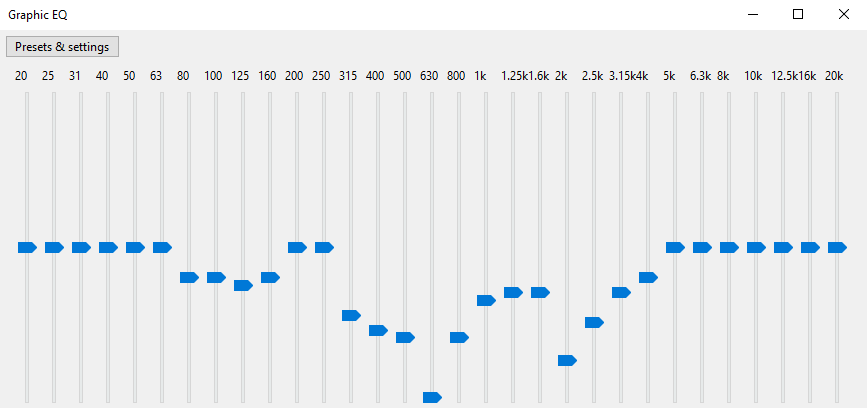
Here's what the EQ looks like. The low-frequency dip below 200hz is correcting a big hump in the IR (edit: now I think I shouls have left it alone so I'll go back and flatten it) and the rest is basically getting rid of the standard quack/honk/ping/metallic frequencies (some of which were made worse by the IR, so I'll probably need more attenuation).
This was recorded direct, from the DB-1 through the fdeck HPFpre (HPF at 100) and NUX Pulse right into my laptop. I used just a touch of the "Space" control on the NUX, which is a room reverb -- the knob was set at about 8 o'clock which is not quite off.
DBQ IR EQ2 HPF100.mp3
DB1 IR EQ2 HPF100.mp3
Here is my DB-1 test recording, so you can hear what the pickup sounds like without any IR or EQ:
DB1 test.mp3
DB1 test.mp3
Here is my bass recorded acoustically with a P170 small-diameter condenser mic right in front of the bridge.
P170 bridge.mp3
P170 bridge.mp3
Here is a direct recording of the Lifeline clean through the fdeck HPFpre with no other effects. This is what I was using before -- my goal was to improve on this tone.
Lifeline test.mp3
Lifeline test.mp3
I'm quite happy with how the impulse response/EQ turned out. The IR introduced some wood/air into the tone which I probably wouldn't have been able to do just with EQ, and the EQ shaped the tone for my individual setup, including banishing the awful quack/honk frequencies to the shadow realm (edit: on second listen I need to banish them further so I will probably use a notch filter for the really bad ones). So the combination of IR and EQ does more than either could do alone. And the best part is that I can build the EQ into the IR itself so that it's all in one pedal. I will use this setup on a gig this weekend and report back.
Here's what I did:
1. Record a test with the clean pickup, or with the pickup plus the IR if you know which one you want.
2. Play it back through a parametric EQ app and fiddle with the settings until you get something you like. I used a desktop application called Equalizer APO -- it's great because it supports graphic EQ, parametric EQ, and impulse responses! So I could easily swap out different IRs to compare and select my favorite, then EQ the IR.
3. Open the IR in a sound editor like Audacity. Apply the same EQ settings to the EQ filter, apply it to the IR file, and save the new version. I just used the graphic EQ because it was sufficient for my purposes (for now).
4. Load up the equalized IR file into your IR loader and see how it sounds. Listen back through whatever you will use to play live, or a reasonable approximation thereof.
5. Revise.
After a few iterations of that I arrived at a sound that I like pretty well. It's not perfect and I'll probably fiddle with it forever, but I think it will mix well for live shows -- not too muddy and not too prominent. It sounds more "electric/metallic" on headphones, but those frequencies basically disappear on speakers/amp/PA so I have ignored them for now.
Regarding the hiss I mentioned in the post above, that is not a concern with the DB-1. The UP-1 pickup I used on the Ergo EUB has a MUCH lower signal, so I had to turn up the gain, but the DB-1 has a strong signal so the gain stays low and the hiss is inaudible.
Here's what the EQ looks like. The low-frequency dip below 200hz is correcting a big hump in the IR (edit: now I think I shouls have left it alone so I'll go back and flatten it) and the rest is basically getting rid of the standard quack/honk/ping/metallic frequencies (some of which were made worse by the IR, so I'll probably need more attenuation).
Last edited:

Well, my first gig with the IR loader was a qualified success. It also provided an accidental natural experiment. During our intro tunes, a storm blew in and a strong gust of wind blew into the tent (it was an outdoor wedding). Our gear got wet and we lost power briefly. When it came back, I forgot to turn the pedal on for the beginning of the first set. So, here are examples with and without the pedal.
Longview, with pedal -- featuring an isolated bassline
Love On Top, with pedal -- featuring some walking with the band
Wave, with pedal -- featuring a bass vamp/solo (You can hear the wind gust at the end of the guitar solo - I stop playing to push the side of the tent back over the board. Then I take a time-filler vamp solo while the rest of the band scrambled to save their gear.)
King of the Road, without pedal -- featuring an isolated bassline
Amplification: Trace Elliott Elf amp into a Mesa Boogie Subway 410 cab (4 10" drivers) plus PA speakers through the board
Mic: Zoom H2, 120 degree stereo mics, on the floor at the edge of the stage, sort of in front of the amp and just behind the PA speakers flanking the stage
Pickup: KNA DB-1
Pedal: NUX Pulse with 3Sigma bass IR and my own EQ applied (slightly different than the graphic settings above but similar)
Band: Doubledown
Basically, I think the IR/EQ improved the sound a lot. IR or EQ alone is noticeably worse than both together. Unfortunately I cut the bass too much in this case, because I did the soundcheck through the amp but also went direct into the board, so I adjusted for the bass-heavy 4x10 cab but the PA speakers needed more bass in the signal. There were a number of other problems that stemmed from this (poor intonation because I couldn't hear myself well on stage, etc.) but those are not related to the IR loader. The recorder also doesn't pick up much bass on the lowest gain setting, so I think the actual live sound had more bass than comes through on the recording.
In general, I think I got a nice punchy sound that supported the band and cut through the mix without sticking out too much. It's not quite MBOL but it's an improvement over the Lifeline: more defined and woody. And it's certainly much better than the DB-1's clean sound. Hopefully I'll be able to make it better with more work - I could get rid of some more quack around 700Hz with an actual notch filter...
Longview, with pedal -- featuring an isolated bassline
Love On Top, with pedal -- featuring some walking with the band
Wave, with pedal -- featuring a bass vamp/solo (You can hear the wind gust at the end of the guitar solo - I stop playing to push the side of the tent back over the board. Then I take a time-filler vamp solo while the rest of the band scrambled to save their gear.)
King of the Road, without pedal -- featuring an isolated bassline
Amplification: Trace Elliott Elf amp into a Mesa Boogie Subway 410 cab (4 10" drivers) plus PA speakers through the board
Mic: Zoom H2, 120 degree stereo mics, on the floor at the edge of the stage, sort of in front of the amp and just behind the PA speakers flanking the stage
Pickup: KNA DB-1
Pedal: NUX Pulse with 3Sigma bass IR and my own EQ applied (slightly different than the graphic settings above but similar)
Band: Doubledown
Basically, I think the IR/EQ improved the sound a lot. IR or EQ alone is noticeably worse than both together. Unfortunately I cut the bass too much in this case, because I did the soundcheck through the amp but also went direct into the board, so I adjusted for the bass-heavy 4x10 cab but the PA speakers needed more bass in the signal. There were a number of other problems that stemmed from this (poor intonation because I couldn't hear myself well on stage, etc.) but those are not related to the IR loader. The recorder also doesn't pick up much bass on the lowest gain setting, so I think the actual live sound had more bass than comes through on the recording.
In general, I think I got a nice punchy sound that supported the band and cut through the mix without sticking out too much. It's not quite MBOL but it's an improvement over the Lifeline: more defined and woody. And it's certainly much better than the DB-1's clean sound. Hopefully I'll be able to make it better with more work - I could get rid of some more quack around 700Hz with an actual notch filter...
Last edited:
After my experience playing live, I went out and bought a PA speaker so I could prefect my live sound through a PA in a more controlled environment.
Here's a recording of me playing through a PA speaker using the IR loader, recorded with a (better) mic. I turn the pedal off and on during the recording to contrast the unmodified pickup sound.
DB1 IR EQ3 compare PA
DB1 IR EQ3 compare PA.mp3
There is no acoustic sound in this recording: I played through the pickup into a looper pedal, then played the loop through the PA speaker and recorded it with an AB pair of small-diameter condenser mics about 12 feet from the speaker. Speaker volume is low gig volume: about 20% gain on a 200-watt amp. Here's a graphic representation of the IR/EQ:
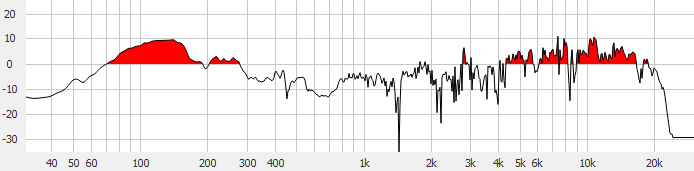
As you can see, it's doing a lot to modify the signal.
I have a few different EQs loaded into the pedal. The one above is meant to reproduce "what my bass sounds like from 10 feet away." Here's the same loop with another brighter EQ closer to "what I hear when I'm playing." I might use it with a jazz trio for example.
DB1 IR EQ4 compare PA
DB1 IR EQ4 compare PA.mp3
Overall I'm very happy with the sound. Now I will have to get back to actually practicing.
Here's a recording of me playing through a PA speaker using the IR loader, recorded with a (better) mic. I turn the pedal off and on during the recording to contrast the unmodified pickup sound.
DB1 IR EQ3 compare PA
DB1 IR EQ3 compare PA.mp3
There is no acoustic sound in this recording: I played through the pickup into a looper pedal, then played the loop through the PA speaker and recorded it with an AB pair of small-diameter condenser mics about 12 feet from the speaker. Speaker volume is low gig volume: about 20% gain on a 200-watt amp. Here's a graphic representation of the IR/EQ:
As you can see, it's doing a lot to modify the signal.
I have a few different EQs loaded into the pedal. The one above is meant to reproduce "what my bass sounds like from 10 feet away." Here's the same loop with another brighter EQ closer to "what I hear when I'm playing." I might use it with a jazz trio for example.
DB1 IR EQ4 compare PA
DB1 IR EQ4 compare PA.mp3
Overall I'm very happy with the sound. Now I will have to get back to actually practicing.
Hello everybody,
I read this thread with interest. Thanks for posting your expieriences. Thought about buying an IR Pedal to achieve a better live sound. My setup so far: Double bass, Gallien MB-112, Balsereit Piezo, Headwy 2HE. Sounds not bad, but sometimes too Piezo-ish. The tonedexter seems to be the best, but is also expensive. I look for a cheaper pedal. I thought a wet/dry control would be good and an 2048 mB audio resolution. Does anyone have a recommendation? Or might a pedal with 1024 mb or without the dry/wet option be sufficient for live-setup?
Thanks in advantage for your thoughts
Greetings from Florian/Germany
I read this thread with interest. Thanks for posting your expieriences. Thought about buying an IR Pedal to achieve a better live sound. My setup so far: Double bass, Gallien MB-112, Balsereit Piezo, Headwy 2HE. Sounds not bad, but sometimes too Piezo-ish. The tonedexter seems to be the best, but is also expensive. I look for a cheaper pedal. I thought a wet/dry control would be good and an 2048 mB audio resolution. Does anyone have a recommendation? Or might a pedal with 1024 mb or without the dry/wet option be sufficient for live-setup?
Thanks in advantage for your thoughts
Greetings from Florian/Germany
I recently sold my EDB 2 HE for $275, and I only paid $500 ($528 with tax) for my lightly used TD ii—but that was a little more than a year ago, and they (the TD IIs that is) have gone up in price since. I think it’s well worth the money if you can afford it. If not, i would just stick with the Headway until you have the funds for the ToneDexter.Hello everybody,
I read this thread with interest. Thanks for posting your expieriences. Thought about buying an IR Pedal to achieve a better live sound. My setup so far: Double bass, Gallien MB-112, Balsereit Piezo, Headwy 2HE. Sounds not bad, but sometimes too Piezo-ish. The tonedexter seems to be the best, but is also expensive. I look for a cheaper pedal. I thought a wet/dry control would be good and an 2048 mB audio resolution. Does anyone have a recommendation? Or might a pedal with 1024 mb or without the dry/wet option be sufficient for live-setup?
Thanks in advantage for your thoughts
Greetings from Florian/Germany
Another option would be the ToneDexter I, which can be had for significantly less but is not nearly as user friendly. I never used the TD I personally, specifically because it seemed a little too complicated.
The MB is the memory that is needed for the impulse response. How much you need depends on the size of the impulse response you want to use or the sum of several IRs if you can store several at nice and select.Hello everybody,
I read this thread with interest. Thanks for posting your expieriences. Thought about buying an IR Pedal to achieve a better live sound. My setup so far: Double bass, Gallien MB-112, Balsereit Piezo, Headwy 2HE. Sounds not bad, but sometimes too Piezo-ish. The tonedexter seems to be the best, but is also expensive. I look for a cheaper pedal. I thought a wet/dry control would be good and an 2048 mB audio resolution. Does anyone have a recommendation? Or might a pedal with 1024 mb or without the dry/wet option be sufficient for live-setup?
Thanks in advantage for your thoughts
Greetings from Florian/Germany
IRs are typically recorded with a microphone, so you might need to EQ your pickup signal or modify the IR to integrate the EQ needed for your pickup.
I think the 1024 value is referring to the number of points (length) of the impulse response, the more you can afford, the better for bass.I thought a wet/dry control would be good and an 2048 mB audio resolution. Does anyone have a recommendation? Or might a pedal with 1024 mb or without the dry/wet option be sufficient for live-setup?
An IR with 1024 values has quite widely spaced frequency points down in the low frequencies so it is difficult to shape the deeper tones without affecting the ones close by (like a graphic eq with not many bands). At frequencies that make guitars or violins sound individual, 1024 is fine because the bands become much closer together in that range.
The 3sigma IRs have lots of resolution but I believe they are truncated when imported to a device like the NUX Pulse, or at least simplified when selected into the working memory of the processor. I have used one or two of these IRs in the Pulse..
I think the Tonedexter II has 8192 points in it's wavemaps which gives you great precision in shaping tone well below 200Hz. You have to pay for the processing power in any device which can apply that added level of detail to the sound in real time.
Cheers, Steve
If the impulse response length is meant (measured in samples of a certain sampling rate), then we need to know the sampling rate of the impulse response too to calculate the lowest repräsentableres frequency.
Assuming a sampling rate of 48 KHz and 1024 samples IR length, the lowest frequency is about 47 Hz. With 44,1KHz it is about 43 Hz. Just a bit above the low E string. With 2048 samples the reachable frequencies are half the value, 23.5 or 21.5 Hz.
So, first find out what the numbers 1024 and 2048 mean, total IR memory size or maximum processable IR length.
Otherwise you cannot make a well thought decision.
Assuming a sampling rate of 48 KHz and 1024 samples IR length, the lowest frequency is about 47 Hz. With 44,1KHz it is about 43 Hz. Just a bit above the low E string. With 2048 samples the reachable frequencies are half the value, 23.5 or 21.5 Hz.
So, first find out what the numbers 1024 and 2048 mean, total IR memory size or maximum processable IR length.
Otherwise you cannot make a well thought decision.
FWIW, I tried my Boss IR-200 with my homemade EUB(3 Sigma German IR's with Full Circle) for the first time. It sounded shockingly good through my headphones. I'm going to try it through my Genzler Gollihur Bass Array soon. I am optimistic. Next, I'll try it on my double bass.
PS - Here's my son playing the bass without the IR loader. You can get an idea of what I'm dealing with....haha...
FWIW, I tried my Boss IR-200 with my homemade EUB(3 Sigma German IR's with Full Circle) for the first time. It sounded shockingly good through my headphones. I'm going to try it through my Genzler Gollihur Bass Array soon. I am optimistic. Next, I'll try it on my double bass.
PS - Here's my son playing the bass without the IR loader. You can get an idea of what I'm dealing with....haha...
Amazing playing and the EUB sounds really good!
Is it still up for sale?
If not, could you, please, share who made it?
Thanks in advance!


