• TalkBass has been independent since 1998. Add your voice.
    Create a free account to reply to discussions, view embedded media, and browse with fewer display ads.
    Join freeLog in
    Want zero display ads or expanded classifieds tools? Compare plans.

Inside The Secret Underground Laboratory

I read over thirty Eric Sloane books when I was in high school, and loved to visit the Sloane-Stanley Museum. I was that weird kid that would win the “what’s it” contests that the guidance counselor occasionally put out, and was an avid reader of Yankee magazine—the old version, much smaller than the current iteration, with columns written by old Maine coots that knew all sorts of arcane Americana.
 
  • Like
Reactions: Bobo and Flamingo21
I've got a few file cabinet drawers full of old machinery manuals and catalogs from 1900 to 1960. Some rare ones too. They are the main source of my research into my machines. I love the old giant machinery & hardware catalogs from the '20's and '30's. Thousands of small ads for every mechanical thing that was available back then. So much of my machinery knowledge comes from reading every page of them.

Here, for example, is the actual 1908 catalog ad for my Knecht Bros drill press. They were made and sold for less than 5 years, and only two are known to still exist today. This ad alone was very helpful in figuring out how to restore mine.

Knecht Bros Ad 1908 B.jpg


There it is, patiently waiting for me to finish restoring it.

IMG_6723B.jpg
 
I've got a few file cabinet drawers full of old machinery manuals and catalogs from 1900 to 1960. Some rare ones too. They are the main source of my research into my machines. I love the old giant machinery & hardware catalogs from the '20's and '30's. Thousands of small ads for every mechanical thing that was available back then. So much of my machinery knowledge comes from reading every page of them.

Here, for example, is the actual 1908 catalog ad for my Knecht Bros drill press. They were made and sold for less than 5 years, and only two are known to still exist today. This ad alone was very helpful in figuring out how to restore mine.

View attachment 4829981

There it is, patiently waiting for me to finish restoring it.

View attachment 4829982

Oh, that’s neat! I assume those cones with a wheel between them create a sort of continuously variable drive? I’m guessing the wheel can be positioned up or down between the cones, smoothly varying the drive ratio?
 
  • Like
Reactions: Bobo
Oh, that’s neat! I assume those cones with a wheel between them create a sort of continuously variable drive? I’m guessing the wheel can be positioned up or down between the cones, smoothly varying the drive ratio?

Yes, that's exactly what it is, a double-cone variable speed drive! It was patented too; I've got a copy. It's a clever mechanical device. The range of speed adjustment is 9:1; most cone-type variable speed drives are more like 3:1. The wheel between the cones is a stack of leather disks between two steel flanges. The drive is by friction between the leather and the machines cast iron cones. The wheel slides up and down along the angled path on a guide rail on the back side. The clamping force between the cones is set by adjusting the center cone up and down vertically a small amount.

Overall this is a Sensitive Drill, in the same class as the Avey that I got recently. That is, this machine is made for drilling small holes less than 3/16" dia. The cone drive doesn't have a lot of torque capability. It needs about 1/2 HP from the belt drive. Some previous owner stuck that big 1/2" drill chuck on there, but that's not right. I've got a real old 1/4" chuck that I'll be fitting to it as I get it restored.

I found this drill press here in Los Angeles. If I remember right, the owner contacted me to see if I wanted it. I paid him about $100 for it. As it arrived here, it had a goofy angle iron frame up on top with an electric motor and V-belt drive. It had been in use for some decades like that. I stripped all that off and have been getting the missing pieces together to rebuild the original leather belt drive train. There are a few parts I need to machine up. I've got the frame cleaned up and the upper half of it repainted. It'll be black with the cast iron cones and wheels polished. I'll be building it into a frame of old timbers with an electric motor hidden up high, driving the leather belt from above.

This is one of about 5 of my most prized antique machines. It's very unique and rare, and I intend to restore it to almost museum level condition. Clean and handsome, full running condition, as close to original as I can. Nice enough that it will live on forever, after me. That's the motto of us antique machinery hobbyists: Save a few fine examples and make them nice enough that they will be cared for forever by future generations.
 
I love these old machines you show us. the mechanical bits are ingenious, the material quality is excellent, there isn’t any reason they can’t continue for hundreds of years. They were built to last, and should, but there is also something in the lines, a bit of artistry in their form, and that must help some when you stand with it and create new art with it. It’s not just something that helps you make little holes, it’s a beautiful piece of history that helps you make excellent little holes in new pieces of art. If I was retired and had the time I’d like to do a book like Cody did for #11, following a build, but focusing on the tools used, and their history and restoration. If someone else made it, I’d buy a copy.
Large format, quality paper, sewn binding, big pictures…
 
I particularly love the machinery of the 1900-1940 era. In those days, the most efficient way to make the frame of a machine tool was to cast it from iron. A Patternmaker would hand carve a full size pattern of the frame from wood. That's a skilled craft in itself. They would make a sand mold from the pattern in a dirt pit out back, and pour in a few ladles of molten iron. Let it cool for a few days, and dig the casting out. Set it up in a bigger machine and cut all the precision bores and flat surfaces. The whole process was quite amazing. The casting process gave them a lot of freedom to make the parts in crazy shapes. They put some effort into the appearance and styling of their machines, with flowing curves and shapes. Better looking than their competition. Some of these old machines are a beautiful mix of function and visual design.

During the '40's (WWII) it became more practical to make big machine frames by fabrication. Flat rolled plate stock, cut into rectangles and welded together into boxes. Practical but ugly.
 
I particularly love the machinery of the 1900-1940 era. In those days, the most efficient way to make the frame of a machine tool was to cast it from iron. A Patternmaker would hand carve a full size pattern of the frame from wood. That's a skilled craft in itself. They would make a sand mold from the pattern in a dirt pit out back, and pour in a few ladles of molten iron. Let it cool for a few days, and dig the casting out. Set it up in a bigger machine and cut all the precision bores and flat surfaces. The whole process was quite amazing. The casting process gave them a lot of freedom to make the parts in crazy shapes. They put some effort into the appearance and styling of their machines, with flowing curves and shapes. Better looking than their competition. Some of these old machines are a beautiful mix of function and visual design.

During the '40's (WWII) it became more practical to make big machine frames by fabrication. Flat rolled plate stock, cut into rectangles and welded together into boxes. Practical but ugly.
Not unlike how engine blocks and heads were/are cast. ;)
 
  • Like
Reactions: Bobo
I got some quality time in on the Avey Sensitive Drill Press this afternoon. Jeremy was making up truss rods for 7 necks, and the little 2mm holes needed to be drilled in the DATR head assemblies. Exactly the job I got the Avey for. I wheeled it into the main shop, and used it to drill all the holes. I drilled them myself, to gain experience with this fine machine. And for pure enjoyment. I didn't let Jeremy have any of the fun. I will let him use the Avey eventually.

Overall, it did a great job and I learned a few things. It's a Sensitive Drill Press, and it's very sensitive to the quality, grind and sharpness of the drill bits. With a sharp, high grade American drill bit, it purred smoothly drilling down through the stainless. With a cheapo import bit, even a new one, it grumbled and chattered and argued with me. It let me know that it was unhappy.

It really is very sensitive. Pressing down lightly on the quill lever with one fingertip, I can feel in my fingertip exactly how the drill is cutting. If it's cutting smoothly or it begins to chatter or stall out. That's really important when drilling a tough metal like stainless. The best cutting is a narrow window of speed and download. By the time I got through these seven parts, I was getting a feel for just how much pressure to apply, and when to pause, lift up, and add a drop of cutting oil. It does take some operator skill. And this old Grandpa Avey was patiently teaching me. How many hundreds of people has it taught before me?

I may try some solid carbide drill bits in it. In almost everything else I do, I haven't found carbide drill bits to be worth the extra cost. But here, they might help.

Right now, the Avey is running at 2000 rpm, fixed. The junky drill press that I was using was running at 600 rpm. I'm not convinced yet that the higher speed is better or speeds up the process. For the stainless, the ideal speed may be more like 1000 rpm. I may think about switching the motor on the Avey to a DC variable speed. Or maybe wire it through a VFD to slow it down.

But overall, it's running great, and is a welcome addition to my shop. I'm going to be moving it into a permanent spot on Drill Press Row in the main machine shop. One of the full time staff.

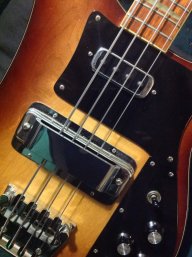
IMG_9019B.jpg
 
I've just realised I drove through Fillmore one time when I was working in Oxnard. I went out towards Victorville one Sunday to see the desert and to see some Joshua trees. I recall there being mile after mile of lemon trees by the road. You're 5300 miles from me and I've been about 1/4 of a mile from your workshop. It's a small world.

So, you drove through Fillmore, and didn’t even realize it until some time later? That sounds about right. If I didn’t live here, I would’ve done the same.
 
Yep. Downtown Fillmore is two blocks long, one street. And half of the buildings are vacant. And there's some stores and small shopping centers along the 126, a stopping point when driving down through Ventura County.

Two blocks from downtown is a big, run-down 110 year old packing house building, across the street from the Fire Department. Hidden away underground, beneath the old packing house, is the legendary Secret Underground Laboratory. Private, secret, high security. Nobody knows what goes on down there.
 
And a CVS, McDonalds, iHop, Taco Bell, Gas Stations, High School, even a shopping center. Wikipedia describes it as a "small city".

View attachment 4843703

Yes, but that's about it. Plus three good burrito shops and the Secret Underground Lab. We're at the bottom end of "Small". But Fillmore is incorporated as a city, and has a stupid, barely-functional government. And a very good Fire Department.
 
Hahahaha, your map pic almost captured the Secret Underground Lab building! You just got the corner of it! ;)

Yep, that's the corner of our building. Mobile Flooring is one of our tenants; he rents an office space in the SE corner. He listed himself on Google and breached our stealth mode.