• TalkBass has been independent since 1998. Add your voice.
    Create a free account to reply to discussions, view embedded media, and browse with fewer display ads.
    Join freeLog in
    Want zero display ads or expanded classifieds tools? Compare plans.

Inside The Secret Underground Laboratory

Oh wow. Can you cut guilloché? Or is it not that kind of engraver?

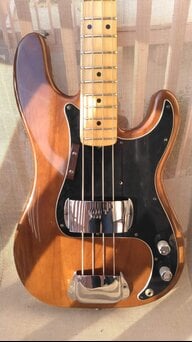
No, it's not that type of engraving machine. This is a pantograph-type engraving machine. You drag a stylus around a template on the upper table, and the motor driven spindle copies the pattern on the part on the lower table, at a reduced size. This is a 1950's New Hermes VB, a really rare and fine machine. I found it back in the '90's and tooled it up to do all the engraved name plates on my basses. Like this:

IMG_8632B.jpg


Here are some oval 12th fret inlays in synthetic pearl stock, that I just engraved with this machine yesterday for a Luthier customer (Touch Singleton).

IMG_8928B.jpg
 
Those are wonderful machines.
and it’s nice to see where you bring them back to life and give them purpose again. I’ll be backpacking in the sequoias and maybe around Mt Baldy in October. my backpacks are from the 1990s, and look it. Does your roommate have somewhere to see his work? Maybe I can send some business that way if he does simple durable packs.
 
  • Like
Reactions: Bobo and Lo-E
No, it's not that type of engraving machine. This is a pantograph-type engraving machine. You drag a stylus around a template on the upper table, and the motor driven spindle copies the pattern on the part on the lower table, at a reduced size. This is a 1950's New Hermes VB, a really rare and fine machine. I found it back in the '90's and tooled it up to do all the engraved name plates on my basses. Like this:

View attachment 4788044

Here are some oval 12th fret inlays in synthetic pearl stock, that I just engraved with this machine yesterday for a Luthier customer (Touch Singleton).

View attachment 4788049
Seeing my nameplate on your post makes me so feel so fortunate to be playing it as my #1. :)
 
Those are wonderful machines.
and it’s nice to see where you bring them back to life and give them purpose again. I’ll be backpacking in the sequoias and maybe around Mt Baldy in October. my backpacks are from the 1990s, and look it. Does your roommate have somewhere to see his work? Maybe I can send some business that way if he does simple durable packs.

Chris is just getting started in the business. He's made some custom backpacks for himself and a few friends. I'll ask, but I don't think he has any developed products or catalog yet.
 
  • Like
Reactions: Crawforde and Bobo
My heart is filled with joy today! That special joy of acquiring a new antique machine tool! Because, as you've seen, I still don't have enough drill presses....

This appeared on CraigsList last night. For sale near me, by a man I met recently. He runs a home business restoring and reselling small antique machine tools. It's his passion too. He visited my shop a month ago, and we obviously talked for hours.

It's a 1925 Avey No.1 Sensitive Drill. In the terminology of the day, a Sensitive Drill is a special kind of drill press made for drilling tiny holes in metal.

IMG_8957B.jpg


It's a bench top drill press, with a heavy cast iron frame. It weighs about 220 lbs. A very strong spindle, with a tiny little 1/4" Jacobs chuck. It's designed for drilling holes smaller than 1/8". It'll drill a #60 or smaller hole, no problem, in steel!

The weight of the spindle is counter-balanced by that rocker arm and an actual counterweight down inside the column. And notice the short little quill feed arm. This machine has a very delicate Sensitive feel to the amount of down pressure you apply to the drill bit.

The spindle is driven at a moderately high speed of about 2000 rpm by a flat belt that turns over two staggered idlers. That originally would have been a leather belt, but that's a synthetic fiber belt on there now. The small crank handle on the front finely adjusts the belt tension. You can adjust the point where it will slip as a safety clutch to help prevent snapping tiny drill bits.

IMG_8959B.jpg


The motor on the back isn't original, although it's from the '50's. This machine would have originally had an idler pulley back there, and another leather belt going up to the line shaft on the ceiling.

Overall, this drill press is in beautiful condition. That's the original paint. James did a few mechanical repairs on it, and it's in full running condition. It needs a switch to be wired in. I may make up a special rolling wooden base for it. I paid him $150 for it, a bargain.

You know all those hundreds of tiny 2mm stainless pins that I use in my truss rods? I have to drill 2mm holes crosswise through brass and stainless rod stock in every one. Right now, I do that with a cheap little import drill press, and it's annoying.

This is the machine for that job.
 
Last edited:
This Avey fills the last major spot in my list of drill presses that I need. Yeah, right. I'd been looking for a good Sensitive Drill for a long time, because I actually need to drill a lot of tiny holes in my bass-building business. Every truss rod that we make in this shop needs two of the 2mm holes drilled. This Avey will get almost daily use.

And that's what really brings me joy....Not only is this a sweet old machine, but it's up and running and ready to go to work! James already tuned it up mechanically. I was just over in unit 16 running it a few minutes ago. It's not a project, requiring lots of my time.
 
Last edited:
I hope you don’t hurt it’s feelings!

It weighs the same as I do! If I abuse it, it'll hurt my feelings. You're going to like this machine, Jeremy. It'll teach us how to drill small holes.

It's amazing to think that this machine started drilling holes before our parents were born. And here it is in my shop, about to take on a new career.
 
Last edited:
This Avey fills the last major spot in my list of drill presses that I need. Yeah, right. I'd been looking for a good Sensitive Drill for a long time, because I actually need to drill a lot of tiny holes in my bass-building business. Every truss rod that we make in this shop needs two of the 2mm holes drilled. This Avey will get almost daily use.

And that's what really brings me joy....Not only is this a sweet old machine, but it's up and running and ready to go to work! James already tuned it up mechanically. I was just over in unit 16 running it a few minutes ago. It's not a project, requiring lots of my time.
I know the feeling
On a smaller scale. I just scored some beautiful old Swan gouges, and an old router plane with a full set of irons. this stuff has been in a box somewhere for decades but is now tuned up, sharp, and ready to shape wood again.
it sounds like you got just the drill press you needed at just the right time. Enjoy!
 
  • Like
Reactions: Bobo and coy garcia
Some Sensitive fun! I gave the Avery Sensitive Drill its first true test today: Drilling the 2mm hole through a brass and stainless DATR truss rod head unit..

No problem at all. Smooth and clean, easy. This is what it was built to do 97 years ago. The spindle is smooth and true, no visible runout. And yes, the feel in the quill lever is very sensitive. It's easy to control how much downforce is on the bit.

This fine old machine is ready to take a prime spot in the shop and get to work. All I need to do is wire in an electrical switch. I'll rig up something cool and old-looking.

IMG_8968B.jpg


IMG_8969B.jpg
 
I'm thinking....
s-l1600.jpg

I actually have a box full of cool old vintage knife switches like that. That was my first thought, too. But, to be reasonably safe, I'd need to run low voltage through the knife switch, powering a hidden relay. And a low-voltage power supply. Some extra parts and wiring.....but I might.

On industrial electrical gear in the 1920's, they would often use open knife switches like that, with asbestos-insulated copper wire on porcelain standoffs. :wideyed: But they would mount them up on the ceiling, out of reach. With a long greasy wooden handle hanging down from the knife switch.

Edit: Looking at the picture, I just had an amusing idea. Mount a (fully insulated) pushbutton switch down under the knife switch, with a pin, so that closing the knife switch pushes the button. And some fake bare copper wires connected to the knife switch terminals.
 
Last edited:
Edit: Looking at the picture, I just had an amusing idea. Mount a (fully insulated) pushbutton switch down under the knife switch, with a pin, so that closing the knife switch pushes the button. And some fake bare copper wires connected to the knife switch terminals.
That's probably the best way to do it, but it's no fun if it doesn't arc or spark at least a little when you throw the switch.