• TalkBass has been independent since 1998. Add your voice.
    Create a free account to reply to discussions, view embedded media, and browse with fewer display ads.
    Join freeLog in
    Want zero display ads or expanded classifieds tools? Compare plans.

Inside The Secret Underground Laboratory

I find CNC really appealing but when you're starting from scratch there is a lot of setup effort needed before it pays off. I've contemplated building a CNC for myself but decided that I was less interested in the hacking-on-the-machine side of it and really only interested in producing. To that end I figure I'm better off joining one of the maker shops in the area, where somebody else is taking care of the machine and I have them to lean on when I have a pattern ready to cut.

Even so, CNC is probably less expense and effort than a legit antique steam engine. Especially since those suckers topped out at, what, ten horsepower? Probably significantly less at the tools being powered due to transfer losses.
 
I’ve actually suggested to Bruce that he get a steam engine to power his shop or we get a bench top CNC router to do some of the really stupid, non-critical and repetitive tasks we do from day to day. He seemed more open to the idea of a steam engine.
Bruce should go totally SteamPunk with a Steam-Powered CNC programmed with Hollerith cards. :D
 
Yeah, well, when there's a giant solar flare that knocks out the power, or some other end times scenario, Bruce will be the only guy around that can whip up a pedal powered machine with his 1895 hand tools and will be the only one who can build a bass.
All those kids that only know how to run a CNC with an ipad will be out of luck.
We'll still need basses during the apocalypse, so poke fun all you want.
 
Yeah, well, when there's a giant solar flare that knocks out the power, or some other end times scenario, Bruce will be the only guy around that can whip up a pedal powered machine with his 1895 hand tools and will be the only one who can build a bass.
All those kids that only know how to run a CNC with an ipad will be out of luck.
We'll still need basses during the apocalypse, so poke fun all you want.
I mean:
R.39ccbd58bb76a50a908385d225fcf9bc
 
I’ve actually suggested to Bruce that he get a steam engine to power his shop or we get a bench top CNC router to do some of the really stupid, non-critical and repetitive tasks we do from day to day. He seemed more open to the idea of a steam engine.

Yeah, I actually wouldn't mind having a boiler and a steam engine here. But I would probably hook it up to an old style generator. It would be fun to have some of my oldest machines powered by leather belts and overhead lineshafts. But I do kind of like most of my machines to be powered by electric motors. Electricity is awfully handy. And I like electric powered lights. They are a good modern invention. Especially LED lights.

But I draw the line with excessive use of computers. I mean, I use computers a lot, for CAD design of instruments, spreadsheets of data, communications with customers, ordering materials and writing on TalkBass. But I don't let computers run my machines. My brain controls my machines. If it's cutting material, I'm right there, working the handles and knobs and reading the dials. I'm telling it where to go and what to cut. I don't like the idea of sitting at a desk, pushing a button on a keyboard, and watching a computer take control of the machine and drive it all around. To me, that's not fun. It's annoying. That's taking away the enjoyment of owning a shop full of beautiful machines. Like watching a robot drive away in your Ferrari. They are my machines, and I gathered them up because I want to run them!

Pattern following machines, like the big pin router, are okay. I may have used a computer to help lay out the template, but I'm still at the controls, guiding the machine around the template. No computers are connected to it.

I may be old-fashioned, but so are my machines. :eyebrow:
 
I put some more time into the Powermatic Scroll Saw last night. I pulled out the old wiring, mounted a new box and switch, and wired it up. I used a square box with space for a second switch, because I'm thinking I might mount a permanent lamp on it.

IMG_8669B.jpg


I topped off the oil in the gearbox, took out the blade for safety, and flipped the switch! It seems to run fine, smooth and quiet. It's pretty fast because of the motor speed. With the 1/4" x 10tpi blade, it will probably cut wood with the same speed and power as my 14" bandsaw.

Next up is taking a good look at the blades and blade clamps. I need to work out the right length to cut the bandsaw blade segments. I may rework the hold-down and guard a bit.

It's almost ready to go into service here in the Lab! I think it's going to be a very useful machine.
 
Minutes ago, I fitted a blade to the Scroll Saw, oiled the top spring plunger assembly.....and hit the switch! Nice and smooth and surprisingly quiet. I ran some test cuts on a scrap of 3/4" plywood. Beautiful. It cuts about like a bandsaw. Smooth square edge.

IMG_8670B.jpg


IMG_8671B.jpg


The only problem was that some of the oil from the upper plunger ran down onto the blade and the plywood. I'll need to clean up the excess before cutting any good wood. I may need to use grease up there.

When restoring an old machine like this, it's important to make sure it's thoroughly lubricated before starting it. This saw probably hasn't run in 20-30 years.

I think I can declare the Powermatic Scroll Saw to be in service and operational! Another fine old machine in the Lab.

How many other fine old machines do I have waiting in line to be made operational? Honestly, about 50. I'm not kidding.
 
Last edited:
That's fantastic Bruce! How do the blades work? Do you just cut small sections of bandsaw blade and they clamp in place?

Yes, that's it. The saw has steel clamping blocks top and bottom that hold anything flat, up to about 3/8" wide. They tighten with a 10-32 socket head machine screw. I took a 1/4" x 10tpi bandsaw blade that had broken but was still reasonably sharp, and snapped it into short lengths. With bandsaw blades, you just hold them with pliers and bend them back and forth a few times, and they snap off clean. By measuring and experimenting, I found that 6 1/4" lengths fit just right.
 
That sounds convenient :) What's the length of the cutting stroke? Hope I'm wording that correctly.

It's fairly short stroke; 1 1/4". But the frame clearance and plunger adjustment will allow it to cut up to about 3" thick wood. And it has the power and strength to do it. The little tabletop scroll saws can't do that.

I have two of the tabletop scroll saws, a Ryobi and a Delta. Both are decent machines...for small thin work. Not much horsepower, frames that flex, skinny little blades. Not much good for cutting thicker than 1/2" wood. I have the Ryobi over in Unit 2, and Jeremy uses it sometimes for trimming spots on headstocks. The Powermatic is on wheels, so he may borrow it fairly often. We'll see.
 
If you are wondering about those other 50 cool old machines that are waiting for me to get them into operation.....Here are three that are at the top of the list. I want to get them in operation soon....I could use them now, building Scroll Basses.

This is a 1938 Boice-Crane 1000 12" Planer. Direct drive motor, heavy duty, weighs about 400 lbs. Made for lumberyards and boatyards. It'll take off 1/8" per pass of hardwood boards when all tuned up. I found it a couple of years ago for $400. It's basically in good running condition, but the knives are all chewed up and dull. I need to get a new set or regrind the existing ones. And I need to make up a set of knife-setting gauges to install them. I also need to build a new heavy wood box base for it. This steel base it came on is poorly designed, and it tends to clog up the inside with chips. Plus I'll need some good sheet metal hoods for the top. This machine throws streams of wood chips about 6 feet. This is a serious planer.
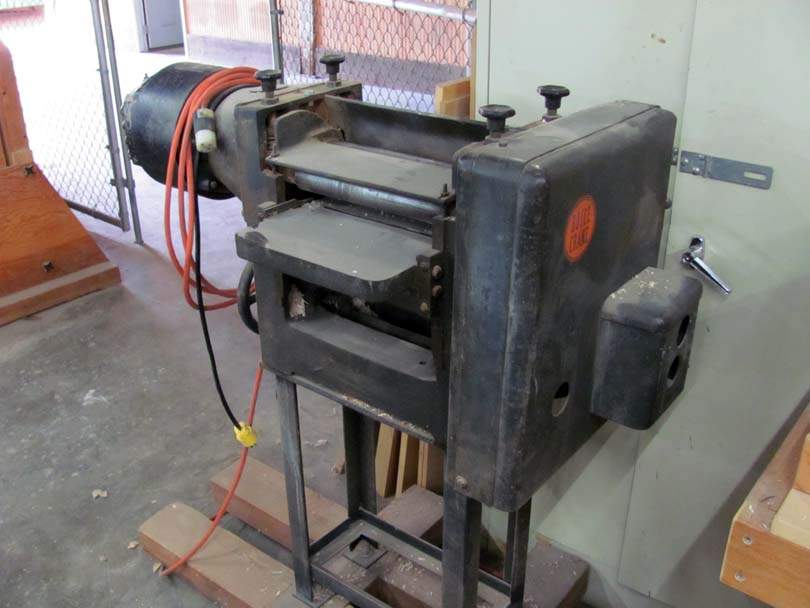
IMG_8673B.jpg


This is a cute little Walker-Turner Driver Line 12" bandsaw, also from 1938. From back when they put some art-deco styling into machinery. The guy I bought it from did most of the restoration, and it's about ready to run. I mounted it on a base cabinet on casters. It just needs a motor and belt drive hooked up.

I'm thinking of making up a special aluminum fixture jig for it, just for cutting accurate thickness wood strips. That would be a really handy machine to have, and a good permanent job for this nice old-timer.

IMG_8674B.jpg


This is a 1970's Onsrud Overhead Pin Router. I acquired it for free about 18 years ago from a Luthier who went bust. The spindle head is all taken apart. I have all the parts, I think, but it may be some trouble getting it back to original function.

If you've been following me on the Pin Routers thread, I've got my Big Green Monster Pin Router fully up and running, and I love it. As I've learned how to build the tooling and use it, I'm really appreciating its value in turning out instrument parts in quantity. And it would be extra cool to have a second medium-size pin router set up next to it, with a smaller 1/4" or 3/16" bit. It would do the smaller bits of routing and tighter corners. With the same tooling and no change in setup.

So, my thought is to get this old Onsrud running again to do that job. Rather than spend the effort trying to get the original spindle head and motor drive back together, just mount a Porter-Cable router head on the end of the overhead arm. Make use of the 2000 lb heavy frame and the big cast iron elevating table. It's already sitting here in my shop....

I'll cover this story over on the Pin Routers thread, as I get going on it....

IMG_8672B.jpg
 
The newly-operational Powermatic Scroll Saw got its first real job today: Sawing out the pickup opening in a 3/4" MDF pickguard routing template. This is exactly the type of job that I wanted this machine for; cutting internal openings in patterns and templates. It worked beautifully. Smooth and easy to maneuver right to the lines. An enjoyable machine experience. It's a welcome member of my shop.

IMG_8727B.jpg
 
The newly-operational Powermatic Scroll Saw got its first real job today: Sawing out the pickup opening in a 3/4" MDF pickguard routing template. This is exactly the type of job that I wanted this machine for; cutting internal openings in patterns and templates. It worked beautifully. Smooth and easy to maneuver right to the lines. An enjoyable machine experience. It's a welcome member of my shop.

View attachment 4713391
Smooth!
 
  • Like
Reactions: coy garcia
The newly-operational Powermatic Scroll Saw got its first real job today: Sawing out the pickup opening in a 3/4" MDF pickguard routing template. This is exactly the type of job that I wanted this machine for; cutting internal openings in patterns and templates. It worked beautifully. Smooth and easy to maneuver right to the lines. An enjoyable machine experience. It's a welcome member of my shop.

View attachment 4713391
Nice!! is that the template for the Medium size scroll?
 
  • Like
Reactions: Bobo

Latest posts