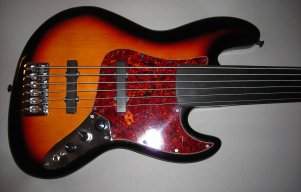
P bass
Not necessarily when switching, I just need to touch it.
Sounds like a grounding issue. Can you post a pic?

TalkBass has been independent since 1998. Add your voice.
Create a free account to reply to discussions, view embedded media, and browse with fewer display ads.
Join free Log in
Want zero display ads or expanded classifieds tools? Compare plans.
P bass
Not necessarily when switching, I just need to touch it.
This is the diagram I used:
[Invalid or Expired Link Removed]
Yours looks like another good option.
Both Circuits are good options. Note that whether you have two or three settings depends on the switch you buy. I prefer an on-off-on 3 position toggle rather than the two cap on-none-on 2 position toggle.
The idea is that the center position has NO cap and hence is as bright as the bass goes. And you can select that without twiddling the tone knob. So you can go from bright to a pre-set tone setting just by flipping the switch.
I have not done this on my P/J 5er yet, but many of my jazz clones have it. Now my preference is to go lighter in tone rather than heavier so my choices are .047 and .015 mfd. (and of course none). But that is for a Jazz bass and you just have to play with values. For a P-bass it might be a different thing.
Do you have a wire connecting both pots, soldered to the body of each?
Yes, cavities shielded as well and continuity checks out on all connections. Everything works perfectly.
Cool! Never seen caps that small before. Very interesting! Thank you for the suggestion.


Thanks for the suggestion. Is there one for a config with two vols one tone?
Here's the final version: View attachment 365345


Try this
[/IMG]
This is what I was given when doing the same thing, just different values. I haven't tried it yet but do have a two cap version running with .047 & .022.

Yup. Check out the diagram in my post above. I used that configuration on my two-pickup P/J. As long as you only have one tone knob, it'll work just fine.
What kind of switch is this? 2P, 3P ... ON ON / ON ON ON / ON OFF ON
Thanks
Ok...wasn't the final version! I decided to grab an ON/ON/ON to add a third cap to the mix. I played around with the .0047 but it didn't bleed enough treble for my taste, so I tried a .022. Bam! The .022 is exactly the sound of my tone knob rolled full on but minus the final ringing fret noise! I think I've found my magic potion
I have another 3 way switch, some more VitaminQ's and a Mallory 150 on the way for what I'm thinking will be the most obnoxiously cost inefficient/tone irrelevant/gratuitous cap mod ever!
Test circuit:
View attachment 366322

Man those caps are so uselessly big
I couldn't find anything bigger
It's totally excessive, but I figured since I had a few PIO accumulated, why not? I'm thinking of making an outboard cap tester/switch. What do you think? Maybe some Allesandro pots and handmade paper in oil caps with ivory knobs and gold plated jacks in diamond encrusted, quilted maple enclosure
My brother in laws family owns a home electronics repair shop, so I've got the pick of the litter as far as old tubes and caps go. They've got a tremendous stockpile. When I asked them about the PIO caps, they gave me what they had and told me I was lucky they had any at all, since they're are the first thing that get ripped out of old radios and such because of their tendencies to leak in those applications. It's funny how the radio repair community views PIO caps as the most unreliable crap in the universe while misguided tone snobs will pay upwards of $50 a pop for NOS bumblebees.
In my research, I was amazed to discover that Gibson actually sells repro bumblebees that they claim to be paper in oil, but actually are standard Mylar caps in a bumblebee housing for $50 a pair! That's just shameful. Is there a tonal difference? Maybe, but that would more likely be the result of varying degraded tolerances as opposed to construction. Still, many claim that there is an absolute difference and that the PIO are superior...to the extent that entire forums are devoted to the subject.
I've heard of old electronics being scavanged for useful electronic components. Is it just radios or can you get them from other old electronics as well?