• TalkBass has been independent since 1998. Add your voice.
    Create a free account to reply to discussions, view embedded media, and browse with fewer display ads.
    Join freeLog in
    Want zero display ads or expanded classifieds tools? Compare plans.

Double Bass Installing adjusters on a bridge with slanted feet

So I have been playing my Gliga for a couple of years now, and decided it's time to get adjusters installed in the bridge. I took the bass to a local luthier/setup guy who agreed to put them in, but when he saw the bridge, he advised against it due to the angle of the feet in relation to the belly of my bass.

His logic is that a bridge such as this is sending force, not down in to the belly at a 90 degree angle, as a more conventional bridge might do, but slightly out to the sides, according to the angle of the feet. He warned me that with adjusters installed, their threaded spindles would be subject to this sideways stress, and could damage the bridge, seeing as they would be pressing against the insides of the holes drilled into the wood.

I totally understand what he is saying, which is why I have held off on getting the adjusters put in, but I wanted to see if anyone else has dealt with a similar problem. Does anyone else use adjusters in a bridge with a similar angled effect on it's feet?

This repair guy is a stubborn sceptic of bridge adjusters, believing that putting them in will make your bass "25% less loud", so I had to argue him into the idea in the first place. I don't think this is true at all, and the vast majority of jazz bassists cant be wrong can they??:D Because of this, I wanted to get the opinion of some people less biased against cutting a bridge for adjusters.

So what do you guys reckon? Will the off-centre pressure created by the slanted feet damage my bridge?
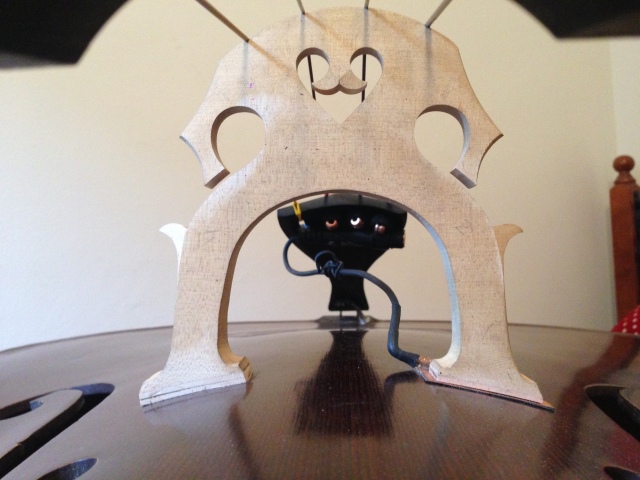

2czy2jq.jpg
 
This bridge will take adjusters just fine if installed properly. I have installed hundreds of sets of adjusters in various bridges with no issue. I will say, there was a time when I would have installed the adjusters in line with the leg on a bridge like this, instead of parallel. I would only do that now if I was using a pair of adjusters with a really large thread size.
 
Thanks for the reply Joey.

So do you think this bridge should have the adjusters placed parallel, or in line with the legs? Surely if the adjuster wheels were tilted inwards, the bridge would not be able to be raised in a straight line?

The adjusters must be placed parallel to each other. When they are installed in line with the legs, the feet move on the top of the bass. With a highly arched instrument, turning the adjusters often has little effect on the string height because the feet are moving sideways on the top of the instrument.
 
Not to pick a fight Tom, but I have personally installed a few dozen sets of adjusters in line with the legs and I've seen a number of other shops and makers doing it this way. Adjusters introduce enough flexibility that it seems to work just fine. I am not longer doing it this way, but if I was installing a larger diameter adjuster in a bridge with slanted legs, I would consider putting them in line.
 
The adjusters must be placed parallel to each other. When they are installed in line with the legs, the feet move on the top of the bass. With a highly arched instrument, turning the adjusters often has little effect on the string height because the feet are moving sideways on the top of the instrument.
If the adjusters are installed parallel, the only effect is to raise the bridge straight up, and the arching would have nothing to do with how far the adjuster extends the bridge. How do you figure the feet move sideways? I'm not following the logic of this.
 
If the adjusters are installed parallel, the only effect is to raise the bridge straight up, and the arching would have nothing to do with how far the adjuster extends the bridge. How do you figure the feet move sideways? I'm not following the logic of this.
Read Tom's post again: "When they are installed in line with the legs, the feet move on the top of the bass." The legs in the above photo are very angled and in-line adjusters would move the feet 'outward' as much as 'downward'.

Make sense now?
 
The adjusters must be placed parallel to each other. When they are installed in line with the legs, the feet move on the top of the bass. With a highly arched instrument, turning the adjusters often has little effect on the string height because the feet are moving sideways on the top of the instrument.

I agree with you schoolhouse, and no offence to you joeynaeger, but I think if I were to install my adjusters in line with the legs, the very arched belly of my bass would make this sideways movement a problem.

Just to get us back on topic, my question here is whether or not parallel adjusters will cause too much stress to the physics of this particular bridge. Does anybody use parallel adjusters on a bridge with slanted legs?
 
I agree with you schoolhouse, and no offence to you joeynaeger, but I think if I were to install my adjusters in line with the legs, the very arched belly of my bass would make this sideways movement a problem.

Just to get us back on topic, my question here is whether or not parallel adjusters will cause too much stress to the physics of this particular bridge. Does anybody use parallel adjusters on a bridge with slanted legs?

No offense at all. I am using 1/4-20 adjusters almost exclusively and install them parallel regardless of the bridge.
 
Just to get us back on topic, my question here is whether or not parallel adjusters will cause too much stress to the physics of this particular bridge. Does anybody use parallel adjusters on a bridge with slanted legs?

Not sure if JTs last question was responded to. I haven't installed hundreds of adjusters, but I have done a dozen or so. I think the answer is that adjusters that are truly parallel and well-fitted shouldn't cause much added stress to a bridge (this bridge or any bridge). The reason being that they are simply raising the upper half of the bridge while maintaining the feet in their original position. OTOH, If the wheels are poorly fitted and not really parallel, then all kinds of stress is added (to any bridge).
 
  • Like
Reactions: Jake deVilliers