• TalkBass has been independent since 1998. Add your voice.
    Create a free account to reply to discussions, view embedded media, and browse with fewer display ads.
    Join freeLog in
    Want zero display ads or expanded classifieds tools? Compare plans.

Instrument Cable that Really Sounds Better

What an absurd analogy. Steaks are organic, they come from cows which aren't all the same, which aren't all the same ages and haven't had the same diets. They're not cut from the same places, in the same way, or aged for the same lengths of time in the same way. Anyone could quite easily point to one steak having a higher fat content, more even marbling, different temperatures at different places, different seasonings, anything. If I was absolutely clueless about steaks and I asked you to explain to my why two steaks were different to each other then you could. You could even explain why salts taste different. If you couldn't then someone else more knowledgeable than either of us could. There's actually a great Mythbusters episode on how they can try to quantify the best way to cook a steak. Spoiler, they build a machine and use numbers. People! Right? Too biased and unreliable.

It's a similar story with the pickups that you mention. (edited for clarity) Of course there are differences. Measurable ones. In output, construction, response, inductance, field strength, and many more things I'm not smart enough to understand.

If you told me two steaks were different and I didn't believe you, you could prove it if you wanted to. The same is true for pickups.

We're waiting on cables.

The tone of all of your typed sentences in this thread does leave a taste of you trying to authoritatively coerce others into acknowledge your personal experience Zero Difference between cables as the only possible real experience.
Emphasis mine. Please, don't acknowledge my personal experience at all. That's kind of the point here. We're not talking about something subjective like 'tone' or 'heft'. This isn't a 'what bass is best for metal' thread.

You're also not the person in this thread to misunderstand me, either accidentally or purposefully. I have not once claimed that there is 'Zero Difference' between cables and I have not once shared my personal experience. I am just skeptical of others when they say they hear a difference. For what it's worth, I believe that most of the time, that difference is almost entirely due to confirmation bias. But I can't prove that, so up until now I haven't said it.

Are you fully retired from teaching and in need of the thrilling feeling of sculpting other people's minds?
No. But I like many discovered Talkbass (20 years ago!) by searching for an answer to a question that I had typed into Google. Newbies will read this thread, people who have no or little experience. If I can save some poor teenager thinking they need to spend £50 on a cable then that's good enough for me.

Besides, why does anyone post here? Because they know that Jaco only needed 4 strings and that anyone else is a heathen. What is TB if not a place to discuss bass gear?
 
Last edited:
Depends how long. I don't think I can tell the difference between a 6' free cable that comes with cheap instruments in a sandwich bag or a proper cable.

But much above 15' can definitely tell the difference. Especially if I'm running rounds, bright bass. Definitely with guitar. Highs can get lost.

The short answer is I only use Rattlesnake and don't have to worry anymore. It's fine if you don't.
 
Last edited:
  • Like
Reactions: NorthTexasBass
Me: My sound was a too fat and muddy and I didn't have as much articulation as I like so I cut the bass and low mids on my preamp and added a some high mids and treble. That really helped and I like the tone much better.

Contrarian on internet: How do you know the knobs on your preamp even do anything? Isn't it possible they aren't even wired to anything? Have you tested every parameter on your preamp using high end scientific equipment? Perhaps you want it to sound better so you are tricking your brain into this. I am very smart.
 
Hi @NorthTexasBass , there's quite a bit to unpack in your post here.


That's a real shame that you got that. I think that people who (probably unknowingly) spread misinformation, half-truths and even outright lies are the people who do that. For the record, I'm an educator. I spent most of my early career as a science teacher in secondary schools and now I do e-learning consultancy. I have also worked for the Institute of Physics and I have a volunteer post as an Ask for Evidence Ambassador for Sense About Science. If you [This invalid link has been removed], I'm the pin just west of Newcastle. Basically, I care a LOT about people being able to make informed decisions based on the facts. Look around the world today, the fact that 'fake news' and 'alternative facts' are even terms will tell you how much of a mess we're in. You will not find me this animated on a thread in the composition sub-forum because I am a decidedly average bass player. However, I am an excellent experimental designer.

When I taught I would ask my GCSE students to design an experiment to prove that those magnetic sports bracelets didn't work. The next lesson I would ask them to prove to me that they did. I also used to do the much-overused experiment of giving everyone in my class their horoscope, asking them to rate how accurate it was, and then revealing that everyone in the class has the same horoscope. This goes some way to proving that humans are superb at pattern-recognition. We see the things in the horoscope that apply to us and we disregard the bits that don't. It's why we can see shapes in clouds, hear ghosts in the wind, and it's why Invalid Link Removed. Why does this happen? Because, as we all know, one of the most reliable (not) patterns in capitalism is that expensive = better. And I'm just saying that if you can actually be fooled into healing faster, then you can definitely be fooled into hearing a little extra bass in a cable.

To address that point:

I am telling you that that is NOT the case.

The fact that humans are fallible, squishy, unreliable, biased, messy creatures is why anecdotal evidence is treated as being essentially "trust me, bro". As I said in my post, I am absolutely not doubting that you heard a difference. But, at the moment, we don't know if that difference was actually being created by the cables or by your own psychology.

I can think of two ways to test that, there might be more. Firstly, you could use mechanical device to measure the properties of the cable. If me and you are looking at two different trees that both look taller than the other depending on where you stand, the way to settle that would be to use a tape measure and measure the trees. An oscilloscope would be able to tell you the frequency response, or you could do similar to @bongomania did and measure capacitance. The danger there is deciding what measurable differences on the scope are meaningful and noticeable by human ears. You could correctly argue that a cable that had -0.2dB at 50KHz is technically different from a cable that didn't, but then you also correctly argue that nobody could ever hear that difference.

The other thing that you could do would be what we call a double blind study. In this case you would not know which cable you were listening to. If you could reliably and statistically pick out which cable was which under those conditions then again we could be sure that the difference really was the cables rather than the psychology.

About the other bit:


You're putting words in my mouth there. The original post asked if there was a "material difference ... that blew you away". That's what I responded to. And I maintain that the answer is 'no'. Yes, if you've got a faulty cable, or a cable that doesn't make proper connections with your jack (a trick that Monster used to use) or if you have a passive bass and you swap from a 1m cable to a 50m cable then of course you will notice a difference between cables. I was operating under good faith and I thought we were talking about broadly comparable cables from across brands. Perhaps I was wrong. Perhaps I should have written a 12000 word thesis as my first post, I thought my post was snappier though!

My actual thoughts on cables for anyone interested:
  • Cables are passive, they can't (by definition) add anything, only remove. If one of your cables has more treble then it's actually either got less bass, or your other cable has less treble.
  • Stick with as short as you can if your instrument is passive. Passive basses and true-bypass pedals have been responsible for many a frustrated musician.
  • Anything to to with time or phase alignment should set your alarm bells ringing.
  • Once you've bought cables with oversized jacks (at least Planet Waves and Monster used to do this, don't know if they still do) then going back to normal cables will sound worse as you'll have stretched the jack and it won't make good contact. Get some pliers and squeeze it back together.
  • It's no so bad with musicians as we're a pretty educated bunch on the whole, but hifi and audiophile cables are a massive pile of snake oil. Stay away.
  • Cables are two jacks with some copper between. Just make your own. Or don't. I buy Thomann own brand as they're cheaper than making my own. Are they holding my tone back? Nah. Like I said I'm a decidedly average bass player.
You are SOOOO wrong....cables are two PLUGS with wire between them, not jacks, at least in terms of instrument 1/4" cables. You can't buy cables with oversized jacks....just oversized plugs.

(Grin).....just teasing....but yeah, in the interest of correctness and all.....(grin)

On your other points, I completely concur as a lifelong audiofool who grew up with Elementary Electronics in the late 60s and early 70s, then Stereo Review, then far too many years subscribing to Stereophile and the many tweaks and subjective hyperbole contained therein before finally digging in, building, doing some rudimentary design, and digesting as many EE texts as I could find and comprehend (still very much a work in progress, but am really enjoying the journey). I'm blessed to have accumulated, built, repaired, and tweaked a lot of great audio gear over the decades (and have built every cable in my six current systems). Every improvement can be explained with accepted acoustic and electronic theory. Yes, my wife and I HAVE done a ton of double blind tests over the years (much to her chagrin....she HATES that game) and every supposedly audible difference caused by green pens, cable risers, magic cable geometries/construction....every one of them...has failed the double blind tests, with the exception of a peculiar set of expensive cables that were identifiable, but only because fhey sounded worse...unusually high capacitance speaker cables. Don't recall the brand...it was a long time ago.

For what it's worth, I thought you made your points kindly, in a friendly manner, and without animosity towards those that disagree. Not sure why some have taken offense. Differing viewpoints are the whole reason folks share thoughts.
 
[QUOTE="....every one of them...has failed the double blind tests, with the exception of a peculiar set of expensive cables that were identifiable, but only because fhey sounded worse...unusually high capacitance speaker cables. Don't recall the brand...it was a long time ago.

[/QUOTE]

So, if you originally used the cables that sounded worse and then went to another cable, wouldn't it sound, oh...what's the word... better?

This is the point I made and I was told I can't make this claim without a scientific triple blind peer reviewed study and that I am suffering from every bias known to man.
 
So, if you originally used the cables that sounded worse and then went to another cable, wouldn't it sound, oh...what's the word... better?

This is the point I made and I was told I can't make this claim without a scientific triple blind peer reviewed study and that I am suffering from every bias known to man.
The cables sounded different in that one case (and yes, to answer your specific question, if the high-capacitance cable had been in place first, then the second cable would have represented an improvement, of course) because they, for a reason that escapes me, were designed with a high capacitance to be a "synergistic" match for certain type of speaker... perhaps to tame a deficiency in that speaker's design or help it pair with a specific amp. I just don't recall. The point is, the cables themselves WERE measurably different than a standard appropriately-gauged wire.

Seriously, you needn't take offense to anything posted about double-blind tests or "suffering" from bias. You are not alone in that "suffering;" we ALL suffer from it. It's part of the human psyche. Nothing wrong with it. After years sharing observations with audiophiles from all points on the objective-subjective continuum, the only thing that matters is if the listener/owner hears a difference, enjoys it, and finds it worth the money. I don't put down folks for indulging themselves in things that make them happy and don't harm others. I don't recall anyone else in this thread doing so, either. I enjoyed my years messing around with every tweak in the book, and had a lot of fun. These days, I'm enjoying learning more and more about physics and electrical engineering. It's all good.
 
  • Like
Reactions: bongomania
My point is, I noticed my two cheap cables sounded noticeably worse than the mid priced cables I tried. I wasn't expecting a difference, but when I A/B'd them it was very noticeable. Bongo's study showed that the various cables he tested definitely rolled off treble anywhere from 2.5k to 6.5k. That's a noticeable difference! To say you don't want to spread disinformation and then say that all cables are the same is literally spreading disinformation.

I probably couldn't tell a difference between his 2nd and 3rd or 8th and 9th rated cable (as far as treble content getting through). I think anyone could tell a difference between the best and worst of those cables.

I am not advocating spending $200 on a gold plated cables dipped in the taint shavings of a unicorn. But after thinking a cable is a cable for my entire bass playing life, I realized I was wrong and I do think it's a good idea to not just buy the cheapest cable available because it can definitely make a difference.
 
Despite the insinuations that I can't tell two steakcables apart and that I have no friends I would just like to make some further comments.

...To say you don't want to spread disinformation and then say that all cables are the same is literally spreading disinformation...
You know, I've read through the thread and I can't see anyone who's said that.

Me: My sound was a too fat and muddy and I didn't have as much articulation as I like so I cut the bass and low mids on my preamp and added a some high mids and treble. That really helped and I like the tone much better.

Contrarian on internet: How do you know the knobs on your preamp even do anything? Isn't it possible they aren't even wired to anything? Have you tested every parameter on your preamp using high end scientific equipment? Perhaps you want it to sound better so you are tricking your brain into this. I am very smart.
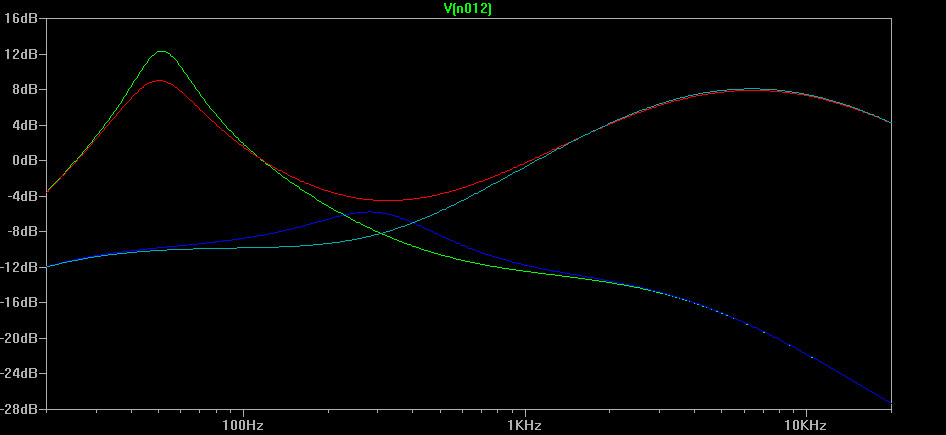
Preamp graph from the people who make the preamp in one of my Spectors.
BP-4_curves.jpeg


The great bongo has shown that if you try really really hard, mess around with the impedance and use a passive bass, then you can tease out some meaningful differences in some cables. This is superb! Blew my mind when I first read it ages ago. Not that he needs kudos from me but for what it's worth he's got it. His work shows that, in certain situations, there will be differences between some cables. His work also shows (and states in the text) that pretty much all of these differences will disappear in the real world. Paraphrasing mine.

Again, I really don't think that all cables sound exactly the same. I think that if you've gone out, bought an expensive cable, come home, plugged it in an heard a massive difference then there's probably something else going on other than the actual cable. That's all. I just don't get why we have a million posts on here that talk about ohms, watts, impedance, frequency response, high pass filters, tone control centers, linear and log pots, and all of that is fine, but if you try to bring any kind of science to cables you're burned at the stake for being a witch.

Right, I think that I've taken up too much of this thread so I'm going to back out.
 
I agree with the OP. I've been playing for over 30 years and I can't hear a difference between a $10 cable and a $100 cable. Maybe its just because my hearing sucks from years of not protecting my hearing when I should. I am very skeptical that there is any difference. I watched a video recently where a man was demonstrating one of the newer, pedal board based wireless systems on a bass. I don't remember if it was a Shure or the newer NUX model. He was switching between a Mogami cable and the wireless and I could hear NO difference at all between the two. I have seen other demonstrations where they compare Mogami to some other, less expensive brand (I think they said the cables were $25 for a 20ft). While they said they could hear a difference, I could not, even using headphones. YMMV

I will say that I know from experience that the cheaper cables seem to become dumpster fodder a LOT quicker than a $30-$40 cable.

I know this isn't really the topic, but I do prefer cloth wrapped cables, though. Over the years I have found that rubber covered cables have a tendency to get sticky and gross over time, and the cloth wrapped cables don't.
 
@Jack Here's my take on the subject.

ignoring cheap badly made cables as they are not relevant and assuming the cable isn't ridiculously long,

the critical issue with cables is the capacitance which can roll off the high frequencies.

the capacitance per metre runs from approximately 50pf per metre (van damme) to 190pf per metre (Belden)

The tone cap on a bass is in the uf range so the moment you start to roll of the tone any cable capacitance is irrelevant

likewise irrelevant on an active base.

So in theory the capacitance of the cable
Might make cables sound slightly different to each other but I have not observed this personally

The OP used the expression "blown away" So no nothing that extreme in performance

Other sonic attributes assigned to ludicrously expensive cables are complete b0llocks ime.

A ready made 3 metre guitar cable from Amazon With Neutric Jack plugs and Van Damme cable Costs about £25

If you pay more than that you're being rinsed
 
  • Like
Reactions: Jack and Jefenator
My :atoz: emojis didn't land the way I hoped, go figure. I just didn't want to start a dustup with people that don't remember me from when I used to post here obsessively.

The testing I did on cables demonstrated that, outside of faulty connections and corrosion, the ONLY measurable difference between cables is capacitance. And that mostly applies to passive guitars, because the cable makes a literal filter (EQ) in combination with the passive electronics.

There are limitations to my testing, of course! I didn't test for whataboutmyears and I didn't use ivebeenplayingsince1965 as a signal source. I didn't measure prideotrons or egometric waves. And, not joking now, there really may be some ineffable quality to sound besides how it appears in spectrum analysis.

For example, an analog audio transformer can alter the slope of an incoming wave shape, producing *potentially* audible changes that may not appear in spectrum analysis unless you use 3D graphing and software to identify the shift in timing. It is *hypothetically* possible a cable could do something like that—although I have never seen any evidence supporting that idea.

Yes, we all are subject to biases in perception. That is a stone fact which you can build any skyscraper upon, because it is unmovable bedrock. We do not "hear sounds"!!! Our ears and other body parts pick up vibrations, and send messages about those vibrations to our brains, but not to the conscious part! No, first the signal goes to a comparator. The comparator weighs the incoming data against data it has collected before, and labels it (say, XYZ). Maybe XYZ is a specific Geezer Butler bass tone. Then it sends a memo to the conscious part of the brain, and the memo says "you hear an XYZ". By golly, you hear Geezer's tone! It's perfect and amazing! Or, perhaps you were aiming for that tone, and the comparator sends a memo saying XYW, and you go "that is not the tone I wanted to hear". Short version, there is a game of telephone happening between the sound and your conscious mind, and one of the "people" in that game is specifically telling the next person NOT what was originally said to them, but something SIMILAR and FAMILIAR, for labeling purposes. Like a translator app.

Anyway, it's human nature to believe your own ears, and nobody including me can dissuade you from doing exactly that. When it's about your own tastes and choices, it's your party! Go nuts! Buy that Victor Wooten IEC cord! The problem is when any one of us tells the world that our personal subjective party is how the rest of you should also hear it, and that what you heard is facts because you have been mowing down audiences with your bass skills for decades, and you've recorded on sessions with Bigname Producerman. Guess what, Bigname has the same problem with ears and biases as the rest of us. He just did more with it.
 
I have two noteworthy (to me) experiences with cables.

1. I think this dates back to when I was mostly using a passive bass. Something was wrong with my tone. It was a little to muddy/dark/muffled/whatever-adjective-you-want-for-this. I couldn't knob twist or string change my way out of it. One day, it was magically better. Then another day it got bad again. As it turns out, I had two identical instrument cables. I assumed one to be defective or failing (neither was new) and threw it away.

2. For at-home practice, I like a cable with a mute switch. (I'm not ready to trust new-fangled technology like that on stage!) My sample size here so far is one, but I don't like the right angle Neutrik silent plug. I thought it was the new sliced bread at first, but then the sliding ring switch quit sliding to the mute position. The plug had bent a little at the base. I straightened it and it worked again, but it was really fragile. In less than a month of ownership, the shaft separated from the base when I tried to remove it from the particularly snug jack of my Lakland 55-02. I replaced the plug with a D'Addario (Planet Waves?) right angle with a little red button. The button is in and awkward location, but this plug seems to be much more durable. Both sounded fine to me.

Related to things affecting tone, I keep an amp in my living room. At times, it has been my gigging amp. (Nowadays, most of my gigs are amp-less, but I still use a real amp at home daily.) Sometimes after a gig, I would set my amp back up and would be unable to get anything but a boomy tone with a a few overpowering frequencies. I eventually figured out that, given that where I sat when played was generally always the same, my amp sounded worlds better if I moved it out of the corner a little bit. Apparently, lots of things affect my perception of tone.
 
I would have to think that a cable would have to be the ultimate weak link in the sound chain to produce a sonic difference. Perhaps if one is going direct into a computer it might matter. Though an amp or into a house system? I don't think so.