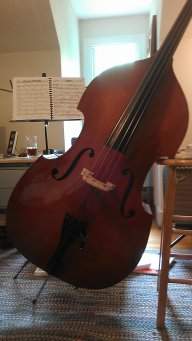
It’s a bass Trevor worked on and set up, but not one he built specifically. It’s the 2022 ISB Build-a-bass I’ll be insuring. He recommended Clarion, but I’ve found some mixed reviews of their service.I assume you have one of Trevor's basses.

TalkBass has been independent since 1998. Add your voice.
Create a free account to reply to discussions, view embedded media, and browse with fewer display ads.
Join free Log in
Want zero display ads or expanded classifieds tools? Compare plans.
It’s a bass Trevor worked on and set up, but not one he built specifically. It’s the 2022 ISB Build-a-bass I’ll be insuring. He recommended Clarion, but I’ve found some mixed reviews of their service.I assume you have one of Trevor's basses.

Makes sense I guess. I always had a separate inland marine (no idea why it’s called that) policy for all my tools, trailer, etc… I wonder what the compensation threshold is for playing music as a business vs. a hobby gig or two


I use Total Dollar, which insures through Chubb, a huge insurance company. For something around 90K worth of coverage, it's $350/year.
Musical Instrument Insurance | Get A Quote Online | Total Dollar Insurance
That is pretty good.
I think that’s what it would cost to cover a few laptops.


Just because you CAN doesn't mean you SHOULD. See my post above about the purpose of insurance. Insurance companies will happily take your premiums to insure stuff that you shouldn't bother insuring, but that doesn't make it a good choice to do so.Today, you can insure everything you want.

Thank you for the advice. I’ve narrowed it down to three companies and I’m seeking quotes from each.Here’s a suggested list of questions to ask when choosing an insurance provider for your gear:
1. Who sets the replacement cost value of an instrument, and how?
2. Is the gear insured if I use it at a paid gig even once? (With many general homeowners policies the answer is “no”).
3. Are their exceptions to the coverage provided for loss or damage? (Some policies exclude thefts from motor vehicles from coverage, and some homeowners policies exclude thefts that occur at a place owned by somebody other than you).
4. Are repair costs covered at all, and are the covered if the damage was accidentally caused by you?
5. Who determines how much will be paid for the repair (your repair shop or the insurance company), and can you choose your own repair shop to do the work?
5. If there is a loss in value caused by a repair is the loss in value covered along with the repair costs?
Insurance policies are contracts. That means each company has their own rules, and if you don’t read the policy, you won’t know the answers to these questions.
Also, unless somebody on Talkbass or wherever has read your policy they don’t know what’s covered or isn’t, or how it works. Please don’t listen to such advice, as well-meaning as it might be. I know how my Heritage Insurance policy works, but I have no clue about any other policy in the world.
Do not assume that you know what your policy covers if you’ve never read it. Once you sign the insurance agreement, you are covered by its terms, whether or not you think they are fair.
Assume nothing. Read the policy.
Thank you for the advice. I’ve narrowed it down to three companies and I’m seeking quotes from each.
Hopefully at least one of them will specialize specifically in musical instrument insurance. If not, keep looking.Thank you for the advice. I’ve narrowed it down to three companies and I’m seeking quotes from each.
Keep in mind that insurance companies earn money by taking in more in premiums than they pay out in claims.
If the loss of a particular item would cause you deep, lasting financial distress, by all means insure it. But if you can simply scrimp for two months and buy its replacement, I'd eschew insurance.
Any one of my musical instruments could be replaced with two weeks' salary or less. If I had to replace one of them, it would NOT cause me deep, lasting financial distress. I'd still be able to pay all my bills. Therefore, I don't carry insurance on any of them.
Thinking that everything you own has to be insured is a misunderstanding of the purpose of insurance. Insurance is to protect you against unlikely but catastrophic events. If the event is common (annual teeth cleaning), then you'll pay more in insurance than the expense. If the event is not catastrophic (your cell phone craps out and you have to pay $150 for a replacement) then you're just giving them money that (on average) you will never get back.
A $100,000 bass? Yep, insure that baby. A $1500 bass? Almost certainly not a good ROI.