• TalkBass has been independent since 1998. Add your voice.
    Create a free account to reply to discussions, view embedded media, and browse with fewer display ads.
    Join freeLog in
    Want zero display ads or expanded classifieds tools? Compare plans.

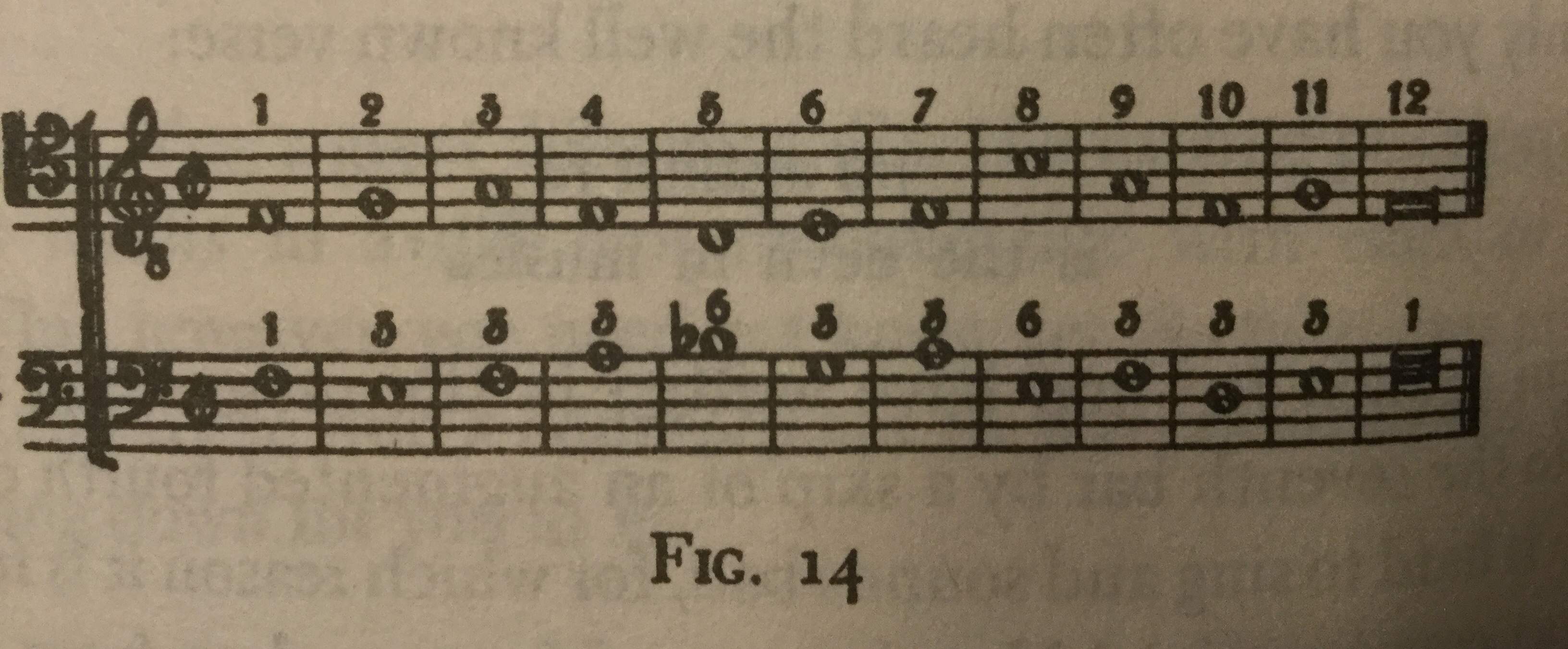
Interval question on Fux' Study of Counterpoint Fig 14.

I'm working through Fux' Study of Counterpoint. (For fun, so on my own.)
Can someone please explain why the lower counterpoint in bar 5 of Fig 14 (attached) shows a Bb for the 6, instead of a B? The cantus firmus note is D. Since D to Bb is 8 semitones, I make that a minor sixth, not a sixth. What am I missing? Thanks!
8F0F220E-4075-4305-9074-4E6C80A5076B.jpeg
 
You gave the musical example completely out of context, without the accompanying text, so I had no way of knowing it was supposed to be F Lydian. ;)

May I ask, is "F Lydian" Fux's original title for this composition, or is it something an editor added in at a later date, and maybe the editor made a mistake?

In my opinion/experience, it would surprising and shocking to have a Baroque composition in a "Lydian mode." Fux was about 200 years too early for that style of composition.
 
Last edited:
Alrighty. I just downloaded the Fux book so I can better help answer your question. Which is the chapter where Fux talks about Lydian mode please? If I see the text that goes with the example, hopefully your question will make more sense to me.
 
Last edited:
Alrighty. I just downloaded the Fux book so I can better help answer your question. Which is the chapter where Fux talks about Lydian mode please? If I see the text that goes with the example, hopefully your question will make more sense to me.

This is Chapter 1, Note Against Note. Fux doesn't use the term Lydian, but does say that these are modes. Mann (the translator) uses the modal names in the footnotes, as do other commentators. The exercises begin with a mode starting on D (Figs. 5 & 6), then E (Figs. 11 & 12), then F (Figs. 13 & 14). No flats or sharps in the cantus firma.
But my question is perhaps more specific that that. The exercise is to write a counterpoint by using imperfect (3, 6) and perfect (1, 5, 8) intervals. In bar 6 of exercise 14, the student has chosen to use a 6th interval above the D in the cantus firmus (as indicated by the 6 between the two staves). The note the student has entered is Bb. I'd have expected B, that being the 6th of D, and B being in the modal scale of F (which runs F G A B C D E F, with the raised 4.)
I'm sorry not to have put this more clearly. Thanks.
 
The upper voice is tenor (written in G clef with octava symbol), the lower voice in bass notated in bass clef. The number in the upper staff label the bars; the labels in the lower staff indicate the interval between the 2 voices, as measured from the lowest voice.
The voices start and finish in unisson; in bars 2 & 3, the tenor is above the bass, then the voice cross and bass is above tenor on bars 4 to7, then they cross again and tenor is above from bar 8 to the end.
In species counterpoint a taught by Fux, successive perfect intervals such as 5ths and 8ths are rejected, where as imperfect consonances such as 3rds and 6ths (both major and minor) are favored and can be occur 2 or 3 times in a row. 4th and 7th are prohibited.
So the numbering in the lower staff serve as tracking potential errors the counterpoint. 3rd and 6ths are labelled identically irrespective of major or minor. For example bars 2, 7, 10, 11 are minor 3rds, bars 3, 4, 7, 9 are major 3rds, bars 5, 8 are minor 6ths. The are no major 6ths, nor 5ths or 8ths.
Clearly, this counterpoint is in F Major (not F lydian), although notated with an accidental B flat instead of key signature.
 
The upper voice is tenor (written in G clef with octava symbol), the lower voice in bass notated in bass clef. The number in the upper staff label the bars; the labels in the lower staff indicate the interval between the 2 voices, as measured from the lowest voice.
The voices start and finish in unisson; in bars 2 & 3, the tenor is above the bass, then the voice cross and bass is above tenor on bars 4 to7, then they cross again and tenor is above from bar 8 to the end.
In species counterpoint a taught by Fux, successive perfect intervals such as 5ths and 8ths are rejected, where as imperfect consonances such as 3rds and 6ths (both major and minor) are favored and can be occur 2 or 3 times in a row. 4th and 7th are prohibited.
So the numbering in the lower staff serve as tracking potential errors the counterpoint. 3rd and 6ths are labelled identically irrespective of major or minor. For example bars 2, 7, 10, 11 are minor 3rds, bars 3, 4, 7, 9 are major 3rds, bars 5, 8 are minor 6ths. The are no major 6ths, nor 5ths or 8ths.
Clearly, this counterpoint is in F Major (not F lydian), although notated with an accidental B flat instead of key signature.

Yes, I think you have to be right that it's actually in F major. To work through these exercises, I'm using a workbook (http://www.ianstoner.com/pdf/fux_workbook_0.1.pdf ) prepared by a music prof for his students; this labels the exercises as Lydian, etc. throughout.. hence the confusion. Ho hum...
 
Yeah, I'm going with my original hunch, that the Lydian thing was added by a later editor. B natural just sounds "wrong" to me in the context of Baroque music. Too avant garde for Fux. Respectfully I would avoid this 21st century professor's weird interpretation (who seems to be approaching Fux from a "modal jazz" perspective) and just study some actual Baroque music. :)
 
Last edited:
I mean this as a compliment.

You guys ----- have been working. I tip my hat to you.
Yeah... next life I'm coming back as an infant prodigy. This time through I'm relying on diligence and discipline. I know, I know, fun at parties!
Learning is a strange thing. It's never linear. You (well, I!) can't just read a book/explanation and get it. It takes wrestling with the thing, reading a bunch of other books/interpretations, lying awake thinking about it and counting semitones on your fingers at 2am... and when it's got to the point Jackson Pollock reached with his canvases, the fog clears and you understand. Then the next step waits!

I truly appreciate the help of people here.:bassist:
 
Yeah, I'm going with my original hunch, that the Lydian thing was added by a later editor. B natural just sounds "wrong" to me in the context of Baroque music. Too avant garde for Fux. Respectfully I would avoid this 20th century professor's weird interpretation (who seems to be approaching Fux from a "modal jazz" perspective) and just study some actual Baroque music. :)

Nope. Lydian mode was not added later.

The Bb is an example of "mi contra fa."

A Dictionary of Music and Musicians/Mi contra Fa - Wikisource, the free online library
 
  • Like
Reactions: Bass Momma
Yeah, I'm going with my original hunch, that the Lydian thing was added by a later editor. B natural just sounds "wrong" to me in the context of Baroque music. Too avant garde for Fux. Respectfully I would avoid this 20th century professor's weird interpretation (who seems to be approaching Fux from a "modal jazz" perspective) and just study some actual Baroque music. :)

And to be clear, Fux may have lived during the Baroque period, but the Gradus Ad Parnassum is absolutely a guide to *modal* 16th century counterpoint. Nothing to do with jazz (or Baroque music) in there.
 
  • Like
Reactions: stringtapper
Nope. Lydian mode was not added later.

The Bb is an example of "mi contra fa."

A Dictionary of Music and Musicians/Mi contra Fa - Wikisource, the free online library

I don't understand how you can claim this piece is F Lydian. There are no B naturals, only B flats. By definition, a song without any B naturals cannot by considered "F Lydian."

The simplest "Occam's Razor" explanation is that the OP's example is in the key of F Major.

Your "mi contra fa" argument is not relevant, as neither B natural nor Bb creates a tritone interval with the note D. "Mi contra fa" means to avoid playing B natural and F natural at the same time; you should either flat the B or sharp the F to create a perfect interval. But that is not relevant in this example, which involves 6ths, not tritones. The cantus firmus note D is 're,' not 'mi' nor 'fa.'

And to be clear, Fux may have lived during the Baroque period, but the Gradus Ad Parnassum is absolutely a guide to *modal* 16th century counterpoint. Nothing to do with jazz (or Baroque music) in there.

I would like to fact-check this. Could you please tell me in which chapter of Gradus ad Prarnassum Fux discusses the Lydian mode? (The original text, not additions by 20th century editors.) I would like to see with my own eyes. Thanks.
 
Last edited:
The B natural is flattened to maintain the perfect 4th. The only mode that creates a tritone between I and IV is Lydian. All other derived from the major scale have a perfect 4th between I and IV so naturally the adjustment is to accommodate this.

You are forgetting at this time in music the tritone was deemed the devil in music, it even says so in the book (if I remember correctly). So stepping outside of the mode was common practise to avoid the tritone and maintaining the tritone would have been considered outside. This is pretty much the sole reason the locrian mode was never used.
 
Fux refers to modes in Chapter 1, Note Against Note. The footnotes, by Alfred Mann, use the names (Dorian etc) we use. Mann translated the book from Latin in 1945, so unless you're fluent in Latin, that as close as we get to the original text.