
Last edited by a moderator:

Enjoy the benefits of a premium membership!
Upgrade Account
-
TalkBass has been independent since 1998. Add your voice.
Create a free account to reply to discussions, view embedded media, and browse with fewer display ads.
Join free Log in
Want zero display ads or expanded classifieds tools? Compare plans.
You are using an out of date browser. It may not display this or other websites correctly.
You should upgrade or use an alternative browser.
You should upgrade or use an alternative browser.
Introduction to Scale and Chord Theory
- Thread starter TalkBass
- Start date
- Status
- Not open for further replies.
More options
Who Replied?
The Chromatic Scale
Music is music, and is pretty wide opened, but learning the language of WesternTonal music is based in learning scales. The chromatic scale is a scale thatuses all 12 possible pitches, (also known as tones, or notes).Those pitches are:
A -- A# (Bb) -- B -- C -- C# (Db) -- D -- D# (Eb) -- E -- F -- F# (Gb) -- G-- G# (Ab) -- a

(Lower case letters denote the next octave).
Also note that the scale is a cycle, continuing in a circular fashion.
So, I have two lists of the pitches. Those notes listed in parentheses nextto another note are known as enharmonics. An enharmonic is a note thatcan be written two different ways, but whose tone is the same. A# is said tobe an enharmonic of Bb. D# and Eb are enharmonics.
Out of these twelve pitches, comes all of the music you're used to hearing.In my opinion, the best way to become familiar with these, is from a piano orkeyboard.

What is a Chromatic Scale?
Scales create a pattern of pitches. They talk about the distance between pitches,and how they relate. The distance between pitches is known as intervals.Look back at the list of all 12 pitches. The distance between A to A# is justone note, eh? This is known as a semi-tone (or half-step). The distancebetween A to B is two notes. This is known as a tone (or whole-step).So now we have two different intervals we know, semi-tones and whole-tones.Knowing just this information, the 12 pitches and semi- and whole-tones, wecan learn about scales.
A chromatic scale is always 12 pitches, and each pitch is a semi-tone awayfrom the other. This is an important scale; however, I'm going to speak morein-depth about another type of scale. The diatonic scale is a very importantscale to start from. More commonly, it is referred to as the major scale.So, how do we figure out what a major scale is.
The Major Scale
A major scale is just a formula used to create a certain musical language fromthe 12 pitches. Let's start with any pitch, let's say "C." So if westart from "C" and build a major/diatonic scale, we are said to bein the key of C.
How do you build that scale? Here's the formula:tone - tone - semitone - tone - tone - tone - semitone
So, from C, we move up one tone, to D, another tone to E, a semitone to F,another tone to G, a tone to A, a tone to B, and another semitone, back to C(an octave higher).
So, using the above formula of (t-t-s-t-t-t-s), a major scale in thekey of C, will look like:C - D - E - F - G - A - B - c
The key of the scale, C, is also said to be the root.
So, we've discovered how to make a C Major scale. Congrats. What you reallyhave to do at this point, is take that same formula, and learn the scale forall 12 pitches. The best way to do this is through the Circle of Fifths(aka Cycle of Fourths). There is a thread in the Miscellaneous forum, by Gard>,about this.
To reinforce the theory behind building a scale, let's choose another key.For example, how 'bout Fmaj? So, here are our possible pitches again:A - A# - B - C - C# - D - D# - E - F - F# - G - G# - a
This is the A chromatic scale if you recall. Just to get back to chromaticsagain, the chromatic scale is a scale of 12 pitches, from root to octave, thatare each a semi-tone apart. So a D# chromatic scale, would look like this # - E - F - F# - G - G# - A - A# - B - C - C# - D - d#
Easy, right? It is important to note the intervals, or distance between eachpitch. The chromatic scale is simple because it's just all the tones. So let'sget back to Fmaj. The formula for a major scale again is "t-t-s-t-t-t-s."Where "t" stands for "tone" and "s" stands for"semi-tone." To reiterate, a tone is a distance of one fullstep, a semi-tone is a half-step. Now, why is a full step really liketwo steps? I think the best way to explain this is from looking at a keyboard.If you find F on the keyboard, then the next white key is G. That's a full step,which is a distance of two pitches. F# (or Gb) is between those two pitches,a black key, but it is just a half step. Weird. Have I confused myself wellenough yet?
Okay, Fmaj.
F, then using the formula, find the pitch one tone away, which is G. The nextstep is another tone, which is A. The next step asks for a semi-tone, whichis A# right? Now we run into a problem. A major scale, when written, can onlybe represented by each pitch letter once. So what I mean, is that you can'thave two As, even if one is A (without a sharp or flat, it's A natural),another is Ab, and another is A#. But Bb is the same as A#, no?
So, so far, we have:F - G - A - Bb
We have done the t-t-s part of the formula to get G - A - Bb. No we have tomove another whole tone from Bb to what? C. No another whole tone to D, anotherwhole tone to E, and a semi-tone, which gets you back to the octave, F. Here'sour scale:F - G - A - Bb - C - D - E - f
No we have an Fmaj. scale. Try and do it for Gmaj. You should come up with:G - A - B - C - D - E - F# - g
If you don't, look through it again and figure out what went wrong.
From understanding where a major scale comes from, you can understand all themodes, including the minor scale. And even more importantly, you canunderstand the triads derived from a scale.
Additional scales that I didn't mention are: pentatonic, blues, melodicminor, harmonic minor, and many many more.
Triads
What's a triad? Well, it's a type of chord. So, what's a chord? A chordis usually a group of 3 or more notes (pitches) played in unison. NowI know what you're thinking to yourself. Where can I learn to play me some ofdem phat pitches? Okay, maybe you're not, never mind.
A triad is a chord consisting of 3 notes wherein the intervals are root,3rd, 5th. Back to those tricky intervals. So, an interval being the distancebetween two notes, we've learned about a semi-tone (minor 2nd) and a whole-tone(major 2nd). I'm not going to get too much into intervals, Harvard's Music Dictionaryhas an excellent definition, but I am going to introduce two other importantintervals.
· The major 3rd is an interval wherein the two pitches are 2whole-tones apart.
· The minor 3rd is an interval wherein the two pitches are 1 1/2 whole-tones(one whole-tone, one semi-tone) apart.
Now, you actually have the basis to build all your chords.
My original bass teacher used to try and have me think about major andminor 3rds when I was away from my bass. So if I was driving my car, or ina really boring class, I would think, okay, what's a minor 3rd from Bb, ora major 3rd from E, or a major 3rd from F? Really, you should do this as muchas possible.
Some examples:
E up a major 3rd is G#
E up a minor 3rd is G
C up a major 3rd is E
C up a minor 3rd is Eb
So, WHAT DOES IT ALL MEAN?! Knowing major and minor 3rds gives you the toolsto build triads.
Here are the triads that appear naturally in a major scale. I'll explain ina few minutes what it means for a triad to appear in the major scale.
· Major chord: Root + Major 3rd + minor 3rd
· Minor chord: Root + minor 3rd + Major 3rd
· Diminished chord: Root + minor 3rd + minor 3rd
So, using that information, let's construct a Major chord. The rootis also the name of the chord. Let's stay with C. So, a Cmajchord will take the root, C, move up a Major 3rd, E, then up a minor 3rd, G.Cmaj. chord = C - E - G
How 'bout a minor chord. C, the root, up a minor 3rd, or Eb, up a Major 3rd,which is G.Cmin. chord = C - Eb - G
And a diminished chord. C, the root, up a minor 3rd, or Eb, up a minor 3rdagain, which is Gb.Cdim. chord = C - Eb - Gb
Congrats. 3 chords constructed. How does this relate to the major scale?
Back to Cmaj: C - D - E - F - G - A - B - c
Let's use some backwards thinking from what we just learned, and build chordswith each scale degree, using the notes of the scale. To do this, the easy wayto think of it, is to take the root and use every other note, as every othernote in the major scale is a 3rd from the other. Whether it's a minor 3rd orMajor 3rd is what we'll figure out. Confused, yet? It gets better.
So, let's do that.
First note of the scale = C. The scale gives us every other note as C - E -G. (Look familiar?)
C being the root (roman numeral I), E is a Major 3rd from C, and G is a minor3rd from E. What chord has a root, then Major 3rd, then minor 3rd? Major chord.
The chord found naturally from the root (I) of a major scale, is a majorchord.
The second scale position (ii) is D. Using the scale, the chord we would findis D - F - A. D being the root, F is a minor 3rd from D, and A is a Major 3rdfrom F. Root + minor 3rd + Major 3rd = minor chord.
The chord found naturally from the ii of a major scale, is a minor chord.
Do the same for each position, next with E (E - G - B), then F (F - A - C),then G (G - B - D), then A (A - C - E), then finally B (B - D - F). You shouldget:
C D E F G A B c
I ii iii IV V vi vii I
Maj. min. min Maj Maj min dim Maj
Notice the Roman number scale degrees. Also notice that the major chordsare capitalized, and the minor chords (or diminished) are lower-case. You'llfind this common in most musical notation.
What this tells us, is that in every single major scale, the first noteof the scale (the I, or root, position) is going to be a major key. Here's whatthis would look like for Fmaj.
F G A B C D E f
I ii iii IV V vi vii I
Maj. min. min Maj Maj min dim Maj
The "I" chord from Fmaj, is F - A - C, a major chord. Also, didjanotice that this chord also appears as the "IV" position of Cmaj?Neat, eh? The Cmaj. triad is found as the root of the C major chord, but alsoas the fourth scale position of the F major scale.
Applying this to the Bass
Remember that the principles that I'm outlining are basic music theory principles.I haven't mentioned how they relate to a particular instrument yet. I reallybelieve the piano is the best instrument for first learning scales and chords,seeing how intervals form, and what they mean, but you can apply this to anyinstrument. Which would, of course, include the bass.
So put away the things I've been speaking of so far, and look at the bass.
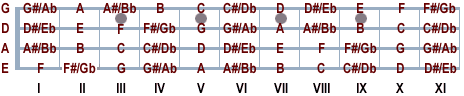
The strings are tuned E-A-D-G from lowest to highest. What you may notice isthat the strings are spaced a fourth apart. Then each individual string's pitchcan be manipulated by fretting. Starting with the E string, when you fret fromthe first fret, you raise the pitch by one semitone. Then if you fret the secondfret, you raise the pitch a semitone from F, which would be F# (Gb). Going forwardall the way to the 12th fret, you get:E -- F -- F# -- G -- G# -- A -- A# -- B -- C -- C# -- D -- D# -- e
This is a chromatic scale. We're used to seeing it begin at C, per my earlierexamples. This just happens to begin at E. Doing the same thing for the otherstring, you're fretboard should look like this:G - G# - A - A# - B - C - C# - D - D# - E - F - F# - G
D - D# - E - F - F# - G - G# - A - A# - B - C - C# - D
A - A# - B - C - C# - D - D# - E - F - F# - G - G# - A
E - F - F# - G - G# - A - A# - B - C - C# - D - D# - E
The trick now is to be able to identify a major scale on your own. Thefretboard itself is not designed to naturally show the major scale. However,as the intervals between the strings are the same, transposing on a stringedinstrument is fabulously simple. If you look for Cmaj, (C-D-E-F-G-A-B-c), startingwith the E string, you'll find your scale by playing (in tab form):
G: 2 - 4 5
D: 2 3 - 5
A: 2 3 - 5
E: - 3 - 5
These are all the possible notes of the Cmaj scale in a four-fret positionat the lowest point on the neck (to play a complete scale). The lowest noteI show is the 3rd fret of the E string (G), the fifth of the scale. It's a possiblenote of the scale, but many people prefer to only show the notes on the A-D-Gstrings because you can play one full octave of the scale that way. That's finetoo, I just wanted to show you where all the notes in that finger position are.So you'll notice the 3rd fret of the A string is C, and the 5th fret of theG string is C. If you play that pattern with that beginning and end point, you'veplayed one octave of Cmaj.
If you wanted to play a Db major scale, let's use the t-t-s-t-t-t-s formulato get the Dbmaj. scale, which would beb - Eb - F - Gb - Ab - Bb - C - db
And to show, in tab form, that scale on the fretboard, you would have:
G: 3 - 5 6
D: 3 4 - 6
A: 3 4 - 6
E: - 4 - 6
Notice how the pattern just moved one step higher on the fretboard? The rootof the first scale was C. The root of the second scale was Db, which is a semi-tonehigher than C, eh? So just move the pattern one semi-tone higher.
Personally, I think memorizing patterns is fine, but it's better to memorizethe notes of the scale, or the intervals, and discover patterns on your own,it will make you very familiar with the fretboard.
The Minor Scale (Natural or Pure Minor)
So I haven't talked about minor scales yet. There's been some talk of the majorscale and triads, but nothing about the minor scale.
The natural minor scale is built from a similar formula of intervalsas the major scale. Instead of the formula we're used to of "t-t-s-t-t-t-s,"the order of tones and semitones for minor scales is:t-s-t-t-s-t-t
So, let's use as an example, C again, for a C minor scale.
Start with C, then move one whole tone to D, then a semitone to Eb, then awhole tone to F, then another whole tone to G, then a semitone to Ab, then atone to Bb, then another tone back to c (the octave). This gives us a C minorscale:C - D - Eb - F - G - Ab - Bb - c
So let's look at everyone's favorite major scale; Cmajor.C - D - E - F - G - A - B - c
Every scale has it's RELATIVE NATURAL MINOR. The relative minor is theminor scale built from a major scale. It's considered one of the scale's modes,which essentially is simply playing the same scale from different root pointswithin the scale. (Maybe I'll do modes later). So, play a C major scale withA, (the sixth position of the scale), as the root:A - B - C - D - E - F - G - a
This isn't a major scale right? Notice it does follow the format of a minorscale. Amin is the relative minor scale to C Major. The Sixthposition of a major scale is the relative minor. You can also note that therelative minor root is a minor 3rd lower than the Major root. A is a minor 3rdlower than C.
With major scales, we have a series of triads that naturally occur:
C D E F G A B
I ii iii IV V vi vii
(Note the trend that Major triads are represented by a capital Roman numeral,and that minor triads are associated with a lower case Roman numeral).
This is just to illustrate how the order of the notes changes, but when buildingtriads, each one retains it's interval value.
Play a C major scale, then a C minor scale. Try and hear the differences betweenthe two scales, the feel of them, the flavors. Major scales and minor scaleshave no instructions as to when or apply them. It's up to you to know them,understand them, and get the feel in you to decide how you want to use the notesfrom these scales.
Music is music, and is pretty wide opened, but learning the language of WesternTonal music is based in learning scales. The chromatic scale is a scale thatuses all 12 possible pitches, (also known as tones, or notes).Those pitches are:
A -- A# (Bb) -- B -- C -- C# (Db) -- D -- D# (Eb) -- E -- F -- F# (Gb) -- G-- G# (Ab) -- a
(Lower case letters denote the next octave).
Also note that the scale is a cycle, continuing in a circular fashion.
So, I have two lists of the pitches. Those notes listed in parentheses nextto another note are known as enharmonics. An enharmonic is a note thatcan be written two different ways, but whose tone is the same. A# is said tobe an enharmonic of Bb. D# and Eb are enharmonics.
Out of these twelve pitches, comes all of the music you're used to hearing.In my opinion, the best way to become familiar with these, is from a piano orkeyboard.
What is a Chromatic Scale?
Scales create a pattern of pitches. They talk about the distance between pitches,and how they relate. The distance between pitches is known as intervals.Look back at the list of all 12 pitches. The distance between A to A# is justone note, eh? This is known as a semi-tone (or half-step). The distancebetween A to B is two notes. This is known as a tone (or whole-step).So now we have two different intervals we know, semi-tones and whole-tones.Knowing just this information, the 12 pitches and semi- and whole-tones, wecan learn about scales.
A chromatic scale is always 12 pitches, and each pitch is a semi-tone awayfrom the other. This is an important scale; however, I'm going to speak morein-depth about another type of scale. The diatonic scale is a very importantscale to start from. More commonly, it is referred to as the major scale.So, how do we figure out what a major scale is.
The Major Scale
A major scale is just a formula used to create a certain musical language fromthe 12 pitches. Let's start with any pitch, let's say "C." So if westart from "C" and build a major/diatonic scale, we are said to bein the key of C.
How do you build that scale? Here's the formula:tone - tone - semitone - tone - tone - tone - semitone
So, from C, we move up one tone, to D, another tone to E, a semitone to F,another tone to G, a tone to A, a tone to B, and another semitone, back to C(an octave higher).
So, using the above formula of (t-t-s-t-t-t-s), a major scale in thekey of C, will look like:C - D - E - F - G - A - B - c
The key of the scale, C, is also said to be the root.
So, we've discovered how to make a C Major scale. Congrats. What you reallyhave to do at this point, is take that same formula, and learn the scale forall 12 pitches. The best way to do this is through the Circle of Fifths(aka Cycle of Fourths). There is a thread in the Miscellaneous forum, by Gard>,about this.
To reinforce the theory behind building a scale, let's choose another key.For example, how 'bout Fmaj? So, here are our possible pitches again:A - A# - B - C - C# - D - D# - E - F - F# - G - G# - a
This is the A chromatic scale if you recall. Just to get back to chromaticsagain, the chromatic scale is a scale of 12 pitches, from root to octave, thatare each a semi-tone apart. So a D# chromatic scale, would look like this
# - E - F - F# - G - G# - A - A# - B - C - C# - D - d#Easy, right? It is important to note the intervals, or distance between eachpitch. The chromatic scale is simple because it's just all the tones. So let'sget back to Fmaj. The formula for a major scale again is "t-t-s-t-t-t-s."Where "t" stands for "tone" and "s" stands for"semi-tone." To reiterate, a tone is a distance of one fullstep, a semi-tone is a half-step. Now, why is a full step really liketwo steps? I think the best way to explain this is from looking at a keyboard.If you find F on the keyboard, then the next white key is G. That's a full step,which is a distance of two pitches. F# (or Gb) is between those two pitches,a black key, but it is just a half step. Weird. Have I confused myself wellenough yet?
Okay, Fmaj.
F, then using the formula, find the pitch one tone away, which is G. The nextstep is another tone, which is A. The next step asks for a semi-tone, whichis A# right? Now we run into a problem. A major scale, when written, can onlybe represented by each pitch letter once. So what I mean, is that you can'thave two As, even if one is A (without a sharp or flat, it's A natural),another is Ab, and another is A#. But Bb is the same as A#, no?
So, so far, we have:F - G - A - Bb
We have done the t-t-s part of the formula to get G - A - Bb. No we have tomove another whole tone from Bb to what? C. No another whole tone to D, anotherwhole tone to E, and a semi-tone, which gets you back to the octave, F. Here'sour scale:F - G - A - Bb - C - D - E - f
No we have an Fmaj. scale. Try and do it for Gmaj. You should come up with:G - A - B - C - D - E - F# - g
If you don't, look through it again and figure out what went wrong.
From understanding where a major scale comes from, you can understand all themodes, including the minor scale. And even more importantly, you canunderstand the triads derived from a scale.
Additional scales that I didn't mention are: pentatonic, blues, melodicminor, harmonic minor, and many many more.
Triads
What's a triad? Well, it's a type of chord. So, what's a chord? A chordis usually a group of 3 or more notes (pitches) played in unison. NowI know what you're thinking to yourself. Where can I learn to play me some ofdem phat pitches? Okay, maybe you're not, never mind.
A triad is a chord consisting of 3 notes wherein the intervals are root,3rd, 5th. Back to those tricky intervals. So, an interval being the distancebetween two notes, we've learned about a semi-tone (minor 2nd) and a whole-tone(major 2nd). I'm not going to get too much into intervals, Harvard's Music Dictionaryhas an excellent definition, but I am going to introduce two other importantintervals.
· The major 3rd is an interval wherein the two pitches are 2whole-tones apart.
· The minor 3rd is an interval wherein the two pitches are 1 1/2 whole-tones(one whole-tone, one semi-tone) apart.
Now, you actually have the basis to build all your chords.
My original bass teacher used to try and have me think about major andminor 3rds when I was away from my bass. So if I was driving my car, or ina really boring class, I would think, okay, what's a minor 3rd from Bb, ora major 3rd from E, or a major 3rd from F? Really, you should do this as muchas possible.
Some examples:
E up a major 3rd is G#
E up a minor 3rd is G
C up a major 3rd is E
C up a minor 3rd is Eb
So, WHAT DOES IT ALL MEAN?! Knowing major and minor 3rds gives you the toolsto build triads.
Here are the triads that appear naturally in a major scale. I'll explain ina few minutes what it means for a triad to appear in the major scale.
· Major chord: Root + Major 3rd + minor 3rd
· Minor chord: Root + minor 3rd + Major 3rd
· Diminished chord: Root + minor 3rd + minor 3rd
So, using that information, let's construct a Major chord. The rootis also the name of the chord. Let's stay with C. So, a Cmajchord will take the root, C, move up a Major 3rd, E, then up a minor 3rd, G.Cmaj. chord = C - E - G
How 'bout a minor chord. C, the root, up a minor 3rd, or Eb, up a Major 3rd,which is G.Cmin. chord = C - Eb - G
And a diminished chord. C, the root, up a minor 3rd, or Eb, up a minor 3rdagain, which is Gb.Cdim. chord = C - Eb - Gb
Congrats. 3 chords constructed. How does this relate to the major scale?
Back to Cmaj: C - D - E - F - G - A - B - c
Let's use some backwards thinking from what we just learned, and build chordswith each scale degree, using the notes of the scale. To do this, the easy wayto think of it, is to take the root and use every other note, as every othernote in the major scale is a 3rd from the other. Whether it's a minor 3rd orMajor 3rd is what we'll figure out. Confused, yet? It gets better.
So, let's do that.
First note of the scale = C. The scale gives us every other note as C - E -G. (Look familiar?)
C being the root (roman numeral I), E is a Major 3rd from C, and G is a minor3rd from E. What chord has a root, then Major 3rd, then minor 3rd? Major chord.
The chord found naturally from the root (I) of a major scale, is a majorchord.
The second scale position (ii) is D. Using the scale, the chord we would findis D - F - A. D being the root, F is a minor 3rd from D, and A is a Major 3rdfrom F. Root + minor 3rd + Major 3rd = minor chord.
The chord found naturally from the ii of a major scale, is a minor chord.
Do the same for each position, next with E (E - G - B), then F (F - A - C),then G (G - B - D), then A (A - C - E), then finally B (B - D - F). You shouldget:
C D E F G A B c
I ii iii IV V vi vii I
Maj. min. min Maj Maj min dim Maj
Notice the Roman number scale degrees. Also notice that the major chordsare capitalized, and the minor chords (or diminished) are lower-case. You'llfind this common in most musical notation.
What this tells us, is that in every single major scale, the first noteof the scale (the I, or root, position) is going to be a major key. Here's whatthis would look like for Fmaj.
F G A B C D E f
I ii iii IV V vi vii I
Maj. min. min Maj Maj min dim Maj
The "I" chord from Fmaj, is F - A - C, a major chord. Also, didjanotice that this chord also appears as the "IV" position of Cmaj?Neat, eh? The Cmaj. triad is found as the root of the C major chord, but alsoas the fourth scale position of the F major scale.
Applying this to the Bass
Remember that the principles that I'm outlining are basic music theory principles.I haven't mentioned how they relate to a particular instrument yet. I reallybelieve the piano is the best instrument for first learning scales and chords,seeing how intervals form, and what they mean, but you can apply this to anyinstrument. Which would, of course, include the bass.
So put away the things I've been speaking of so far, and look at the bass.
The strings are tuned E-A-D-G from lowest to highest. What you may notice isthat the strings are spaced a fourth apart. Then each individual string's pitchcan be manipulated by fretting. Starting with the E string, when you fret fromthe first fret, you raise the pitch by one semitone. Then if you fret the secondfret, you raise the pitch a semitone from F, which would be F# (Gb). Going forwardall the way to the 12th fret, you get:E -- F -- F# -- G -- G# -- A -- A# -- B -- C -- C# -- D -- D# -- e
This is a chromatic scale. We're used to seeing it begin at C, per my earlierexamples. This just happens to begin at E. Doing the same thing for the otherstring, you're fretboard should look like this:G - G# - A - A# - B - C - C# - D - D# - E - F - F# - G
D - D# - E - F - F# - G - G# - A - A# - B - C - C# - D
A - A# - B - C - C# - D - D# - E - F - F# - G - G# - A
E - F - F# - G - G# - A - A# - B - C - C# - D - D# - E
The trick now is to be able to identify a major scale on your own. Thefretboard itself is not designed to naturally show the major scale. However,as the intervals between the strings are the same, transposing on a stringedinstrument is fabulously simple. If you look for Cmaj, (C-D-E-F-G-A-B-c), startingwith the E string, you'll find your scale by playing (in tab form):
G: 2 - 4 5
D: 2 3 - 5
A: 2 3 - 5
E: - 3 - 5
These are all the possible notes of the Cmaj scale in a four-fret positionat the lowest point on the neck (to play a complete scale). The lowest noteI show is the 3rd fret of the E string (G), the fifth of the scale. It's a possiblenote of the scale, but many people prefer to only show the notes on the A-D-Gstrings because you can play one full octave of the scale that way. That's finetoo, I just wanted to show you where all the notes in that finger position are.So you'll notice the 3rd fret of the A string is C, and the 5th fret of theG string is C. If you play that pattern with that beginning and end point, you'veplayed one octave of Cmaj.
If you wanted to play a Db major scale, let's use the t-t-s-t-t-t-s formulato get the Dbmaj. scale, which would be
b - Eb - F - Gb - Ab - Bb - C - dbAnd to show, in tab form, that scale on the fretboard, you would have:
G: 3 - 5 6
D: 3 4 - 6
A: 3 4 - 6
E: - 4 - 6
Notice how the pattern just moved one step higher on the fretboard? The rootof the first scale was C. The root of the second scale was Db, which is a semi-tonehigher than C, eh? So just move the pattern one semi-tone higher.
Personally, I think memorizing patterns is fine, but it's better to memorizethe notes of the scale, or the intervals, and discover patterns on your own,it will make you very familiar with the fretboard.
The Minor Scale (Natural or Pure Minor)
So I haven't talked about minor scales yet. There's been some talk of the majorscale and triads, but nothing about the minor scale.
The natural minor scale is built from a similar formula of intervalsas the major scale. Instead of the formula we're used to of "t-t-s-t-t-t-s,"the order of tones and semitones for minor scales is:t-s-t-t-s-t-t
So, let's use as an example, C again, for a C minor scale.
Start with C, then move one whole tone to D, then a semitone to Eb, then awhole tone to F, then another whole tone to G, then a semitone to Ab, then atone to Bb, then another tone back to c (the octave). This gives us a C minorscale:C - D - Eb - F - G - Ab - Bb - c
So let's look at everyone's favorite major scale; Cmajor.C - D - E - F - G - A - B - c
Every scale has it's RELATIVE NATURAL MINOR. The relative minor is theminor scale built from a major scale. It's considered one of the scale's modes,which essentially is simply playing the same scale from different root pointswithin the scale. (Maybe I'll do modes later). So, play a C major scale withA, (the sixth position of the scale), as the root:A - B - C - D - E - F - G - a
This isn't a major scale right? Notice it does follow the format of a minorscale. Amin is the relative minor scale to C Major. The Sixthposition of a major scale is the relative minor. You can also note that therelative minor root is a minor 3rd lower than the Major root. A is a minor 3rdlower than C.
With major scales, we have a series of triads that naturally occur:
C D E F G A B
I ii iii IV V vi vii
(Note the trend that Major triads are represented by a capital Roman numeral,and that minor triads are associated with a lower case Roman numeral).
This is just to illustrate how the order of the notes changes, but when buildingtriads, each one retains it's interval value.
Play a C major scale, then a C minor scale. Try and hear the differences betweenthe two scales, the feel of them, the flavors. Major scales and minor scaleshave no instructions as to when or apply them. It's up to you to know them,understand them, and get the feel in you to decide how you want to use the notesfrom these scales.
Last edited by a moderator:
In practicing, I strongly advice to become just as familiar with the minorscales for all pitches, as you are with the major scales for all pitches. Also,understand the relative minors to each scale. The best way to do this, I feel,is through the Circle of Fifths.
The Pentatonic Scale
Ah, the Pentatonic Scale. The crutch of the rock guitarist. The cliff notesof tonal theory. The scale responsible for making Eric Clapton a millionare!Okay, kidding.
The pentatonic scale is just another type of scale, similar to the majoror minor. As such, a major and minor pentatonic scale exists. So, how 'boutwe have a good look at those today.
Let's look at the diatonic scales (major and minor) again, and look at theintervals a little differently than we were. I was introducing them aseither (t-t-s-t-t-t-s) or (t-s-t-t-s-t-t), for major and minor, respectively.Here's another way to look at it.
Let's take C major again (are we getting sick of this scale, hmmmmm?)
C - D - E - F - G - A - B
Start with the root, and another way to think of the scale is
Root - 2 - 3 - 4 - 5 - 6 - 7
Okay, boring. Whatever. Look at Cminor and you'll notice where I'm going withthese intervals.
C - D - Eb - F - G - Ab - Bb
Root - 2 - b3 - 4 - 5 - b6 - b7
Okay! Now do you see where I'm going with this? A minor scale is just amajor scale with a lowered 3rd, 6th, and 7th.
Now, how can we use this information for evil? Well.....wait, wrong thread.Sorry.
Anyhoo, looking at the scale as a whole group of intervals, in relation tothe root, can be easier than thinking, "okay, Eb, um....minor, okay, firstum, tone, then um....a....semitruck, um, tone, then....um....wait!" Seewhat I mean?
I like this approach when I'm looking at the fingerboard. If you understandthe intervalic relationship on your fingerboard, playing any scale will be easier,knowing the intervals of the scale from the root.
So how does this pentatonic stuff fit in? Like I said, it's just another typeof scale. There's nothing more special, or less special, about it, in comparisonto the diatonic scale.
Okay, here's Pentatonic Major: (director's cut):
t - t - 1.5t - t - 1.5t
Um....what?
Okay, humor me. C Pentatonic Major. Start with the root, C. Move up a tone,D. Move up another tone, E. Now, one and a half tones to G, then another toneto A.
C Pentatonic Major = C - D - E - G - A - c
Here's how I like to think about it:
Root - 2 - 3 - 5 - 6
Ahhhhh, so root = C. Then a second, D. A third, is E. What's a fifth from C,why, it's G! Then a 6th, A.
While I'm thinking of it..... C Pentatonic minor:
1.5t - t - t - 1.5t - t
Ummmm.........
C Pentatonic Minor. Start with C. Follow the formular, um....C, then Eb, thenF, G, Bb.
Here's how I like to think about this one:
Root - b3 - 4 - 5 - b7
C - Eb - F - G - Bb - c
Pentatonic Major and Minor. So, what do you do with them? Why jeez boy, thesame thing you do with every scale, you play it and play it and play it. Youplay it ascending and descending. You play it for two octaves, then 3. You playit out of sequence. You doodle around in using only scale tones. You figureout the triads in those scales, you play those. You let your ears get the flavorof the scale. You let your fingers know them inside and out. You solo in them.
Pentatonic scales are the lifeblood of rock music. Listen very closely to thedifferences between the Pentatonic Scales and the Diatonic Scales. It's justa matter of letting your ear here what is different. What is a PentatonicMajor scale but a Diatonic scale without the 4 or 7?
What is the Pentatonic Minor scale but a Diatonic minor scale without the2 or 6?
A good question to ask yourself is, why take out those notes to build a scale?What is so special about those notes? Now, I could give you some answers asto what is accepted in music circles, but really, it's more important to listento the differences of those scales, and LET YOUR EARS tell youthe differences, so that you can make up your own mind about how youwant to use these scales, and how you want to play them. I can't encourage thatenough.
Scales for all Keys
Okay, so now we've seen the major and minor scales, pentatonic scales, andbuilding triads.
We've seen the "formula" for creating scales is a system of usingwhole tones and semi-tones (whole steps and half steps). I also mentioned thatthere are twelve different tones (or notes) in music, so we have scales fortwelve different keys. Let's look at the notes of the major scales for all twelvekeys. Remember, we start with the tonal center, or root, and use the formulaof t-t-s-t-t-t-s, which is also 1-2-3-4-5-6-7 as discussed in another post.
So, here we go:
C: C - D - E - F - G - A - B - c
F: F - G - A - Bb - C - D - E - f
Bb: Bb - C - D - Eb - F - G - A - bb
Eb: Eb - F - G - Ab - Bb - C - D - eb
Ab: Ab - Bb - C - Db - Eb - F - G - ab
Db: Db - Eb - F - Gb - Ab - Bb - C - db
Gb: Gb - Ab - Bb - Cb - Db - Eb - F - gb
B: B - C# - D# - E - F# - G# - A# - b
E: E - F# - G# - A - B - C# - D# - e
A: A - B - C# - D - E - F# - G# - a
D: D - E - F# - G - A - B - C# - d
G: G - A - B - C - D - E - F# - g
Now that we see all of the major keys, we know that the relative naturalminor for all of these keys is the sixth position (Aeolian) of themajor scale. So for Cmaj, the minor key is A minor)
A - B - C - D - E - F - G - a
For Gmaj, we haveE minor)
E - F# - G - A - B - C - D - e
Go through all twelve keys, like I did for the major keys, and get the naturalminor key. So build the natural minor, t-s-t-t-s-t-t, or (1-2-b3-4-5-b6-b7).Do this for all keys.
I like the manner of deriving the scale from the intervallic relationship.Instead of thinking tones and semitones, remember that your whole scale is your1-2-3-4-5-6-7, and to get a minor scale, lower the 3, 6, and 7. Take A Major.Here's the major scale:A - B - C# - D - E - F# - G# - a
Lower the 3, 6, and 7 for the minor key:A - B - C - D - E - F - G - a
7th Chords
Building chords is a system of 3rds. I've discussed some of these intervalsbefore in talking about Major, Minor, and Diminished Triads, all whichappear naturally in the major and minor scales.
To refresh, a 3rd is an interval, a distance from one note to another.
· A Major 3rd is a distance of 2 whole steps, (or two whole tones)
· A Minor 3rd is a distance of 1.5 steps, (or one whole tone and onesemitone)
Again, here's the chromatic scale:C -- C# -- D -- D# -- E -- F -- F# -- G -- G# -- A -- A# --B
From D, a major 3rd is F#
From E, a major 3rd is G#
From G, a major 3rd is B
From E, a minor 3rd is G
From C, a minor 3rd is Eb
From F, a minor 3rd is Ab
Again, when away from your instrument, a great exercise is to go over thesein your head. What's a major 3rd from G? What's a minor 3rd from B? Do thisover and over. Get it in your head.
Note: Notice how from C a minor 3rd is Eb, not D#. Although Eb and D#are enharmonics, (the same note), the note is written as Eb, not D#. Inintervals, the notes are chosen by their distance from one another. FromC, a 3rd will always be E. If it's a major 3rd, we know it's E natural.If it's a minor 3rd it's Eb. If it's an augmented (raised) 3rd, then it'sE#. If we want to go to another interval, a 2nd, then from C, we go to D.If it's a major 2nd, then it's D natural. If it's a minor 2nd, then it'sDb. If it's an augmented 2nd, then the note is D#. Notice that an augmented2nd, is the same as a minor 3rd, but they're written differently. Take sometime reviewing this concept.
Now, recall the three triads found in a major scale:
Major: Root + Major 3rd + minor 3rd
Minor: Root + minor 3rd + Major 3rd
Diminished: Root + minor 3rd + minor 3rd
Incidentally, here's another triad. It does not appear naturally in the majorscale:
Augmented: Root + Major 3rd + Major 3rd
Let's build TRIADS from the scale. Once again, constructing chords froma major scale, let's say Cmaj, we use intervals of 3rds. I've placed the scaleposition, in Roman numerals, underneath each scale tone. We take every othernote to build our triads.C - D - E - F - G - A - B
C= C,E,G
D= D,F,A
E= E,G,B
F= F,A,C
G= G,B,D
A= A,C,E
B= B,D,F
The first chord is C-E-G. This chord has C, the root, followed by E,a major 3rd, to G, a minor 3rd from E, which means it's a major chord.
So we have:
C: (I) : C-E-G : C Major
D: (ii) : D-F-A : D minor
E: (iii) : E-G-B : E minor
F: (IV) : F-A-C : F Major
G: (V) : G-B-D : G Major
A: (vi) : A-C-E : A minor
B: (vii) : B-D-F : B diminished
These chords are TRIADS, because they're chords built from 3rds, containinga total of 3 notes.
7th chords are the logical extensions. 7th chords, still using 3rds,add a forth note, the 7th!
Here are your common 7th chords:
Major 7th: Root + Major 3rd + Minor 3rd + Major 3rd
Minor 7th: Root + minor 3rd + Major 3rd + minor 3rd
Dominant 7th: Root + Major 3rd + minor 3rd + minor 3rd
Minor 7th (flat 5): Root + minor 3rd + minor 3rd + Major 3rd
Let's build one of each 7th chords for C.
C Major 7th: C to a Major 3rd is E. E to a minor 3rd is G. G to a major3rd is B. C-E-G-B.
C Minor 7th: C to a minor 3rd is Eb. Eb to a Major 3rd is G. G to aminor 3rd is Bb. C-Eb-G-Bb.
C Dominant 7th: C to a major 3rd is E. E to a minor 3rd is G. G to aminor 3rd is Bb. C-E-G-Bb
C Minor 7 (flat 5): C to a minor 3rd is Eb. Eb to a minor 3rd is Gb.Gb to a Major 3rd is Bb. C-Eb-Gb-Bb
Let's build 7th chords from the scale. Yet again, constructing chordsfrom a major scale, let's say Cmaj, we use intervals of 3rds. I've placed thescale position, in Roman numerals, underneath each scale tone. We take everyother note to build our triads.C - D - E - F - G - A - B
C= C,E,G,B
D= D,F,A,C
E= E,G,B,D
F= F,A,C,E
G= G,B,D,F
A= A,C,E,G
B= B,D,F,A
Look at the first chord we've constructed from this scale, which is C-E-G-B.Look at the intervals. E is a Major 3rd from C. G is a minor 3rd from E. B isa Major 3rd from G. So what 7th chord is Root + Major 3rd + minor 3rd + Major3rd? A Major 7th. Do the same for all of the chords, and we have:
C: (I) : C-E-G-B : C Major7
D: (ii) : D-F-A-C : D minor7
E: (iii) : E-G-B-D : E minor7
F: (IV) : F-A-C-E : F Major7
G: (V) : G-B-D-F : G Dominant7
A: (vi) : A-C-E-G : A minor7
B: (vii) : B-D-F-A : B minor7 (b5)
Ahhhh, dear 7th chords. Now, the trick is to play all the major 7th, minor7th, dominant 7th, and minor7b5 chords for all 12 tones. Listen to the chordsand play them at a piano if you can, so you really hear the chord voiced.
Vocabulary
Here are some definitions of some "need-to-know" terms. Some of theseare straight from THE HARVARD CONCISE DICTIONARY OF MUSIC, a musthave for anyone serious in learning theory. I've paraphrased, added, or rewrittenwhere I thought it made it easier to understand.
PITCH: The perceived highness or lowness of a sound. It is a functionprimarily of frequency, though at some etremes of frequency, intensity may alsoaffect the perception of pitch.
There are twelve pitches (or pitch classes) in Western tonal music, each ofwhich is represented in each octave of the entire range of pitches.
In slang: "D**n girl, dem be some crazy pitches! Get them pitches outmy face!, knowuti'msayin?
NOTE: The signs with which music is written on a staff. Colloquially,see PITCH.
SCALE: The underlying tonal material of some particular music, arrangedin an order or rising pitches. The basic scale is the diatonic scale, usuallyreferred to as the major scale, as distinguished from the pure minor scale.Both major and minor scales may be transposed to start on any one of the twelvepitches (pitch classes). Thus there are twelve major scales and twelve minorscales, on in each key.
KEY: In a song (composition), the main pitch or "tonal center"to which all of the composition's pitches are related; by extension, the entiretonal material itself in relation to its center. Key is practically synonymouswith tonality, since one may describe a composition as being the key of, e.g.,C.
TONALITY: A system of organizing pitch in which a single pitch (or tone,call the tonic), is made central. "Key" is the more popular term.Tonality being rarely used.
CHROMATIC: An adjective applied to the scale that includes all of the12 pitches (and thus all of the 12 semitones) contained in an octave, (as opposedto the diatonic scale).
MAJOR SCALE: Consists of 5 whole tones (t) and 2 semitones (s) in thefollowing arrangement: t-t-s-t-t-t-s, where the first tone is the key or tonalcenter.
MINOR SCALE: Consists of 5 whole tones (t) and 2 semitones (s) in thefollowing arrangement: t-s-t-t-s-t-t, also where the first tone is the key ortonal center.
CHORD: Three or more tones sounded simultaneously, two simultaneoustones usually being designated as an interval. The most basic chords are themajor and minor triads and their inversions. Other chords that play an importantrole are the seventh chord, ninth chord, the augmented sixth chord, and thediminished triad.
ARPEGGIO: The notes of a chord played one after another instead of simultaneously.(Important for bassists, as bassists played arpeggios more often than not).
INTERVAL: The distance (in terms of pitch) between two pitches. Intervalsare named according to (1) the number of diatonic scale degrees comprised, asrepresented in the letter names of the two pitches, and (2) the number of semitonesbetween the two pitches.
I'm not going to get into this definition that well. Harvard's dictionary hasa table which demonstrates it exceptionally well, but took me several readsto fully understand. As stated in a previous post, the only important intervals,for now, are the major 3rd (2 whole tones) and minor 3rd (1.5 whole tones).
TRIAD: A chord of three pitches consisting of a pitch called the rootand the pitches a third and fifth above it. There are four kinds of triad, dependingon the exact sizes of the intervals combined: major, minor, diminished, augmented.
DIMINISHED TRIAD: A chord consisting of the root, a minor 3rd, and thenanother minor 3rd. Example: C - Eb - Gb. C being the root, Eb a minor 3rd (1.5whole tones) from the root, and Gb being a minor 3rd from Eb. This chord issaid to be dissonant. It appears naturally in a major scale in the 7th position.
AUGMENTED: A chord consisting of the root, a major 3rd, and then anothermajor 3rd. Example: D - F# - A#. D being the root, F# a major 3rd (2 whole tones)from D, and A# a major 3rd from F#. This chord is also said to be dissonant,and does not appear naturally in the diatonic scale.
CONSONANCE / DISSONANCE: Popularly, a combination of pitches that arepleasing or displeasing. More accurately, consonances are those combinationsof pitches that have been used in Western tonal music as suitable points ofat least momentary repose and not necessarily requiring resolution. Dissonancesare those combinations that, in Western tonal music, do not serve as pointsor repose but require, instead, resolution to some consonance.
This is an extremely subjective issue. The best way to understand this is tohear consance versus dissonance. Major and minor triads are said to be consanantwhile augmented and diminished triads are said to be dissonant. Play both ona piano. First play a diminished chord, then a major just after. Now try itthe other way around. Listen very carefully to the sound of both, and listenhow, in the first example, the diminished chord resolves to the major (if you'rein the same key with both chords). Dissonant should never be confused with "bad."Many composers have used dissonance to make very "pleasing" music.The best example I think, is Stravinsky's "Rite of Spring." I am notgoing to touch on this subject much more for now.
ENHARMONIC: Tones that are actually one and the same degree of the chromaticscale, but are named and written differently, e.g., G# and Ab, which are thussaid to be "enharmonically equivalent." Other examples include, F#and Gb, A# and Bb, B# and C, E# and F.
The Pentatonic Scale
Ah, the Pentatonic Scale. The crutch of the rock guitarist. The cliff notesof tonal theory. The scale responsible for making Eric Clapton a millionare!Okay, kidding.
The pentatonic scale is just another type of scale, similar to the majoror minor. As such, a major and minor pentatonic scale exists. So, how 'boutwe have a good look at those today.
Let's look at the diatonic scales (major and minor) again, and look at theintervals a little differently than we were. I was introducing them aseither (t-t-s-t-t-t-s) or (t-s-t-t-s-t-t), for major and minor, respectively.Here's another way to look at it.
Let's take C major again (are we getting sick of this scale, hmmmmm?)
C - D - E - F - G - A - B
Start with the root, and another way to think of the scale is
Root - 2 - 3 - 4 - 5 - 6 - 7
Okay, boring. Whatever. Look at Cminor and you'll notice where I'm going withthese intervals.
C - D - Eb - F - G - Ab - Bb
Root - 2 - b3 - 4 - 5 - b6 - b7
Okay! Now do you see where I'm going with this? A minor scale is just amajor scale with a lowered 3rd, 6th, and 7th.
Now, how can we use this information for evil? Well.....wait, wrong thread.Sorry.
Anyhoo, looking at the scale as a whole group of intervals, in relation tothe root, can be easier than thinking, "okay, Eb, um....minor, okay, firstum, tone, then um....a....semitruck, um, tone, then....um....wait!" Seewhat I mean?
I like this approach when I'm looking at the fingerboard. If you understandthe intervalic relationship on your fingerboard, playing any scale will be easier,knowing the intervals of the scale from the root.
So how does this pentatonic stuff fit in? Like I said, it's just another typeof scale. There's nothing more special, or less special, about it, in comparisonto the diatonic scale.
Okay, here's Pentatonic Major: (director's cut):
t - t - 1.5t - t - 1.5t
Um....what?
Okay, humor me. C Pentatonic Major. Start with the root, C. Move up a tone,D. Move up another tone, E. Now, one and a half tones to G, then another toneto A.
C Pentatonic Major = C - D - E - G - A - c
Here's how I like to think about it:
Root - 2 - 3 - 5 - 6
Ahhhhh, so root = C. Then a second, D. A third, is E. What's a fifth from C,why, it's G! Then a 6th, A.
While I'm thinking of it..... C Pentatonic minor:
1.5t - t - t - 1.5t - t
Ummmm.........
C Pentatonic Minor. Start with C. Follow the formular, um....C, then Eb, thenF, G, Bb.
Here's how I like to think about this one:
Root - b3 - 4 - 5 - b7
C - Eb - F - G - Bb - c
Pentatonic Major and Minor. So, what do you do with them? Why jeez boy, thesame thing you do with every scale, you play it and play it and play it. Youplay it ascending and descending. You play it for two octaves, then 3. You playit out of sequence. You doodle around in using only scale tones. You figureout the triads in those scales, you play those. You let your ears get the flavorof the scale. You let your fingers know them inside and out. You solo in them.
Pentatonic scales are the lifeblood of rock music. Listen very closely to thedifferences between the Pentatonic Scales and the Diatonic Scales. It's justa matter of letting your ear here what is different. What is a PentatonicMajor scale but a Diatonic scale without the 4 or 7?
What is the Pentatonic Minor scale but a Diatonic minor scale without the2 or 6?
A good question to ask yourself is, why take out those notes to build a scale?What is so special about those notes? Now, I could give you some answers asto what is accepted in music circles, but really, it's more important to listento the differences of those scales, and LET YOUR EARS tell youthe differences, so that you can make up your own mind about how youwant to use these scales, and how you want to play them. I can't encourage thatenough.
Scales for all Keys
Okay, so now we've seen the major and minor scales, pentatonic scales, andbuilding triads.
We've seen the "formula" for creating scales is a system of usingwhole tones and semi-tones (whole steps and half steps). I also mentioned thatthere are twelve different tones (or notes) in music, so we have scales fortwelve different keys. Let's look at the notes of the major scales for all twelvekeys. Remember, we start with the tonal center, or root, and use the formulaof t-t-s-t-t-t-s, which is also 1-2-3-4-5-6-7 as discussed in another post.
So, here we go:
C: C - D - E - F - G - A - B - c
F: F - G - A - Bb - C - D - E - f
Bb: Bb - C - D - Eb - F - G - A - bb
Eb: Eb - F - G - Ab - Bb - C - D - eb
Ab: Ab - Bb - C - Db - Eb - F - G - ab
Db: Db - Eb - F - Gb - Ab - Bb - C - db
Gb: Gb - Ab - Bb - Cb - Db - Eb - F - gb
B: B - C# - D# - E - F# - G# - A# - b
E: E - F# - G# - A - B - C# - D# - e
A: A - B - C# - D - E - F# - G# - a
D: D - E - F# - G - A - B - C# - d
G: G - A - B - C - D - E - F# - g
Now that we see all of the major keys, we know that the relative naturalminor for all of these keys is the sixth position (Aeolian) of themajor scale. So for Cmaj, the minor key is
A minor)A - B - C - D - E - F - G - a
For Gmaj, we have
E minor)E - F# - G - A - B - C - D - e
Go through all twelve keys, like I did for the major keys, and get the naturalminor key. So build the natural minor, t-s-t-t-s-t-t, or (1-2-b3-4-5-b6-b7).Do this for all keys.
I like the manner of deriving the scale from the intervallic relationship.Instead of thinking tones and semitones, remember that your whole scale is your1-2-3-4-5-6-7, and to get a minor scale, lower the 3, 6, and 7. Take A Major.Here's the major scale:A - B - C# - D - E - F# - G# - a
Lower the 3, 6, and 7 for the minor key:A - B - C - D - E - F - G - a
7th Chords
Building chords is a system of 3rds. I've discussed some of these intervalsbefore in talking about Major, Minor, and Diminished Triads, all whichappear naturally in the major and minor scales.
To refresh, a 3rd is an interval, a distance from one note to another.
· A Major 3rd is a distance of 2 whole steps, (or two whole tones)
· A Minor 3rd is a distance of 1.5 steps, (or one whole tone and onesemitone)
Again, here's the chromatic scale:C -- C# -- D -- D# -- E -- F -- F# -- G -- G# -- A -- A# --B
From D, a major 3rd is F#
From E, a major 3rd is G#
From G, a major 3rd is B
From E, a minor 3rd is G
From C, a minor 3rd is Eb
From F, a minor 3rd is Ab
Again, when away from your instrument, a great exercise is to go over thesein your head. What's a major 3rd from G? What's a minor 3rd from B? Do thisover and over. Get it in your head.
Note: Notice how from C a minor 3rd is Eb, not D#. Although Eb and D#are enharmonics, (the same note), the note is written as Eb, not D#. Inintervals, the notes are chosen by their distance from one another. FromC, a 3rd will always be E. If it's a major 3rd, we know it's E natural.If it's a minor 3rd it's Eb. If it's an augmented (raised) 3rd, then it'sE#. If we want to go to another interval, a 2nd, then from C, we go to D.If it's a major 2nd, then it's D natural. If it's a minor 2nd, then it'sDb. If it's an augmented 2nd, then the note is D#. Notice that an augmented2nd, is the same as a minor 3rd, but they're written differently. Take sometime reviewing this concept.
Now, recall the three triads found in a major scale:
Major: Root + Major 3rd + minor 3rd
Minor: Root + minor 3rd + Major 3rd
Diminished: Root + minor 3rd + minor 3rd
Incidentally, here's another triad. It does not appear naturally in the majorscale:
Augmented: Root + Major 3rd + Major 3rd
Let's build TRIADS from the scale. Once again, constructing chords froma major scale, let's say Cmaj, we use intervals of 3rds. I've placed the scaleposition, in Roman numerals, underneath each scale tone. We take every othernote to build our triads.C - D - E - F - G - A - B
C= C,E,G
D= D,F,A
E= E,G,B
F= F,A,C
G= G,B,D
A= A,C,E
B= B,D,F
The first chord is C-E-G. This chord has C, the root, followed by E,a major 3rd, to G, a minor 3rd from E, which means it's a major chord.
So we have:
C: (I) : C-E-G : C Major
D: (ii) : D-F-A : D minor
E: (iii) : E-G-B : E minor
F: (IV) : F-A-C : F Major
G: (V) : G-B-D : G Major
A: (vi) : A-C-E : A minor
B: (vii) : B-D-F : B diminished
These chords are TRIADS, because they're chords built from 3rds, containinga total of 3 notes.
7th chords are the logical extensions. 7th chords, still using 3rds,add a forth note, the 7th!
Here are your common 7th chords:
Major 7th: Root + Major 3rd + Minor 3rd + Major 3rd
Minor 7th: Root + minor 3rd + Major 3rd + minor 3rd
Dominant 7th: Root + Major 3rd + minor 3rd + minor 3rd
Minor 7th (flat 5): Root + minor 3rd + minor 3rd + Major 3rd
Let's build one of each 7th chords for C.
C Major 7th: C to a Major 3rd is E. E to a minor 3rd is G. G to a major3rd is B. C-E-G-B.
C Minor 7th: C to a minor 3rd is Eb. Eb to a Major 3rd is G. G to aminor 3rd is Bb. C-Eb-G-Bb.
C Dominant 7th: C to a major 3rd is E. E to a minor 3rd is G. G to aminor 3rd is Bb. C-E-G-Bb
C Minor 7 (flat 5): C to a minor 3rd is Eb. Eb to a minor 3rd is Gb.Gb to a Major 3rd is Bb. C-Eb-Gb-Bb
Let's build 7th chords from the scale. Yet again, constructing chordsfrom a major scale, let's say Cmaj, we use intervals of 3rds. I've placed thescale position, in Roman numerals, underneath each scale tone. We take everyother note to build our triads.C - D - E - F - G - A - B
C= C,E,G,B
D= D,F,A,C
E= E,G,B,D
F= F,A,C,E
G= G,B,D,F
A= A,C,E,G
B= B,D,F,A
Look at the first chord we've constructed from this scale, which is C-E-G-B.Look at the intervals. E is a Major 3rd from C. G is a minor 3rd from E. B isa Major 3rd from G. So what 7th chord is Root + Major 3rd + minor 3rd + Major3rd? A Major 7th. Do the same for all of the chords, and we have:
C: (I) : C-E-G-B : C Major7
D: (ii) : D-F-A-C : D minor7
E: (iii) : E-G-B-D : E minor7
F: (IV) : F-A-C-E : F Major7
G: (V) : G-B-D-F : G Dominant7
A: (vi) : A-C-E-G : A minor7
B: (vii) : B-D-F-A : B minor7 (b5)
Ahhhh, dear 7th chords. Now, the trick is to play all the major 7th, minor7th, dominant 7th, and minor7b5 chords for all 12 tones. Listen to the chordsand play them at a piano if you can, so you really hear the chord voiced.
Vocabulary
Here are some definitions of some "need-to-know" terms. Some of theseare straight from THE HARVARD CONCISE DICTIONARY OF MUSIC, a musthave for anyone serious in learning theory. I've paraphrased, added, or rewrittenwhere I thought it made it easier to understand.
PITCH: The perceived highness or lowness of a sound. It is a functionprimarily of frequency, though at some etremes of frequency, intensity may alsoaffect the perception of pitch.
There are twelve pitches (or pitch classes) in Western tonal music, each ofwhich is represented in each octave of the entire range of pitches.
In slang: "D**n girl, dem be some crazy pitches! Get them pitches outmy face!, knowuti'msayin?
NOTE: The signs with which music is written on a staff. Colloquially,see PITCH.
SCALE: The underlying tonal material of some particular music, arrangedin an order or rising pitches. The basic scale is the diatonic scale, usuallyreferred to as the major scale, as distinguished from the pure minor scale.Both major and minor scales may be transposed to start on any one of the twelvepitches (pitch classes). Thus there are twelve major scales and twelve minorscales, on in each key.
KEY: In a song (composition), the main pitch or "tonal center"to which all of the composition's pitches are related; by extension, the entiretonal material itself in relation to its center. Key is practically synonymouswith tonality, since one may describe a composition as being the key of, e.g.,C.
TONALITY: A system of organizing pitch in which a single pitch (or tone,call the tonic), is made central. "Key" is the more popular term.Tonality being rarely used.
CHROMATIC: An adjective applied to the scale that includes all of the12 pitches (and thus all of the 12 semitones) contained in an octave, (as opposedto the diatonic scale).
MAJOR SCALE: Consists of 5 whole tones (t) and 2 semitones (s) in thefollowing arrangement: t-t-s-t-t-t-s, where the first tone is the key or tonalcenter.
MINOR SCALE: Consists of 5 whole tones (t) and 2 semitones (s) in thefollowing arrangement: t-s-t-t-s-t-t, also where the first tone is the key ortonal center.
CHORD: Three or more tones sounded simultaneously, two simultaneoustones usually being designated as an interval. The most basic chords are themajor and minor triads and their inversions. Other chords that play an importantrole are the seventh chord, ninth chord, the augmented sixth chord, and thediminished triad.
ARPEGGIO: The notes of a chord played one after another instead of simultaneously.(Important for bassists, as bassists played arpeggios more often than not).
INTERVAL: The distance (in terms of pitch) between two pitches. Intervalsare named according to (1) the number of diatonic scale degrees comprised, asrepresented in the letter names of the two pitches, and (2) the number of semitonesbetween the two pitches.
I'm not going to get into this definition that well. Harvard's dictionary hasa table which demonstrates it exceptionally well, but took me several readsto fully understand. As stated in a previous post, the only important intervals,for now, are the major 3rd (2 whole tones) and minor 3rd (1.5 whole tones).
TRIAD: A chord of three pitches consisting of a pitch called the rootand the pitches a third and fifth above it. There are four kinds of triad, dependingon the exact sizes of the intervals combined: major, minor, diminished, augmented.
DIMINISHED TRIAD: A chord consisting of the root, a minor 3rd, and thenanother minor 3rd. Example: C - Eb - Gb. C being the root, Eb a minor 3rd (1.5whole tones) from the root, and Gb being a minor 3rd from Eb. This chord issaid to be dissonant. It appears naturally in a major scale in the 7th position.
AUGMENTED: A chord consisting of the root, a major 3rd, and then anothermajor 3rd. Example: D - F# - A#. D being the root, F# a major 3rd (2 whole tones)from D, and A# a major 3rd from F#. This chord is also said to be dissonant,and does not appear naturally in the diatonic scale.
CONSONANCE / DISSONANCE: Popularly, a combination of pitches that arepleasing or displeasing. More accurately, consonances are those combinationsof pitches that have been used in Western tonal music as suitable points ofat least momentary repose and not necessarily requiring resolution. Dissonancesare those combinations that, in Western tonal music, do not serve as pointsor repose but require, instead, resolution to some consonance.
This is an extremely subjective issue. The best way to understand this is tohear consance versus dissonance. Major and minor triads are said to be consanantwhile augmented and diminished triads are said to be dissonant. Play both ona piano. First play a diminished chord, then a major just after. Now try itthe other way around. Listen very carefully to the sound of both, and listenhow, in the first example, the diminished chord resolves to the major (if you'rein the same key with both chords). Dissonant should never be confused with "bad."Many composers have used dissonance to make very "pleasing" music.The best example I think, is Stravinsky's "Rite of Spring." I am notgoing to touch on this subject much more for now.
ENHARMONIC: Tones that are actually one and the same degree of the chromaticscale, but are named and written differently, e.g., G# and Ab, which are thussaid to be "enharmonically equivalent." Other examples include, F#and Gb, A# and Bb, B# and C, E# and F.
Last edited by a moderator:
- Status
- Not open for further replies.


