There is a thread on tb that shows the frequency responses of the omnicabsim. Interesting graphs. I do a lot of practice at home directly into my daw and using a set of shure 1540 cans - I tried some software with ir's, but wasn't really that impressed. The pedalboard setup is really good sounding and all analog. For live use, no one can tell the difference. Still like a blend of my mic'd b-15r and tube DI for recording, but live, the b-15r is way too heavy.

Enjoy the benefits of a premium membership!
Upgrade Account
-
TalkBass has been independent since 1998. Add your voice.
Create a free account to reply to discussions, view embedded media, and browse with fewer display ads.
Join free Log in
Want zero display ads or expanded classifieds tools? Compare plans.
You are using an out of date browser. It may not display this or other websites correctly.
You should upgrade or use an alternative browser.
You should upgrade or use an alternative browser.
IR Loader vs LPF/HPF and EQ
- Thread starter J-Fev
- Start date
More options
Who Replied?

And if all you want is IRs, there are much cheaper ways to load good ones up than a Stomp.
It does seem a bit like using a sledge hammer to drive a nail.
My reasoning was this: At one end of the spectrum you have Hotone, Nux, Sonicake, and now TC also. Omnicabsim towards the middle. Boss IR-200, Strymon Iridium, and maybe Walrus ACS at the far right. By the time you get to $400 for the IR-200 or Iridium, it isn't that big of a jump to the Stomp but you get a lot more functionality.
I am thinking about picking the Hotone and TC, but I don't know if they are gig worthy.

There’s also stuff like the Darkglass Element and the Two Notes Cab M+, which might give you what you are looking for.It does seem a bit like using a sledge hammer to drive a nail.
My reasoning was this: At one end of the spectrum you have Hotone, Nux, Sonicake, and now TC also. Omnicabsim towards the middle. Boss IR-200, Strymon Iridium, and maybe Walrus ACS at the far right. By the time you get to $400 for the IR-200 or Iridium, it isn't that big of a jump to the Stomp but you get a lot more functionality.
I am thinking about picking the Hotone and TC, but I don't know if they are gig worthy.
There’s also stuff like the Darkglass Element and the Two Notes Cab M+, which might give you what you are looking for.
I forgot the Cab M+. I meant to put it in just right of center in the price spectrum.
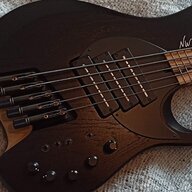
I personally use both : to me cab sim is more a "tone" thing, and HPF/LPF more a "utility" thing, and I'm very happy to have both in my Torpedo CabM+ 

My go-to DI EQ is as follows:
- HPF @ ~30Hz
- High shelf, +6-7dB @ ~1kHz
- Narrow mid cut to counteract the lift before 1kHz @ ~800Hz (Q > 2.5)
- Narrow mid boost to make the speaker resonance steeper @ ~1.5kHz
- LPF @ 3.5-5kHz
I find that, this way, you get a very convincing cab sound (with the midrange rise that is characteristic of many cab sounds). With modern digital mixers (which are usually 5 bands), this is really easy to achieve. It wouldn't be too difficult to make this into a bespoke pedal either, it would amount to a few opamps. A soft clipper before the EQ (even just with LEDs shunted to ground with some resistance in series) can be a good addition, since speakers do distort.
- HPF @ ~30Hz
- High shelf, +6-7dB @ ~1kHz
- Narrow mid cut to counteract the lift before 1kHz @ ~800Hz (Q > 2.5)
- Narrow mid boost to make the speaker resonance steeper @ ~1.5kHz
- LPF @ 3.5-5kHz
I find that, this way, you get a very convincing cab sound (with the midrange rise that is characteristic of many cab sounds). With modern digital mixers (which are usually 5 bands), this is really easy to achieve. It wouldn't be too difficult to make this into a bespoke pedal either, it would amount to a few opamps. A soft clipper before the EQ (even just with LEDs shunted to ground with some resistance in series) can be a good addition, since speakers do distort.
Perhaps someone will be kind enough to correct any errors, but... Here goes.
My understanding is that the fundamental concept of what an IR does is the same as an EQ, i.e. it is increasing or decreasing specific frequencies. However, it is doing so in extremely high detail (I assume dozens of specific frequencies). I also assume it is adding specific reverberations to different frequencies.
The alterations are based on captures of an entire signal chain. Let's hypothesize that a full IR setup modifies 100 different frequencies. You'll have one set of modifications based on:
- the speaker
- the speaker cab
- the specific mic
- the distance of mic from the speaker
- the placement of the mic relative to the center of the speaker
- the reverberation of the room(s) where the IR was generated
- any phase effects of the setup
Even if you had a 100-band EQ, it would be impossible for any human to nail the settings to emulate a specific signal chain.
AFAIK, IRs should always be as close to the end of the signal chain as possible. I happen to put the HPF first, so that low frequencies aren't sent to effects. My guess is you could put the HPF at either the start or the end.
IRs replace cab sims, but are not intended to replace EQs, HPFs, LPF, exciters, and so on. The job of an IR is to replicate a full audio environment when going direct into a flat system (e.g. a PA or DAW). HPF/LPF cleans up your sound so that your amp isn't producing frequencies detrimental to your tone. An EQ is a broad brush that shapes your sound.
IRs can replace EQs, but can do much more than EQs. LPFs and HPFs are forms of EQ, assuming no resonance is involved..
I am about this || close to just acquiring a used HX Stomp and using is just for cabsim duty.
I use my HX Stomp this way. This way I also have the amp sims if I need them plus backups for my analog pedals. Definitely overkill. I do use some of the synth sounds for a few songs and the clawthorn distortion on one.

I'm afraid I have to disagree.IRs can replace EQs, but can do much more than EQs. LPFs and HPFs are forms of EQ, assuming no resonance is involved..
The job of an IR is to simulate parts of a signal chain. They try to replicate specific cabinets, specific microphones, where those mics are placed, and so on. It provides the tonal shaping of a cabinet in a situation where you don't have one, such as going direct into a DAW.
In contrast, the job of EQ is broad tonal adjustment. If you're practicing solo at home, you may want to reduce the midrange. When playing live with a band, you generally boost the mids so you can be heard better in the context of a mix. If one frequency is causing an issue, you can easily use a parametric EQ to target it and notch it out. If one particular instrument has a little too much high end, you can reduce the treble a little bit to compensate.
In the same way that you can't just use a 4- or 9-band EQ to emulate a cabinet, you can't use an IR to boost the midrange by a variable amount on the fly. They are different tools which perform different jobs.
I'm afraid I have to disagree.
The job of an IR is to simulate parts of a signal chain. They try to replicate specific cabinets, specific microphones, where those mics are placed, and so on. It provides the tonal shaping of a cabinet in a situation where you don't have one, such as going direct into a DAW.
An IR applies a convolution. Such a convolution can provide a simple EQ, which can be a broad tonal adjustment, or it can provide any of the things you describe.
In the same way that you can't just use a 4- or 9-band EQ to emulate a cabinet,
True
you can't use an IR to boost the midrange by a variable amount on the fly.
No, you'd have to use a different IR for each situation, but for a certain amount of boost, yes, you can use an IR.
I’ll add that HPF can make the low end tighter, and with a bump at 60hz to 80hz, can give the bass tone added punch. LPF is great for overdrive and distortion by taking out the buzz. Can also get rid of high pitched clicking sounds and string noise. Especially if I have new Roto RS66 on.
I’m completely ampless now a days. Using a MD421 mic and 2x15 cab sim with HPF 45hz and LPF 3.15khz after it. I think the resulting bass tone sounds pleasing to the ear. Still experimenting though.
Last edited:
I’m completely ampless now a days. Using a MD421 mic and 2x15 cab sim with HPF 45hz and LPF 3.15khz after it. I think the resulting bass tone sounds pleasing to the ear. Still experimenting though.
What sim are you using? Cab M?
Boss GT 1000Core. Impressive multi fx.
What sim are you using? Cab M?
This has been an interesting rabbit hole. A couple of couple of days ago, I was possibly adding a Hotone Omni IR or TC Impulse to my board. At 3:00 this morning, I was debating ordering an Alpha-Omega Photon or an HX Stomp.
<insert that-escalated-quickly-jpg here>
The AO Photon is alluring. If it had an effects loop between the drive section and the cab sim, I would likely be hitting reload on an order tracking page as I type this.
<insert that-escalated-quickly-jpg here>
The AO Photon is alluring. If it had an effects loop between the drive section and the cab sim, I would likely be hitting reload on an order tracking page as I type this.
I was planning on picking up an Alpha-Omicron soon anyway.
Doing the math, at new prices, the Photon is like buying an Alpha-Omicron and getting a programmable EQ, compressor, and IR loader for $300 (which, for the same price, the Cab M+ is, mostly).
But I would rather the signal chain was drive->modulation->cabsim.
Doing the math, at new prices, the Photon is like buying an Alpha-Omicron and getting a programmable EQ, compressor, and IR loader for $300 (which, for the same price, the Cab M+ is, mostly).
But I would rather the signal chain was drive->modulation->cabsim.
I’ll add that HPF can make the low end tighter, and with a bump at 60hz to 80hz, can give the bass tone added punch. LPF is great for overdrive and distortion by taking out the buzz. Can also get rid of high pitched clicking sounds and string noise. Especially if I have new Roto RS66 on.
Hpfs really clean up the mud, definitely agree. Lpfs are great to tame overdrive. The genzler pedals have built in hpf/lpf/blend - fantastic tone shaping options.
But I would rather the signal chain was drive->modulation->cabsim.
That is how my board is setup. Works and sounds great. I have a comp at the end to level things out - but I mostly have at least a mild drive on constantly, so it is barely utilized. I've found having drive first really let's a good drive pedal be super responsive to playing nuances.
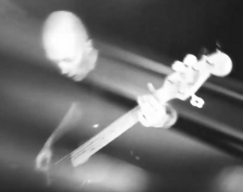
Nux MLD NBP-5. Such a bargain pedal. 3 different preamp models, 8 pre installed IR's, 8 additional slots for user IR's, adjustable HPF/LPF and two independent switches to toggle them on/off for both the 1/4" and XLR outs, pre/post switch, ground lift, and headphone jack. Also a parallel, completely unaffected 1/4" out for a 3rd output. Independent foot switches for drive and preamp. It's the last pedal in my chain. My only wishlist for this pedal is the LPF cutoff only goes down to 10k. Going lower would be preferred. But for $150, it's hard to beat the amount of built-in options.
I seem to prefer not using IR's these days, especially if I'm recording. I can always add them in post. But I like having the option if I don't like what I'm hearing through IEM's or FOH.

I seem to prefer not using IR's these days, especially if I'm recording. I can always add them in post. But I like having the option if I don't like what I'm hearing through IEM's or FOH.


