• TalkBass has been independent since 1998. Add your voice.
    Create a free account to reply to discussions, view embedded media, and browse with fewer display ads.
    Join freeLog in
    Want zero display ads or expanded classifieds tools? Compare plans.

Iron Ether FMeron

How aggressive can this get? I was thinking of doing a PLL (probably a Data Corrupter) for noisier synth sounds, but if this gets gnarly it could be a solid alternative.

For frame of reference on this I'm comparing literal analog synthesizers to FM synths and I find FM tends to be less aggressive or at least not oriented to make tones that are less polite/hollow?

It can get pretty gnarly, but it's definitely been tuned to make it easier to dial in in-tune and [what people commonly describe as] "musical" sounds. Most of the sounds shown in the video have the Mod Freq set on or close to the "sweet spots" indicated by the numbers 1-4, but if you turn that knob below one or above 4 you can get some pretty atonal and raunchy sounds.

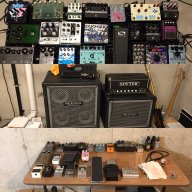
@AngelCrusher also has the right idea in thinking about the entire pedalboard as the synth - FMeron can do a lot on its own, but all the IE pedals have been designed with the idea of breaking different types of functionality out to separate pedals, so you can generate FM tones and then filter them with the Xerograph Deluxe, or generate even more harmonics with fuzzes and the FrantaBit, stack up detuned copies with the Polytope, etc.

Hmmm...got me thinking

Hey @Taylor Livingston, what's your take on using this with The Oxide and Xerograph Deluxe? Settings and pedal order suggestion? Thanks!

I would recommend putting FMeron at or near the beginning of your chain. You might like a compressor before it, but other than that, most effects will work better after it.

So, with those three pedals, I'd go FMeron->Oxide->Xerograph Deluxe. Zach gets a really cool sound towards the end of the video by following the FMeron up with a distortion to make it more aggressive, and then sending something like that into the XD would give it a very harmonically rich sound to carve through. Since most FM synths don't have filters, and most subtractive-oriented synths can't do FM, this pedal combination gives you a synth sound that you actually can't achieve with most keyboard synths.
 
Last edited:
So one thing that's really fun to do is have this with an extreme setting and turn the blend knob way down (meaning allow your clean signal to be more pronounced). I've found that using it this way makes it far more useable for me. I also like to use a CV controller with it or an expression pedal. It can get some really bizarre and amazing sounds with the cv controllers. I need to make a demo.
 
  • Like
Reactions: gregmon79
This past weekend I spent a ton of time coming up with nasty synthy goodness using a variety of dirt, octave, chorus and delay pedals. Got some cool stuff but was thinking about how I could get more. Then I see this thread today and my questions have been answered. Gotta love that timing! I'll definitely be getting in on the next run of these (assuming I act fast enough before they sell out, that is).
 
I can totally understand the annoyance of dealing with an international purchase. Unfortunately, for the time being at least, I'm just not able to support a dealer network, so for now there are no plans to sell IE pedals anywhere but direct through the website.

For anybody wanting to be notified as soon as they're back in stock, you can sign up here. That's true for the other pedals, too - just go directly to the shop page for any out-of-stock item and there will be a spot to enter your email.
 
I can totally understand the annoyance of dealing with an international purchase. Unfortunately, for the time being at least, I'm just not able to support a dealer network, so for now there are no plans to sell IE pedals anywhere but direct through the website.

For anybody wanting to be notified as soon as they're back in stock, you can sign up here. That's true for the other pedals, too - just go directly to the shop page for any out-of-stock item and there will be a spot to enter your email.
Thanks for that link - it's very hard to go to the shop page for an OOS item when anything OOS doesn't appear in the shop! =0)
 
I can totally understand the annoyance of dealing with an international purchase. Unfortunately, for the time being at least, I'm just not able to support a dealer network, so for now there are no plans to sell IE pedals anywhere but direct through the website.

For anybody wanting to be notified as soon as they're back in stock, you can sign up here. That's true for the other pedals, too - just go directly to the shop page for any out-of-stock item and there will be a spot to enter your email.

No biggy. I'll survive another international purchase. :) Thanks!
 
Great to hear all the awesome feedback, everybody! This has been something I've wanted as a bassist for years, and this particular design has been in development for a year now. So I'm excited to finally be able to bring it to life. I'm happy to answer any questions you may have about the FMeron.


That's true, but, it's really a matter of interface. The DX7 has hundreds of parameters that can be programmed, and it would be impractical (and big and incredibly expensive) to have hundreds of knobs, so the designers locked all of those parameters behind a single data entry slider. As a result, almost no users of FM keyboards ever created their own sounds, instead using it as a box of presets.

Now, there's nothing inherently wrong with that, but my own musical philosophy is different. I want to be able to create my own sounds on the fly while making music, and especially when playing bass or guitar, I don't want to be locked into other people's presets.

So, if you consider the challenge of trying to boil down FM synthesis to what can be controlled by 4 knobs (since 2 of the 6 are dedicated to volume control), and especially if one wants "WYSIWYG" controls that aren't controlling ten different things, where you can never tell where anything is set by looking at it, it's a very different design problem.

If people write to me and say they want a gigantic FM synth pedal with 300 knobs that costs more than the rest of their rig, I will definitely consider it! :D I have a Eurorack modular, which I built and/or designed all the modules in, so I'm not afraid of knobs. What I'm afraid of is an interface that makes music-making a PITA.

And that is the real 'elephant in the room' isn't it, we who are using extensive pedal boards are essentially running modular signal processing rigs. And we are seeing pedals being designed as 'systems' not only in regards to individual functionality but now also evolving in terms of control/switching operations for all of these individual pedals. After all, there have been 'all-in-one' systems from Roland/Boss, Line6, Zoom, etc. for a long time and yet they have never been able to displace the desire of bassists and guitarists to utilize configurations of individual pedals. On-The-Fly manipulation/switching/routing architecture capable of integrating many pedals by multiple manufactures is now becoming a real issue. It seems to me that the real challenge for pedal designers going forward is how to incorporate those requirements in such a way that will be compatible across manufacturers, sort of a simplified pedal version of MIDI, and at a workable price point.
 
Thanks. Please let me know if you need any beta testers. Loved the Oxide and use it often, but I tend to like more of the Marshall Guv'nor/Xotic BB bass preamp overdrive tone these days. If only there was a pedal that could do both fuzz and distortion with the flick of a switch? :D

The Oxide is discontinued, but I do plan to come out with another fuzz in 2018.
 
  • Like
Reactions: JES
. . . I also like to use a CV controller with it or an expression pedal. It can get some really bizarre and amazing sounds with the cv controllers. . .

@Taylor Livingston it was my understanding that CV shouldn't be utilized with any of your pedals or is this an exception?

Can't wait to get mine in!!
 
Yeah, it hasn't been designed to accept CV, so I have to tell you not to do that, and sending CV in there will void your warranty. The expression jack is only designed for passive expression pedals or things that emulate them like the Mission Expressionator.

Longer answer: just by virtue of how the circuit works, if a person were to send CV in there (which you shouldn't), the FM amount will change in some unpredictable way as long as the CV is changing, but it's not a one-to-one relationship between what the CV does and what the FM amount does, and as soon as the CV holds steady, it will have no effect regardless of the voltage it stops at.

Since that input hasn't been designed with the expectation of CVs going in there, it doesn't have any protection circuitry that would keep over- or under-voltages or currents from damaging it, so I can't say for sure that it won't damage the pedal, so for warranty purposes I have to assume it will and tell people never to do it.

There's a workaround though, if you wanted to control it with modular synth gear: let's call the expression jack ring the Send and the tip the Return. Using an insert cable, connect the Send to the input of a VCA, the Return to the VCA's output, and then connect your CV to the VCA's CV input. That will do the trick.
 
Yeah, it hasn't been designed to accept CV, so I have to tell you not to do that, and sending CV in there will void your warranty. The expression jack is only designed for passive expression pedals or things that emulate them like the Mission Expressionator.

Longer answer: just by virtue of how the circuit works, if a person were to send CV in there (which you shouldn't), the FM amount will change in some unpredictable way as long as the CV is changing, but it's not a one-to-one relationship between what the CV does and what the FM amount does, and as soon as the CV holds steady, it will have no effect regardless of the voltage it stops at.

Since that input hasn't been designed with the expectation of CVs going in there, it doesn't have any protection circuitry that would keep over- or under-voltages or currents from damaging it, so I can't say for sure that it won't damage the pedal, so for warranty purposes I have to assume it will and tell people never to do it.

There's a workaround though, if you wanted to control it with modular synth gear: let's call the expression jack ring the Send and the tip the Return. Using an insert cable, connect the Send to the input of a VCA, the Return to the VCA's output, and then connect your CV to the VCA's CV input. That will do the trick.

Taylor,

The Lightning Wave EVA acts like the Roland EV5. It is technically an expression pedal but controls CV. I've asked Lee and he told me that it ought to be ok to use with your pedals but if you're not ok with it, I totally understand that. I've never had an issue. Though I will obviously respect your research on your own products.

I believe I had emailed you about this stuff in our million emails. LOL. You may have missed it or maybe we spoke about it and I forgot.

What the EVA does is creates a bpm beat for it. I'm not actually starving the voltage or adding any in that regard. It basically creating a clock beat, which makes for some extremely interesting result.

Listen to the man here folks! I experiment at my own risk! :)
 
I wasn't really able to figure it out from a look at their website/manuals, but if the unit just inserts a variable resistance (like an optocoupler or digital potentiometer) between the ring and tip connection, then it's fine to use it, and it would fall under that category of "things that are functionally equivalent to an expression pedal as far as the FMeron knows."

If it's sending an actual voltage, then it could potentially damage the pedal. That was what Dann was asking about so I was just speaking in that general context.

Of course, anybody is free to do whatever they like with an item they own, without the maker's permission. On my end, I just have to be conservative with what I say about things like this, because if I said something like "it's probably fine to use," and then somebody tried one of the zillions of devices that output CV and it killed the FMeron, I would be responsible for replacing it.
 
  • Like
Reactions: jwr
Yeah, it hasn't been designed to accept CV, so I have to tell you not to do that, and sending CV in there will void your warranty. The expression jack is only designed for passive expression pedals or things that emulate them like the Mission Expressionator.

Longer answer: just by virtue of how the circuit works, if a person were to send CV in there (which you shouldn't), the FM amount will change in some unpredictable way as long as the CV is changing, but it's not a one-to-one relationship between what the CV does and what the FM amount does, and as soon as the CV holds steady, it will have no effect regardless of the voltage it stops at.

Since that input hasn't been designed with the expectation of CVs going in there, it doesn't have any protection circuitry that would keep over- or under-voltages or currents from damaging it, so I can't say for sure that it won't damage the pedal, so for warranty purposes I have to assume it will and tell people never to do it.

There's a workaround though, if you wanted to control it with modular synth gear: let's call the expression jack ring the Send and the tip the Return. Using an insert cable, connect the Send to the input of a VCA, the Return to the VCA's output, and then connect your CV to the VCA's CV input. That will do the trick.

Is that VCA CV trick true for the other IE pedals?

Would something like an auto swell pedal work (Malekko Sneak Attack) or a Moog MF Boost do it?