• TalkBass has been independent since 1998. Add your voice.
    Create a free account to reply to discussions, view embedded media, and browse with fewer display ads.
    Join freeLog in
    Want zero display ads or expanded classifieds tools? Compare plans.

Is having 5+ strings really worth it?

I play 5 strings exclusively these days. I have a 4 and a 6, but almost never play them.

Most of the bands I am in don't call for notes lower than E, but I still more comfortable on a good 5. When I play classic rock, I play it like a 4-string, moving up and down the neck a lot. I feel that gives a consistency to the tone that sounds good in rock music. But I also love sometimes using the over-the-top fatness of a B string on the higher frets. I'm really not tempted to use the low D/C/B when the music doesn't call for it. But it's there when I want it.


Maybe you've never played a *good* P5 through a *good* speaker cabinet. My main bass these days is my Nordy P5, and it kills as a classic P. It also happens to have a great B string and excels in more modern contexts as well. Of course, you do need to have a speaker that can reproduce those low fundamentals, since you don't have a bridge pickup. I also owned an AmStd Fender P5 and that was very nice also.

P5 pron:
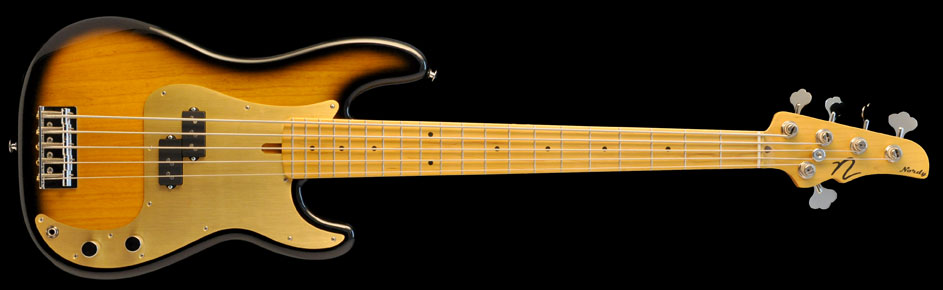
nordy_vp5_studio.jpg

That bass is flippin' beautiful!! That has always been my favorite color combination on a "P" bass. Had to say that first.

As far as 5 string basses....I started playing in 1970 and didn't get my first 5 string until late 2010. I love it! I'll never get rid of my 4 string basses, I play them quite often but for me that low B comes in very handy.
 
If your budget allows, I'd say keep your 4 and get a cheap-ish used 5 to give that a whirl. You just never know what's going to stick until you have given it a lot of time.

Personally, I like having both available. Some people feel very strongly that one or the other is "best" (for them), but I say "don't make me choose between my kids". :)
 
i have tried to get into a 5 string for a very long time ... the only time i was successful was when i was in a hardcore band who tuned a lot to dropped-D. i used the B string for a lot of the D riffs. the tempo was also slow enough for me to really make use of the B string. this was the time i was so used to a 5 string, i get disoriented when i switch back to a 4.

the next band i had was a death metal band who tuned to Eb. normally, i would have been able to play the riffs if i just occasionally touched the B string. but the tempo was so fast that i could not catch up with the drums and guitars especially if i have to mute the 5th string, or used a floating thumb technique. so i switched to 4.

over the years, the next projects i had were B string free, and eventhough i still can play everything with a 5 string, i missed the speed and familiarity with a 4 string.

but, the biggest reason i permanently stuck with 4 string is because i bought some really 'unique' 4 string basses - 2 warwick vampyres and a custom bass thats a cross between an alembic omega and a warwick vampyre.

if i were only able to sell my 4 string warwick vampyres, i might have actually permanently switched to 5 string basses ... but since they never will, i instead, sold my 5 string basses (a stingray 5 and a Ken Smith BSR5MS) and permanently stuck to 4 strings.
 
I have one fiver, an Ibby 505 and own at least a dozen other fours at last count. At first I wasn't too wild about the fiver and mostly used the B string as a thumb rest. But after a while, I got used to it and now I like it. What I like the most is the ability to play further up the neck and get that thicker sound.

I still prefer a four string however, but the five is a nice change of pace.
 
It's worth it if that's what you want/need to be able to play what you want/need and are comfortable playing it. There's a certain "draw" to me to try playing a 4 string but I always find I prefer the options of a 5 string. I feel VERY comfortable on a 5 and can play almost anything on it.

I have also made the move (again) to a 6 string. I want to push myself a bit, play some Bach and Dautzauer. Work on transcribing some Jimmy Haslip stuff.
 
I play 5's the most therefore a 4 feels tiny to me. I like the extra real estate of a 5 neck.
also, 5's tend to be a little tighter in spacing that I like too. like munji said, the B serves as a rest most of the time if nothing else.
an open D will always sound better than a fretted one.
on the other hand, there are some designs that IMO don't lend themselves well to a 5 design (Passive P bass).
I am economical with those low notes; I rarely use them but it is nice to have them.

One of the features of my Roscoe Beck V I like is the fact that it's passive - vintage tone/no batt., awesome B.
 
It's worth it if that's what you want/need to be able to play what you want/need and are comfortable playing it. There's a certain "draw" to me to try playing a 4 string but I always find I prefer the options of a 5 string. I feel VERY comfortable on a 5 and can play almost anything on it.

I have also made the move (again) to a 6 string. I want to push myself a bit, play some Bach and Dautzauer. Work on transcribing some Jimmy Haslip stuff.

Playing Bach's Cello Suites on a 5 is so much easier! Not sure about this, but I think the 1st string on a cello is a C. On a 4 I had to raise the lower notes (C to D#) an octave. Being able to play those notes in the octave Joey intended them to be played has improved the quality as well as the ease of playing the suites.
 
...as compared to the typical 4 string bass. Mostly for reasons of cost, playability, etc. I was thinking about getting a 6'er until I realized that I would almost never use the extra strings. So what are your thoughts?

First of all, 5-string basses are almost the standard now (in my opinion as they should be). I just ran into a bassist at a music store that mentioned that he gets yelled at going into sessions for not having a 5. He said it's the opposite of when all studios wanted to see was a Fender and would scold bassists for their wacky new-fangled choices.

For myself, my oldest working bass is a 6-string. Back in the 90s, I had a fretted 6 and a fretless 6 as my mains. The 6 was absolutely necessary in my "digressive rock" trio. In order to sound as big as possible all three of us sang and the guitarist and I did plenty of contrapuntal two-hand tapping and chords. Some of the parts I wrote have compromised chord voicings if I try to play them on a 5.

Then in the 2000s I got some great-sounding custom 5-string basses made for me, and I began to consider myself mainly a 5-string player. My biggest writing tool for the last dozen years was an acoustic-electric fretless bass - perfect for noodling and writing.

But the pendulum is swinging again. I just picked up a Tanatos 7-string bass and it's fantastic. Why? One of my bands works in multiple tunings and I got the crazy idea stuck in my head to tune it like a 7-string guitar one octave lower (GCGCFAD) so that I can help reproduce guitar overdubs live and harmonize a couple solos. I'm wanting to sell this bass already but only because the finish option wasn't my ideal and I want more of these for the various tunings!

This bass highlights the fact that extended range is not for everyone - the extremes make a good litmus test sometimes. The pros: the upper half of the bass sounds like a baritone guitar almost, very sparky with 2-step bends possible; chord voicing possibilities are huge; I immediately started writing new riffs that are half-guitar and half-bass oriented so it feels like more of a hybrid instrument than even a 6. The cons: I haven't figured out how to wear the strap yet! Too high and the 35" neck sticks out too much to my left, making chords on the wide fretboard painful. If the strap is too low, the instrument feels great for picking and fretting but the upper register becomes difficult to use. Oh, and it's gotta be 14 pounds at least the shipping weight was 7kgs! I'm going to have to get used to jumping around on stage without throwing out my back :help:
 
I don't think it's worth it until you find yourself reaching for phantom strings. When the time came that I was thinking "Hmm a low D would sound really nice here." I decided to start playing 5's. I went 6 for awhile but didn't ever use the C string and went back.

If I could get by playing modern country, rock, Praise music, etc. with a 4 string I would, but I just can't.
 
By the way, I joined an extended-range guitar and bass club on FaceBook. Someone asked the question about at what point an 11-string instrument should be considered more than just a "bass" or "guitar" since the range starts getting closer to a harp.

Nobody seemed to agree with my suggestions: Maybe we should just go back to the term 'lute'? Perhaps Mr. Chapman was onto something when he just called his touch guitar a 'stick'? Maybe we need to reclaim terms like 'basitar' and 'guitbass' from the minimalist Presidents of the United States of America?

I stand by my opinion so far after having delved into 7-string territory. If you watch footage of someone like Yves Carbonne playing, he's using electric bass technique and the instrument has that kind of string spacing, but the treble notes are so important that the word 'bass' almost becomes a misnomer!
 
After using 5-string for the last 20 years, I recently went to a 4-string. I'm mostly playing pre 5-string covers these days and don't need the low B as much. I would do gigs and count the number of times I played a note on the low B and it would consistently be under 10 times on a 4 hour gig. At that point, I figured it was time to go 4-string.

I also notice now playing 4-string, I feel more free on it. Since I don't have as many pitch options, I find myself searching out new melodic options instead. I like that.
 
If a five is helpful for your projects/gigs, then it's worth it. I've mostly played in original rock bands for the past several years, and most of the time a five hasn't been necessary. Several involved tunes in D, for which I usually prefer drop-D tuning on a four.

But one songwriter liked to write in E flat, A flat, etc., and for those keys a five is simply better IMO. I did okay on fours in drop-D for tunes in E flat, but a five would have been better. In fact, my experience in that band inspired me to get my Jazz V.

Soon after that, I played in a rock musical, for which a five was helpful, and I'm currently working on another for which a five is virtually essential. Several tracks involve low D and/or E flat, and on others the hand position flexibility of a five is enormously helpful. I wouldn't play it on a four, and in fact I want another five as a backup because it would be difficult to adapt to a four. In my rock band I can switch between my fours and five at will, but not for this.

So for me, yes it's been worth it, even though I've only needed it on occasion. Also, even though I'll probably continue to play fours more often, I completely understand why many players just switch over to fives completely.
 
And there have been a number of times I've responded to an ad about a gig and people will say, "You aren't one of those 5 string players are you?!" :D

That's just ridiculous. Judge my playing, not my bass. And of course, anything you do on a 4 can be done on a 5 by ignoring a string - or using it as the great thumb rest it is.
 
On the plus side you get a broader range of sounds, which may or may not be useful for the music you're making.

On the negative side you get a heavier bass, that is a bit harder to play, and some bands will not want to work with you. And string changes are of course more expensive.

Even when you get used to playing a 6-string and you no longer think about the extra strings, how you play them or how you mute them, if you later pick up a 4 you find it's such a doddle to play, it's a real joy. Or it was for me anyway, after 3 years of just playing a 6.

I enjoyed playing a 6 and I think there are good sounds to be had from them, but it's so much more fun to play a 4 or even a 5. In my experience.
 
After using 5-string for the last 20 years, I recently went to a 4-string. I'm mostly playing pre 5-string covers these days and don't need the low B as much. I would do gigs and count the number of times I played a note on the low B and it would consistently be under 10 times on a 4 hour gig. At that point, I figured it was time to go 4-string.

I also notice now playing 4-string, I feel more free on it. Since I don't have as many pitch options, I find myself searching out new melodic options instead. I like that.

I switched back to 4 strings after primarily using 6ers for the last 3-4 years or so. It has been fantastic, I feel much faster and more comfortable. I actually feel it has expanded my playing and my solos seem far more interesting. I played a couple 4 string gigs in the last couple months and it feels like coming home. I play in a prog trio, and I am sure I am in the minority of people that experienced this but my guitar player actually complains I don't bring my 6 string.

We have a TV gig this week so I have busted out the 6 again, as it is more visually striking, it feels heavy and cumbersome now, I look forward to bringing my 4 strings again, probably my fretless as that has been my number one lately.
 
For me, no. I have thought about a fiver, but never figured out what I would do with it. For other people, sure, it's worth it. If I played music that requried a low B string, then a fiver would be the way to go. I don't, and I don't have the skill or talent to play crazy stuff that requires a high C string, so four is enough. Besides, I can only count to four.