

Enjoy the benefits of a premium membership!
Upgrade Account
-
TalkBass has been independent since 1998. Add your voice.
Create a free account to reply to discussions, view embedded media, and browse with fewer display ads.
Join free Log in
Want zero display ads or expanded classifieds tools? Compare plans.
You are using an out of date browser. It may not display this or other websites correctly.
You should upgrade or use an alternative browser.
You should upgrade or use an alternative browser.
Is it possible to undo a PJ job?
- Thread starter Doublesixes
- Start date
More options
Who Replied?

That is probably the best suggestion unless you want to refin. I was in the same boat with my ‘75 P. Around 1980 I added a J pickup. I never liked it and I never used. I did finally fill the hole and refin in gold sparkle.Play that baby like it is and don't worry about it. Disconnect the J-pup if it bothers you and use it as a thumb rest. I think any attempt to "fix" it now would take away from the 46 years of mojo.
B.

Brings back a painful memory, around 2006 I bought a top of the line USA Lakland Bob Glaub Darkstar p with j neck, played and sounded great ... then I saw it. A faint outline in the shoreline gold metallic where there had been a second Darkstar installed in the j position, then removed and filled, if I were you I would leave the pickup and just not use it.
Not suggesting you do anything, unless you totally refinish the entire body(solid color). Are you prepared to having it looking worse? I have not seen a "patch" that looked good or seamless. most are very noticeable, the worst was a bass with it's J hole filled with car bondo (don't do it)! i'd just disable the pickup, why ruin an already beautiful bass and lose all that"mojo"!
You could also take the pickup out but leave the pickup cover in the hole. That would reduce the weight but keep the current aesthetic.
You could pull a ZZ Top and take the pickup out and glue a cigarette in there. LOL.
I'd glue a shot gun shell, in it!

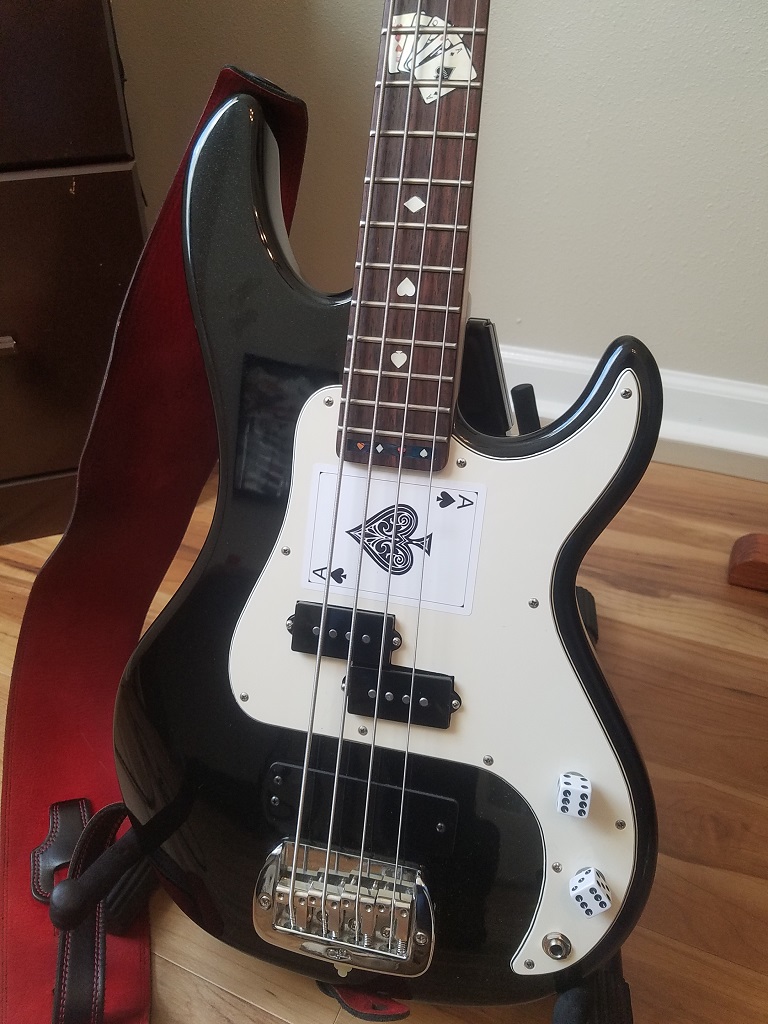
I removed the J pickup from my SB-2. I made a cover out of pickguard material to cover the hole. My bass is black so the black cover blends in pretty well. Otherwise I would make the cover match the existing pickguard or decorate it in some way.

Hopkins
Commercial User
You guys will hate me for this but the biggest improvement was getting rid of that heavy Badass bridge.
Before having the route filled, I had completely disconnected the jazz pickup from the chain. IMO simply turning the knob down did not have the same tonal result. The bass sounds 20 times better to me with the stock pickup and the bent plate bridge.
I don't hate you at all for it, it's the first thing I would have done.
Hopkins
Commercial User
Unless you want to refinish it opaque, you’d need to have someone with real expertise like JohnK or straight up the StewMac guys do it; otherwise just leave it
I see you snipped the wires for the PUp.. if purity is your goal, you’d need to remove the pot and likely rewire the P volume to a proper voltage divider instead of the shunt they usually use for 2-pickup basses. That being said, I’m with JimmyM in that the tonal differences are more subtle than some would suggest- but I also have a bee in my bonnet where the mathematical reality of the wiring is concerned, so I understand taking the J pickup out of the circuit.
Honestly, it is a fairly easy repair to hide with a burst finish. Its a 2 piece flat sawn alder body, finding a grain match would be a piece of cake except on the end grain, which would be covered by the opaque dark brown of the burst, so not hard if you are capable of spraying a burst finish. Hiding the repair and blending in the original finish would be fairly difficult however.
That's fine - we differ in our approach to the instrument. I play church gigs, and the way I play, it's all about subtlety - being a subtle presence at times, making things build, etc. I typically end up playing with the volume dimed about 10 percent of the time - only at the climax of a couple of songs out of our set. Hence how the thing operates with thing dialed back is something I'm very aware of. A VVT wired Jazz is not a very good instrument for what I do - my Jazz is wired very differently as a result. For a Rock gig? that's a different scenario.
Precision wiring typically has the pickup hot lead coming in on the CW post (or CCW?) while a typical J or PJ with two pickups has the pickup hot lead coming in on the center post of the volume pots. At full volume a P and PJ with the J turned off are virtually the same (the loading of the jazz pickup pot is small). As you go to half volume, however, the PJ wiring will load down the P pickup more (less resistance to ground). And in contrast the stock P wiring will exhibit the same load on the pickup.

Precision wiring typically has the pickup hot lead coming in on the CW post (or CCW?) while a typical J or PJ with two pickups has the pickup hot lead coming in on the center post of the volume pots. At full volume a P and PJ with the J turned off are virtually the same (the loading of the jazz pickup pot is small). As you go to half volume, however, the PJ wiring will load down the P pickup more (less resistance to ground). And in contrast the stock P wiring will exhibit the same load on the pickup.
Yes, the crucial thing that's the issue with loading the pickup with a potentiometer (resistor) is that the pickup is highly reactive - it's impedance varies a lot with frequency - the more you load it, using a load that isn't reactive, the more you change its sound. Using the volume control with the circuit used in the P minimizes this issue, as the pickup is always lightly loaded.
At max volume, yes the pickups on a J are fairly lightly loaded. There is still the issue of 3 pots as a load, rather than 2, which makes them different, but that's not the biggest issue - what happens at less than full volume is the biggest issue, and it's part of why some folks never play at less than full volume. A Jazz bass works OK if at least one pickup is on full, less so as you turn things down.

- Jun 30, 2010
- 49,603
- 222,065
- Disclosures
- musician/artist/owner - Gildaxe
That's the way it's done.

I am in the minority here, but those huge bridges do nothing for me but add weight. In fact I think they are a tonal downgrade if there is any difference at all.I don't hate you at all for it, it's the first thing I would have done.
I am in the minority here, but those huge bridges do nothing for me but add weight. In fact I think they are a tonal downgrade if there is any difference at all.
Apologies for my alcohol induced rant, but those in the just turn down the volume knob camp are unrealistic.
I hear time and time again the quote that “the audience can’t tell the difference.” Who cares, tone is a personal quest and is not determined by a 24 year old at the bar. We research gear to it’s ultimate end on here in an attempt to make that tone in our heads reality.
However you get there, how little or how much you spend is irrelevant. If your happy with your tone, own it and don’t look back. Do what you want with your bass and make yourself happy!!
I hear time and time again the quote that “the audience can’t tell the difference.” Who cares, tone is a personal quest and is not determined by a 24 year old at the bar. We research gear to it’s ultimate end on here in an attempt to make that tone in our heads reality.
However you get there, how little or how much you spend is irrelevant. If your happy with your tone, own it and don’t look back. Do what you want with your bass and make yourself happy!!

Authentic, accurate, and interesting as well.IMHO, the modification is just as authentic and historically accurate as the original instrument. If it’s just the tone that bothers you, then take @BLDavis ‘s advice and disconnect the J pickup. If it’s a visual aesthetic issue, then I can’t help you...
Visual aesthetics, what’s that?

After carefully reading each and all responses I'm 95% convinced that the bass should remain as is. It's a creature from another century and has kept that look for almost its entire life.
The bass sounds wonderful in all 3 possible settings (P, PJ and J) so my initiative had only to do with a cosmetic gain. The Doc in Orange County who did a wonderful fret dressing job a few years ago was highly impressed by the bass also suggested to leave it alone.
So, there you have it. I'd like to thank this great community of friends for the shared knowledge.
The bass sounds wonderful in all 3 possible settings (P, PJ and J) so my initiative had only to do with a cosmetic gain. The Doc in Orange County who did a wonderful fret dressing job a few years ago was highly impressed by the bass also suggested to leave it alone.
So, there you have it. I'd like to thank this great community of friends for the shared knowledge.

Sounds like a fine ending. Play her in good health.After carefully reading each and all responses I'm 95% convinced that the bass should remain as is. It's a creature from another century and has kept that look for almost its entire life.
The bass sounds wonderful in all 3 possible settings (P, PJ and J) so my initiative had only to do with a cosmetic gain. The Doc in Orange County who did a wonderful fret dressing job a few years ago was highly impressed by the bass also suggested to leave it alone.
So, there you have it. I'd like to thank this great community of friends for the shared knowledge.

Yep, that's the best course of action: leave it how it is. The mod was well done.
P/Js are somewhat polarized in acceptance, but they do have a really nice, wide range of tones.
P/Js are somewhat polarized in acceptance, but they do have a really nice, wide range of tones.
Now you’re absolutely positively sure? No doubts? Weighed all options? Pros and cons list??After carefully reading each and all responses I'm 95% convinced that the bass should remain as is. It's a creature from another century and has kept that look for almost its entire life.
The bass sounds wonderful in all 3 possible settings (P, PJ and J) so my initiative had only to do with a cosmetic gain. The Doc in Orange County who did a wonderful fret dressing job a few years ago was highly impressed by the bass also suggested to leave it alone.
So, there you have it. I'd like to thank this great community of friends for the shared knowledge.
What about that nagging 5%?Now you’re absolutely positively sure? No doubts? Weighed all options? Pros and cons list??
Just sayin...

A good luthier could make a wood piece to fit it in the j hole with some glue... Also the colour ... The match can be seen but who cares ... You got wood where wood supose to go ... Or you can put a ramp like the Gary Willis bass to cover the color match...View attachment 3498898 I have a 73 Precision which, back in the day (1978 or 79) was modified by adding an original Fender Jazz pup in the bridge position.
Well, after pondering for a while came to the conclusion that this setup doesn't cut it anymore for my needs as I have 3 jazz basses that cover that particular sound that sometimes I use.
I'd like to know if anybody here has reversed a PJ job on an authentic older Fender (sunburst) and if so, what kind of results were achieved. TIA


