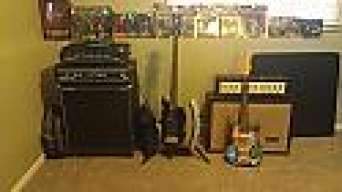
as a builder who has been 'lefty friendly' since I began building for profit in 2005, I think I can can share a few thoughts from my personal business model and experiences
- as a whole I do not charge an additional fee for lefty instruments. my manufacturing structure is that of a custom build shop, even for my production models. as such, each instrument is built to order.
I can see that a large company producting significant quantities of a part per batch needs to leverage tooling/engineering/re-tooling/etc ... across all of the units made in that batch. if the overhead labor rate to swap tooling is $250/hour and it takes 4 hours to certify the line is ready for the new part to be run, then you need to absorb that cost into the part unit cost, while also accounting for what could be considered as lost production time profits you didn't make while changing tooling.
even as I 'upgrade' my shop tooling to incorporate CNC, as a small shop I still won't have the same tooling scenario for the immediate future. this is because of the scale of my operation vs. the scale of a large company like Fender and others
- I do have to pass along any additional costs I incur for lefty specific parts. for my business and my model offerings, this is currently limited to
- reverse AT pots of various values. unless I'm asked to use a 'righty' pot on a lefty build, my philosophy is that pots should work correctly and that lefty players should not have to settle for pots that work backwards
- custom stainless 2, 3, and 4-hole control plates used on my VRB and Heritage Tribute models. I was forced to have custom '51 Tele P style control plates made as there is no lefty part available that was able to find. these were not cheap to have made in a small quantity (think less than 100 pieces per batch)
- since I make my own pickguards, I have no added costs outside of the initial template material and labor
I do charge more for a fretless, whether righty or lefty, but that's because my fretless boards are finished with epoxy as standard. this easily adds 8 extra hours of work (plus the cost of materials and two extra weeks of 'cure time') to a fretless vs. a simple fret job on a fretted instrument. a non-epoxied fingerboard option brings pricing in-line with a fretted unit, as there still is considerable detailing to get a fingerboard perfectly level that is beyond the simple effort needed to level frets
for CNC work, utilizing a simple 'mirror' was sufficient for the basic design geometry. it was not sufficient for developing all of the tool paths or tooling fixtures and hold-downs, as I chose to reuse as many of the alignment pins and vacuum clamping jigs as was possible. if I was paying for someone to do this, it would have easily doubled my design costs - and these would then have to be averaged into the per unit costs averaged over a couple years
from a wood perspective, I need to be aware that certain defect areas that would be outside the body area (and thus cut off) on a righty could be spot in the middle of the upper horn on a lefty. because of this I also grade all of my wood sets as righty/lefty/both. there's an added inventory management time for this ... insignificant for me with my build numbers, but something that could be significant for a company that builds countless thousands of instruments per year
so there you have it - the perspective of a custom builder who actually builds lefty basses. lefty instruments account for about 40% of my deliverables every year.
all the best,
R