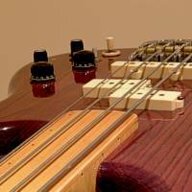
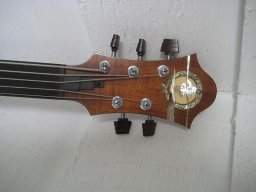
I'm thinking of defretting one ( on a fender jazz).
What kind of sound might I expect? Why is it rare to find fretlesses with maple fingerboards? Rosewood even though softer seems more common, and course ebony ....
Well...
A Maple fingerboard is not a
bad idea, but it's not what I would call "ideal", either. Some kinds of Maple are pretty hard, so the wear factor is no worse than that of some other fretless fingerboards. The main "problem" with Maple, IMO, is what others have pointed out; unless it's seriously sealed, Maple gets nasty looking - pretty quickly. The other woods used for fingerboards don't have that problem because they're naturally oily - which keeps them from turning that grimy looking mess that Maple does, when the finish wears off. And, which can only be cleaned up with lots of sandpaper...
Some Rosewoods ( the real, genus
Dalbergia ones)
are pretty hard, but... those are still on the CITES list, and are difficult (and expensive) to get. Ebony? There are some kinds of Ebony that are actually surprisingly soft (take a look at www. wood-database.com some time); the few that are popular for finger/fretboards are getting pricey, too. But, real Rosewood and Ebony are naturally oily woods, and won't get nasty-looking like non-oily Maple does.
As for Synthetic fingerboards? Well, first; none of them are - or ever were - made of bowling ball material. That stuff is- or was - "Ebon
ite". Ebon
ol is the trade name for black Micarta. Micarta was invented in the 1920's for use as a heavy duty electrical insulator - and is usually green. It's made of layers of either fine linen or high quality paper, soaked in a phenolic resin; compressed under high pressure and heat. Although it wears like iron, ebonol fingerboards- according to some - are "dead" sounding. I don't own a fretless bass with one, but both my aluminum-necked Kramer basses have ebonol
fretboards; they work just fine for that...
Richlite is another synthetic material that's becoming popular - for fretboards, anyhow. It's wood of some kind, that's impregnated with some kind of resin under high pressure - similar to how micarta is made. Would it make a good fingerboard? I have no experience with it, so... I can't really say. So...
Bottom line? If you want to de-fret a Maple fretboard? Knock yourself out... Just know that you'll have to seal it with something that won't wear off real soon - or just resign yourself to a fingerboard that will eventually look... nasty.