• TalkBass has been independent since 1998. Add your voice.
    Create a free account to reply to discussions, view embedded media, and browse with fewer display ads.
    Join freeLog in
    Want zero display ads or expanded classifieds tools? Compare plans.

Is sustain such a many splendored thing?

...Kramer 450B...
If it weren't for how heavy it was and that the cold (at times) aluminum neck kept going out of tune depending on the ambient temperature, I'd still have my old 350B.

Kramer 350B-1200_0729.jpg


Made in October 1976.
 
Better to have it and not need it than to need it and not have it. Each musical situation has its own requirements. Sometimes the deadened thump is perfect, other times the zinging sustain of steel rounds is. I put TI flats on my '68 P bass and it's ideal for what it does. The mutt P with the Badass bridge and the Duncan in it with rounds on it sustains 'til the cows come home.
 
Sustain on a bass guitar is beyond useless for anything I’ve ever played since becoming a musician in 1988.

When I played upright…that’s the kind of music – and instrument – that the bow was for.

There could be a use for long sustain on electric bass guitar, but it would come from setup, technique, and electronics – not a big-ass bridge.
 
  • Like
Reactions: Fynn
As long as you hear the guitar we have sustain?????
What happened to attack and decay?
Well, I'd say the attack depends more on how you play, than the instrument and the decay is also pretty similar on most instruments. Unless you actually put felt, or something like that, underneath your strings, it's all gonna sound almost identical
 
Wetton had surgery because of finger playing.

He would play with a pick for certain songs. Never played with a pick in King Crimson.

He started using a pick in U.K.

In his late years he’d use a thumb pick almost all the time.


String damping and muting are 2 different things.

I usually associate palm muting and using a foam mute as a tick tack type of playing rather than a damping to keep other strings from ringing out like when a finger player uses his thumb.

As a pick player I’ll also use my fretting hand to keep other strings from ringing out.
I do all kinds of things for damping, and with either hand. Poorly, of course, but I do it.
 
On a bass, I really don't need it. I actually have foam under the bridge on most of my basses right now.
I absolutely love hearing a note die out semi slowly.
If you look at Mr Jamerson, you will see what I mean.
Secondly, I know that high mass bridges contribute to sustain, from experience, I know that they change the low end profile. My unscientific experience is, sub lows are enhanced a bit. To me, sub lows are good in recordings, but on a stage, they are just not good on a number of levels unless the sound system is perfect.
Even then, the kick drum needs its
Territory.
I am greatly interested in this subject and would love to hear your thoughts

J l mattox
Back in 1971, when I took the ashtray pickup cover off the 1965 Jazz that I bought in 1966 to give it a good cleaning, I saw what was causing the poor sustain length on my bass. Leo (Fender) had decided to glue a strip of open-cell foam onto the underside of it to mute the strings. I tore that off quicker than "Bob's your uncle" and then had to scrape the residue foam and glue off. IMO it really sucks when you are supposed to hold a whole note and it ends up sounding like you're playing a quarter note and 3 beats of rest. Removing that foam made a big difference. It but still wasn't great, but was OK.

Then in 1976 My '65 Jazz was stolen. After looking for almost 10-years, I finally found another Jazz Bass with the same profile, shape, and radius as the neck on my '65. It's my 1982 Jazz that I bought in 1985 in mint condition. It was an all maple neck instead of maple with a rosewood fretboard like my '65 had. It also has the 70's era pickup spacing of 4" center to center. Because to the pickup spacing moving the bridge pickup a little closer to the bridge, it's a little brighter than my '65 was. And I presume because of the all-maple neck, it has far better sustain. I can play the intro to "Eminence Front" by the Who and actually hold out the F and C# notes for all 4 beats before moving to the next one and it just sounds GREAT! after the intro the bass line gets more animated with room for improvisation, but to set the feeling of the song at the beginning, it needs some really solid whole notes for each move of the progression. And my un-muted Jazz does that wonderfully well.

High mass bridges by the way do contribute to sustain but only a very small amount. Both my '65 and my '82 that I have now have the old standard bent plate bridges. I don't need any more sustain, so I'm not interested in adding one to my already heavy Jazz. YMMV

So that's basically a different strokes for different folks kind of a comment.
 
Palm muting while using a pick is one of the most injurious things you can do on a bass.

It's definitely something one has to develop the technique for. I can see how a fingerstyle player who doesn't use picks regularly could have serious issues. That said, pick playing and palm muting is what I do.

As for the original intent of this thread, well, if your bass isn't sustaining to your liking, compression may be for you.
 
  • Like
Reactions: JimmyM
On a bass, I really don't need it. I actually have foam under the bridge on most of my basses right now.
I absolutely love hearing a note die out semi slowly.
If you look at Mr Jamerson, you will see what I mean.
Secondly, I know that high mass bridges contribute to sustain, from experience, I know that they change the low end profile. My unscientific experience is, sub lows are enhanced a bit. To me, sub lows are good in recordings, but on a stage, they are just not good on a number of levels unless the sound system is perfect.
Even then, the kick drum needs its
Territory.
I am greatly interested in this subject and would love to hear your thoughts

J l mattox

I do actually understand the necessity for sustain, and I do actually understand that some music needs varying amounts of it from a bass. However... IME with a very considerable number of basses - of pretty widely varying brands and types - I have to say; almost all of them have way too much sustain to suit me. And the kind of music I like to play. I also have to say that, IMO, some of the basses I own have too much sustain to suit any kind of music - or anybody that plays it. Like @cataract's aluminum bass, my aluminum-necked '78 Kramer 450B will sustain to the point that I want to throw it out the nearest window - if I let it. With flat wound strings, too. And, even with flats, my Rick 4003 and 4001 can sustain much more than any reasonable person needs. I do have some basses which, IMO, do have a "reasonable" amount of sustain. The 3 Danelectros - with flats - do. And, so does my Gretsch Broadkaster - with TI Jazz Rounds, no less. Surprisingly, so does my aluminum-necked, headless Kramer Duke. Don't ask me why... The '06 Carvin LB-20 is good this way, as is my '13 Gibson Thunderbird. Like the Ricks, the Carvin is not only a neck-thru, with it's all-Maple construction it was specifically built to mimic a Rick. Which, except for the sustain, it pretty much does. And, I also have basses which, IMO, have exactly the "right" amount of sustain - which, for me is - little to none. My MIK Rogue VB-100; '17 German Hofner 500/2 Club Bass (only German ones, if you're a lefty); and the Epi Jack Casady Bass are the stars, here. However...
In the 50+ years I've been playing bass - and playing music where lots of sustain is not a plus, I've learned a couple of things. One is how to dampen out the mostly unwanted sustain with the least amount of grief and effort. The other? To treasure the basses I can play - without having to...:cool:
 
Well, I'd say the attack depends more on how you play, than the instrument and the decay is also pretty similar on most instruments. Unless you actually put felt, or something like that, underneath your strings, it's all gonna sound almost identical
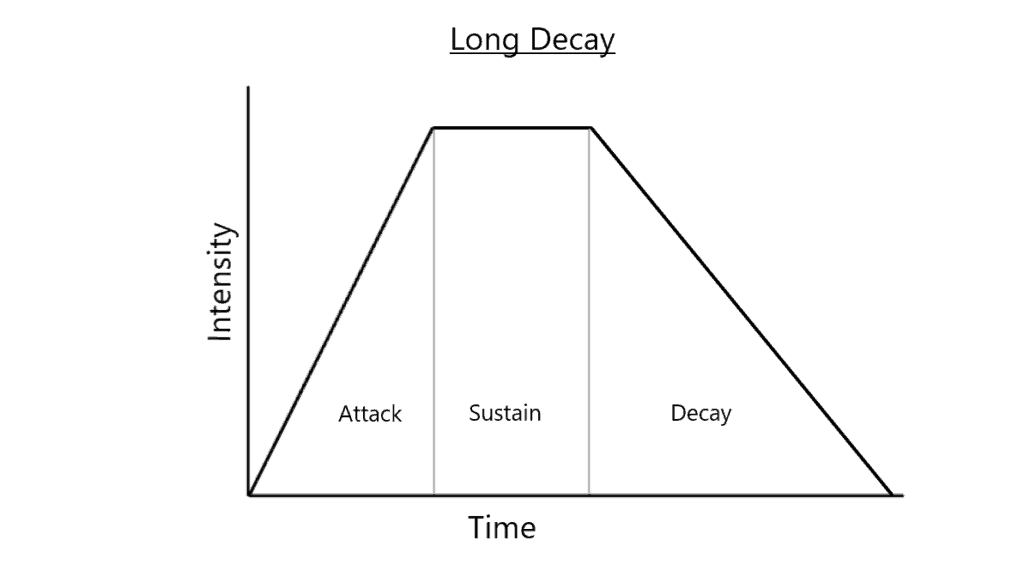
ASD-Long-Decay-16-9-1024x577.png

Above is a very simplistic diagram.
I don't understand why he uses the 4 sec vs. Db loss to measure the sustain.
Sustain is the period that the string will hold after reaching its optimum operating range until decay starts.
He just measures volume loss after 4 seconds.
 
ASD-Long-Decay-16-9-1024x577.png

Above is a very simplistic diagram.
I don't understand why he uses the 4 sec vs. Db loss to measure the sustain.
Sustain is the period that the string will hold after reaching its optimum operating range until decay starts.
He just measures volume loss after 4 seconds.

Which is of course nonsense. The sustain and decay are part of the same exponential loss curve which begins the instant the peak amplitude is reached as part of the pluck/pick or whatever the initial stimulus is. Energy in the vibrating string is absorbed by and dissipated through the immediate environment, which does not wait around for a while to start absorbing and dissipating.
 
  • Like
Reactions: Fynn

Latest posts