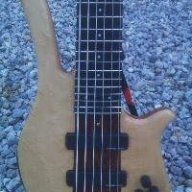
My 6 string I built has a graphite neck and will sustain any note pretty much forever. It's cool sometimes, but not for normal playing. So, I use a Fretwrap to tame the sustain. It works well and doesn't look strange.


TalkBass has been independent since 1998. Add your voice.
Create a free account to reply to discussions, view embedded media, and browse with fewer display ads.
Join free Log in
Want zero display ads or expanded classifieds tools? Compare plans.

This makes sense. I have a P with an aircraft carrier deck of a neck, and it has great sustain. It's a bolt on neck. My other bass guitars are either set neck or neck through and have about the same or a little less sustain. They have narrower necks.Sustain is over-rated,…until you need it. We had this conversation a couple of years ago, and I timed the note I needed for that weekend’s set at church. 14 seconds. In some genres, sustain is a very useful and necessary thing.
A string has two ends. it loses energy at both ends. The end with the massive hunk of metal bolted to a massive block of wood is not the end that needs improvement, The end where the string is anchored to a skinny piece of wood via a tiny strip of metal is where most of the energy is lost from the string vibration. I have a degree in Acoustical Physics, but to me it seems like this should be obvious to most people.
You want more sustain? Get a bass with a thicker neck. A P is better than a J. A 5’er with a nice thick neck; even better.

Palm muting while using a pick is one of the most injurious things you can do on a bass. I do it and my hand hurts badly within seconds. Not to mention that it doesn’t sound good to play finger style and palm mute if you don’t want to play right on the bridge. And I usually don’t.Sustain can be increased or decreased with your plucking technique. Hit a note and it sustains... lightly press your finger down on the string by the bridge and the sustain dies off. Or, hit a note and then as it sustains roll the volume knob down and the sustain dies off. No need to have special bridges or mutes or whatnot.

Ever listen to the end of Larks Tongues in Aspic? Prog needs sustain.On a bass, I really don't need it. I actually have foam under the bridge on most of my basses right now.
I absolutely love hearing a note die out semi slowly.
If you look at Mr Jamerson, you will see what I mean.
Secondly, I know that high mass bridges contribute to sustain, from experience, I know that they change the low end profile. My unscientific experience is, sub lows are enhanced a bit. To me, sub lows are good in recordings, but on a stage, they are just not good on a number of levels unless the sound system is perfect.
Even then, the kick drum needs its
Territory.
I am greatly interested in this subject and would love to hear your thoughts
J l mattox
Not everyone is playing prog.Ever listen to the end of Larks Tongues in Aspic? Prog needs sustain.


Not everyone is playing MotownNot everyone is playing prog.

Call me crazy, but I bet cover bands play Get Ready and I Can’t Help Myself a a lot more often than Larks Tongue In AspicNot everyone is playing Motown


On a bass, I really don't need it. I actually have foam under the bridge on most of my basses right now.
I absolutely love hearing a note die out semi slowly.
If you look at Mr Jamerson, you will see what I mean.
Secondly, I know that high mass bridges contribute to sustain, from experience, I know that they change the low end profile. My unscientific experience is, sub lows are enhanced a bit. To me, sub lows are good in recordings, but on a stage, they are just not good on a number of levels unless the sound system is perfect.
Even then, the kick drum needs its
Territory.
I am greatly interested in this subject and would love to hear your thoughts
J l mattox

You’re ‘crazy’.Call me crazy, but I bet cover bands play Get Ready and I Can’t Help Myself a a lot more often than Larks Tongue In Aspic


Huh, I play pick and palm mute all the time, never had any discomfort. It's one of my most-used sounds actually. This is on your typical FSO's, playing down by the bridge. I wonder why you get pain from it?Palm muting while using a pick is one of the most injurious things you can do on a bass. I do it and my hand hurts badly within seconds. Not to mention that it doesn’t sound good to play finger style and palm mute if you don’t want to play right on the bridge. And I usually don’t.
The angle my hand is at when I pick and palm mute + the strings being at their stiffest by the bridge = massive pain. Heck, just using a pick near the bridge is enough to make it happen. Carol Kaye considers it very detrimental. John Wetton had surgeries on his right hand because of it. Be glad you’re not one of us.Huh, I play pick and palm mute all the time, never had any discomfort. It's one of my most-used sounds actually. This is on your typical FSO's, playing down by the bridge. I wonder why you get pain from it?
Yes, the palm muting while using fingers and thumb really only works down by the bridge--can't "float" up closer towards the neck really and get any kind of serviceable sound or consistency.
Bummer. Yeah, I do the Carol approach when I want that sound, but that's not the most comfortable for me, that sort of "jazz guitarist" approach.The angle my hand is at when I pick and palm mute + the strings being at their stiffest by the bridge = massive pain. Heck, just using a pick near the bridge is enough to make it happen. Carol Kaye considers it very detrimental. John Wetton had surgeries on his right hand because of it. Be glad you’re not one of us.


So, I use a Fretwrap to tame the sustain. It works well
...
Wetton had surgery because of finger playing.The angle my hand is at when I pick and palm mute + the strings being at their stiffest by the bridge = massive pain. Heck, just using a pick near the bridge is enough to make it happen. Carol Kaye considers it very detrimental. John Wetton had surgeries on his right hand because of it. Be glad you’re not one of us.