• TalkBass has been independent since 1998. Add your voice.
    Create a free account to reply to discussions, view embedded media, and browse with fewer display ads.
    Join freeLog in
    Want zero display ads or expanded classifieds tools? Compare plans.

Is there a cure for weird B string overtones?

ric426

In my defense, I was left unsupervised.
Supporting Member
Mar 27, 2002
1,503
1,832
Southeast Michigan
I recently got a 5 string bass that I *really* like, but I'm having a hard time finding strings that don't give me weird overtones (wolf tones?) on the B string, especially if I go above the 7th fret. The higher I go the worse it gets. I've tried several different taper core and regular round wounds and they all seem to do it. The best B string results have been with D'Addario Half Rounds, but overall I prefer nickel round wounds on this bass, except for the B string.
Any suggestions? I've tried action and pickup height adjustments, both higher and lower than I'd normally have them, even a different set of pickups that I had, but so far, nothing has really helped.
Any suggestions?
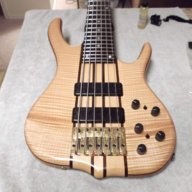
 
The low B string is so big that it doesn't want to produce high pitches, so at some point on the neck it will get a little wolfy unless you have a crazy 40" scale or something. Taper core strings can help, but they will never fully take care of the issue. Technique can play a big factor too. Play closer to the bridge and see if that helps. Also, some basses just have bad B string response. Sad, but true.
 
Well, no one said you can't mix the strings. You should't have any trouble with a half on the B but nicles on the rest.

Another thing to try is a smaller (gauge) B. Have you tried DR's that come with .125". It sounds like a strange idea, but a thicker string is just going to have more thud or thump along with more tesion, where a thinner string will have more natural overtones.

As long as the trouble isn't like a worble type sound, if it is it could be the B string is moving outside of (past) the magnetic field. That would be harder to fix(moving the PU over or replacment).
 
Are you sure that the intonation on the B is correct? I've had a couple of basses which did the same thing you describe, but after a few hours(!) messing about and getting the intonation PERFECT, they now sound like the other strings, within reason, that is. I found the B seems to be intonated correctly in several different places, which makes no sense at all, but after a few stabs in the dark I found the correct area, and worked from there. Does the note seem stable on a tuner? MIne used to move about, and I thought the tuner was at fault, but now it's intoneated correctly, the needle is stable, and I've lost those "wolf tones"
 
  • Like
Reactions: Snipehunter
It may be that the pickup is too close to the string and you get funny noise due to magnetic pull.
Also the more general set up may have something to do with it.
Try a thinner B string , it may be more articulate.
Also another brand or kind of string may do it...maybe
Touch does something as well.
 
LOTS of strings do that, unfortunately. What specific strings have you tried? There are only a few that really work past the 4th fret IME.

The best low Bs in the Biz are the labella hard rockin steels and slappers, sadowsky stainless (the nickels are quite good too, but one notch down IMO), and the last couple days I've been using a dean markley blue steel that is quite nice and has a raw aggressive sound. If none of those work, you've got a bunk bass. It sounds like you want a warm sound, so I'd recommend slappers (as odd as the name is). Nickel outer wrap on a stainless core, taper wound .128 B.
 
  • Like
Reactions: SteveFromBerlin
I don't think wolf tones are nearly as much a problem with solidbodies, but that is right, it is what happens when the body, or neck I suppose, of the instrument has a resonant freq. the same as the note being played, and the whole instrument reinforces that note and the sound leaps out or "barks".
This was why the scalloped bracing was originally done on guitars and other acoustic instruments. It was to tune the braces to notes other than the normal open strings, to avoid wolf tones. Now they just do it at random, to appear high-end, or to make the soundboard a little less stiff perhaps.
 
wolf tones are spots on the fret board where the wave of the note is close to the size of the instrument you're playing on. The sound wave and the wave produced by the vibration of the body hit each other and it causes loud note that sounds kinda airy because the instrument has trouble projecting it. I guess they thought it was animal like while naming it. I've heard about them on violin, cello and double bass a lot. Never on electric...
 
it's maybe for that reason I didn't know what it was. I use .125 DR Highbeam

Well, a .125 is about right for me, especially a DR Hi Beam with a taper core end.

I seem to like anywhere between .120 and .128, and I really have started to prefer the taper core ends which give the B a better tone and feel. Anything larger just seems to add too much tension and souds too woofy to me.
 
With those explanations of wolf tones, that's clearly not what I'm hearing. The notes on the B string are consistent in volume and sustain, it's just that the overtones seem a little dissonant or something. I know that the lower strings tend towards that on any bass the farther you go up the neck, I guess I just noticed it more on this one. It does seem to vary with different string sets so I've got a new set of Sadowsky light gauge (40-100 w/.125 taper core B) nickels coming. This bass seems to sound a little better with light gauge strings and most of the B strings I've tried have been .130 or .135.
FWIW, I tried a set of Slappers I had and the B string sounded great, but the E string had the funny overtones. I've got a bunch of different string sets, but they're all used to some degree, so I'm hoping a brand new set will help too.
The frets need to be dressed and recrowned and I'm having that done next week, so maybe that'll help too.
 
wolf tones? *** is that?

A wolf note is the opposite of a dead spot( more or less).
a note that is louder than the others and often out of focus.
Correct me if I'm wrong!
You are wrong
The fundamental does not ring true because the resonance of the bass is interfering with pitch. The result is wobbly pitch without a strong fundamental and unpleasant overtones... a wolf tone

You can reproduce this phenomenon a couple of ways besides bad resonant characteristic of give piece of lumber. Strong magnetic pull of pickup poll pieces too close to the string will cause a similar sound as will a defective string. If those things are not the cause of the issue, you have to get different wood.

Lighter gauge strings will reduce the severity of the wolf tone because the string vibrates with less amplitude thus bringing out less of the unwanted resonant characteristic of the bad lumber.

Personally, I would look for a different bass. This will be unpleasant and require compromises in your style an tone for as long as you own the bass.