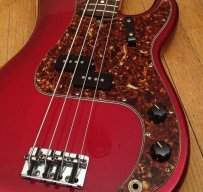
I was recording some different P-bass pickups to compare - and I noticed in my DAW that some of the split P-bass pickups were reverse phase compared to a different brand. They are in phase with themselves (both halves of the split are the same) - and it's a P-bass layout so no bridge pickup - nothing to be out of phase with - so no problem - but I was surprised when I noticed that between brands they were different.
I have several split P pickups on various basses ... Duncan, Yamaha, EMG all phased the same - Barden and MIM Fender were reverse from the Duncan, Yamaha, EMG.
If I were to add a bridge pickup, I would definitely make sure the two pickups were in phase with each other ... but isn't there an industry standard between brands for this? (or is this a ploy to get you to order P-J sets from one company so you know they will work?) The Barden is wired black to ground and white to hot per pdf on Barden's site - the Duncan is wired black to ground and white to hot per diagram on Duncan's site.
I mean if I play the same note, the same way on each of those basses and record it in my DAW, this is what I see between two different brand pickups. In this particular picture, the Barden on top and the Duncan on bottom:
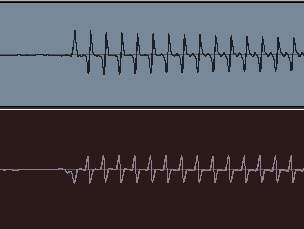
So far I've tested several stock Yamaha, one Duncan, one EMG (all the same polarity)
and one MIM Fender and one Barden (both opposite of the Yam/SD/EMG)
I have several split P pickups on various basses ... Duncan, Yamaha, EMG all phased the same - Barden and MIM Fender were reverse from the Duncan, Yamaha, EMG.
If I were to add a bridge pickup, I would definitely make sure the two pickups were in phase with each other ... but isn't there an industry standard between brands for this? (or is this a ploy to get you to order P-J sets from one company so you know they will work?) The Barden is wired black to ground and white to hot per pdf on Barden's site - the Duncan is wired black to ground and white to hot per diagram on Duncan's site.
I mean if I play the same note, the same way on each of those basses and record it in my DAW, this is what I see between two different brand pickups. In this particular picture, the Barden on top and the Duncan on bottom:
So far I've tested several stock Yamaha, one Duncan, one EMG (all the same polarity)
and one MIM Fender and one Barden (both opposite of the Yam/SD/EMG)