
Animals with better hearing...

Enjoy the benefits of a premium membership!
Upgrade Account
-
TalkBass has been independent since 1998. Add your voice.
Create a free account to reply to discussions, view embedded media, and browse with fewer display ads.
Join free Log in
Want zero display ads or expanded classifieds tools? Compare plans.
You are using an out of date browser. It may not display this or other websites correctly.
You should upgrade or use an alternative browser.
You should upgrade or use an alternative browser.
Is there really a benefit with "sting-thru" vs toploading?
- Thread starter vindibona1
- Start date
More options
Who Replied?
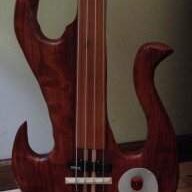
I have pretty much always kept my Gibson Ripper string-through. My impression is that the bridge (and the bushings it is bolted into) prefer to be compressed by the strings, rather than having to hold the full 200 pounds of string tension if I top loaded. I don’t really think I’ve detected a difference in sound, it’s more a matter of avoiding long-term stress on the bridge and bushings that are now over 40 years old and imposing it on the body of the instrument.
I have two much newer basses that are top-load only and they seem to holding up just fine.
One benefit of top load for long scale is a much wider range of string choices. The Ripper has a 34.5” scale which means that only “super long scale” strings have a fully wound section long enough for string through. That is a big limitation on string selection.
In the case of the Wishbass, it’s string through only, as it uses a solid Corian plastic bridge that is just held down by the compression of string force.
Otto
I have two much newer basses that are top-load only and they seem to holding up just fine.
One benefit of top load for long scale is a much wider range of string choices. The Ripper has a 34.5” scale which means that only “super long scale” strings have a fully wound section long enough for string through. That is a big limitation on string selection.
In the case of the Wishbass, it’s string through only, as it uses a solid Corian plastic bridge that is just held down by the compression of string force.
Otto
Last edited:

A lot of "innovations" are nothing more than marketing hype.
Each string has 2 witness points - one where it meets the nut and another where it meets the bridge saddle. The part of the string between the witness points is the "speaking part". The sound comes from what's in the speaking part: length, tension, and diameter of the string. Nothing to do with what's after the witness point if the bass is built correctly. Saying string thru sounds better than top-mounted is like saying that one type of tuning key sounds better than another.
The angle that the string comes off the witness point and the physical sharpness of the witness point can make a difference if they are done wrong; If the bridge saddle is too pointy, and/or the string's angle as it goes over the witness point is too sharp, it can lead to string breakage especially if you bend a lot or hit really hard. If the angle of the string as it comes off the witness point is too shallow, you can have sympathetic vibrations and rattles outside the witness point, or even reduced sustain in the speaking part of the string.
So, either top-loaded or string-thru are subject to the same issues of witness point angle. A well-built bass should sound the same whether top-load or string-thru.
Remember, if someone shows you a difference, and explains what the difference is supposed to sound like, your human brain's default is to believe it can hear the difference that's been suggested. If you really want to know whether they sound different, listen to some unlabeled samples and see if you can tell which is which, or even whether you can separate them into groups successfully.
Each string has 2 witness points - one where it meets the nut and another where it meets the bridge saddle. The part of the string between the witness points is the "speaking part". The sound comes from what's in the speaking part: length, tension, and diameter of the string. Nothing to do with what's after the witness point if the bass is built correctly. Saying string thru sounds better than top-mounted is like saying that one type of tuning key sounds better than another.
The angle that the string comes off the witness point and the physical sharpness of the witness point can make a difference if they are done wrong; If the bridge saddle is too pointy, and/or the string's angle as it goes over the witness point is too sharp, it can lead to string breakage especially if you bend a lot or hit really hard. If the angle of the string as it comes off the witness point is too shallow, you can have sympathetic vibrations and rattles outside the witness point, or even reduced sustain in the speaking part of the string.
So, either top-loaded or string-thru are subject to the same issues of witness point angle. A well-built bass should sound the same whether top-load or string-thru.
Remember, if someone shows you a difference, and explains what the difference is supposed to sound like, your human brain's default is to believe it can hear the difference that's been suggested. If you really want to know whether they sound different, listen to some unlabeled samples and see if you can tell which is which, or even whether you can separate them into groups successfully.
Last edited:
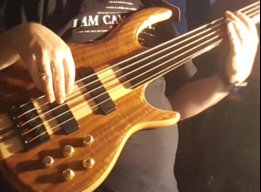
it's a gibson ripper, so yes:I have pretty much always kept my Gibson Ripper string-through. My impression is that the bridge (and the bushings it is bolted into) prefer to be compressed by the strings, rather than having to hold the full 200 pounds of string tension if I top loaded. I don’t really think I’ve detected a difference in sound, it’s more a matter of avoiding long-term stress on the bridge and bushings that are now over 40 years old and imposing it on the body of the instrument.
In the case of the Wishbass, it’s string through only, as it uses a solid Corian plastic bridge that is just held down by the compression of string force.
Otto
- GREAT bass ( I love the tone and build quality of a vintage ripper )
- Gibson bridge design.... for better and for worse.... so yea, I agree with you, let it live as long as it can, because ya just never know if it will hold up if you don't do string through.
I was actually thinking of a ripper when I did my post above... thinking, well, if I owned a ripper (I don't, but my old friend has had one since the early 80s), I would string it through because it clearly is designed to be done like that.
And Gibsons are weird - so why not go along with their unique designs by stringing them uniquely

I've always loved the various two pickup tone combinations from that switch... one of my true fav bass tones (hello vintage kiss tone!)

String-Through makes it a lot harder to find strings. I sold my older Mustangs because they require Medium Scale strings to fit, and there are dang few of those. So happy that the new Mustang P/J is top loading.



If there is an advantage, it's totally subjective and it's up to you to decide.
I tried once with the same brand and gauge of strings, but of different length. I had no preconceived idea, I was just curious to know.
I didn't notice any difference in the sound. I noticed a very slight increase in sustain, but since I don't play Gary Moore solos and do not need 3-minute notes, it doesn't matter at all. A compressor does it better, anyway, if you want to go that route.
On the other hand, I felt a noticeable increase in the stiffness of the strings, which I didn't like. So, because of this and the fact that it's a pain to change the strings, I went back to top-load, and I have no problem with the ferrules falling from the body because my bass is well built.
Idea: Make a poll to find out how many of those who have one, actually use it.
I tried once with the same brand and gauge of strings, but of different length. I had no preconceived idea, I was just curious to know.
I didn't notice any difference in the sound. I noticed a very slight increase in sustain, but since I don't play Gary Moore solos and do not need 3-minute notes, it doesn't matter at all. A compressor does it better, anyway, if you want to go that route.
On the other hand, I felt a noticeable increase in the stiffness of the strings, which I didn't like. So, because of this and the fact that it's a pain to change the strings, I went back to top-load, and I have no problem with the ferrules falling from the body because my bass is well built.
Idea: Make a poll to find out how many of those who have one, actually use it.

Only thing I can think of:
All else being equal, a longer total string length will have to have a higher tension to achieve the same pitch as a shorter string length, so it might be a way to use lighter gauge strings for downtuning.
My LTD B-204’s were topload AND string-thru. I experimented with both. Couldn’t discern a tonal difference, and the only practical difference I noted with string-thru was that it made changing strings a longer process. So I always toploaded.
The working length of the string doesnt change, therefore it wont be any tighter. Pure physics.

Is there really a benefit for this string-loading method?
No idea for flats! I play rounds.
The difference is that you don' t have to cut your new strings on some basses
and you have the silk on the nut on others.
Darn long scale basses they never have the same scale length (sarcastic
 )
)String through is therefore better for metal.

I’ll see myself out...
Why? You just sold me a string through!

greetings
Wise(b)ass

I can think of another advantage to top-loading, as opposed to stringing through the body. Top-loading enables you to take strings off without damaging them by having to unwind the wrap at the tuner, and you can use the alcohol soak tube trick to get several passes out of a set.

Interesting... I, too, have a B-204 and I find string-thru actually speeds up my string change time because I don't have to keep tabs on the bridge to see if they have slipped out of the saddle...Only thing I can think of:
All else being equal, a longer total string length will have to have a higher tension to achieve the same pitch as a shorter string length, so it might be a way to use lighter gauge strings for downtuning.
My LTD B-204’s were topload AND string-thru. I experimented with both. Couldn’t discern a tonal difference, and the only practical difference I noted with string-thru was that it made changing strings a longer process. So I always toploaded.

It can make a HUGE difference, just not in tone. String thru is superior in 2 ways: you can remove 1 or 2 of the screws that hold the bridge in place. This would reduce the weight of your bass by at LEAST 1/10 of a gram. Those TBers that complain about their heavy 12lb amp would appreciate this. Also, it all but negates the possibility of your bridge flying off of your bass, into the audience, and wounding or killing someone. Bass guitar related deaths were at an all time high last year at 1. Safety first !

The theory is that thru body gives more piano like sustain
another theory is that string thru makes the strings break more often
I have owned close to 100 basses and I have never owned a string thru bass … so I am not a fan of string thru
LaBella actually warns you NOT to use any of their flatwound strings except for their "760FS-TB Thru-Body" strings on a through-body bridge set-up. They caution you that all their other flatwounds will break if you try to string them on your bass that way. They also say that their "Thru-Body" strings "are not suitable for top-loading bridges". So evidently there's quite a bit of difference in the stress put on the string with the thru-body bridges. I have top-loading bridge on my Jazz and a through-body bridge on my 5-string. My Jazz has tapewound flats on it and my 5-string has roundwounds on it.

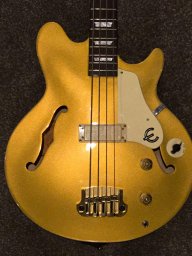
It probably takes a couple minutes longer to drill those holes during the build. Time is money. I’m surprised they still do it.
I have a MIM Tele (guitar) that is string-thru. I recently saw at GC a Squier Indonesian Tele that also had string-thru. The fit and finish was pretty darned good, IMHO.
I have a MIM Tele (guitar) that is string-thru. I recently saw at GC a Squier Indonesian Tele that also had string-thru. The fit and finish was pretty darned good, IMHO.
I figured how the strings are anchored would mostly affect sustain, and maybe to a smaller extent, tone, same as anything else that affects how the string vibration dissipates after it is plucked, such as body and neck material/density. The little sheet-metal bend in the bridge the top-loaded strings contact must vibrate and takes energy from the string, reducing the sustain. I think that's the theory anyway. The natural resonance of that small, short, stiff piece of bent metal is probably very high (kHz), has very little vibration amplitude and so probably pulls very little energy out of the string vibration.

also harder to simply change strings. Once I got a bass with a slotted bridge, anything else annoys me.String-Through makes it a lot harder to find strings.

With lower tension strings, the extra down force on the saddle prevents rattling.
Also if it is a string thru bass, it holds the ferrules in place so they dont fall out.
Some will says adds sustain, if it did we would be talking a minimal amount. Minimal....
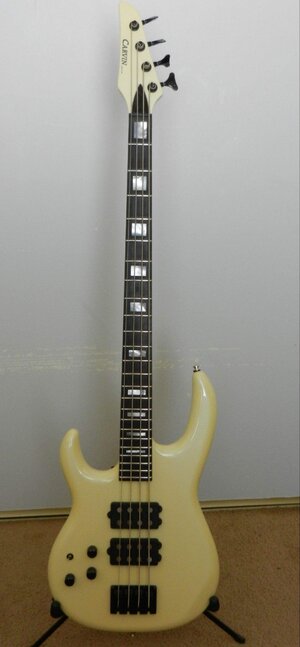 ^This^ Pretty much says everything that needs to be said. Except for... I suppose it could help keep a floating bridge from sliding around/falling off - assuming there is a string-thru bass with a floating bridge. As for sustain/tone? I tried stringing my Carin LB-20 that way - once. It made no difference in the tone/sustain that I could discern (this bass, for a neck-thru, has surprisingly little sustain, anyway). Stringing it thru-body was a PITA, though... So, no benefit for me at all...

also harder to simply change strings. Once I got a bass with a slotted bridge, anything else annoys me.
A pair of dykes makes it much faster!

