• TalkBass has been independent since 1998. Add your voice.
    Create a free account to reply to discussions, view embedded media, and browse with fewer display ads.
    Join freeLog in
    Want zero display ads or expanded classifieds tools? Compare plans.

Is there really a benefit with "sting-thru" vs toploading?

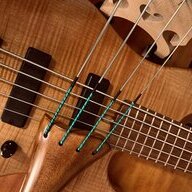
Most of my basses have a string through hole and ferrule option - on the E string (the B string for a 5'er). With a Fender in line style headstock, it's not very far from the nut to the closest string tuner. With strings having more winding length to accommodate 35 inch basses, and a Fender style headstock, you'll often end up with the fat part of your fattest string wound around the tuner if you go top load, which isn't how it's supposed to work.

So, I often (when the fat part of the string winding would go around the tuner otherwise) string the fattest string through the body, which neatly avoids that issue. The other strings? - top load.
 
the bending of the string adds tension. The tension encourages fast attack, allowing faster playing. Faster playing means better for metal. String through is therefore better for metal.
I’ll see myself out...

You don't have to leave, but I will let you know your assumption (bending the string adds tension) is without any scientific basis.
 
I currently only have basses that allow string through. I do not use it.

I have used it in the past, but I see and hear zero benefit. Other than holding the ferrules in, which wouldn't be a problem if these basses didn't allow string through.
I glued my ferrules in with a little Elmer's glue. Never came loose in 6 years, but will easily pull out if needed.
 
I have both string-through and top loaded basses. I don't hear a difference between the two types or even on the same bass when I have tried switching up during string changes. I prefer string-through for the basses that have it, though, just because it's there, I guess.
 
  • Like
Reactions: alpan254
I have a 5 string P-bass. Stringing the B string through and the other strings top seemed to make the B sound a little tiny bit more like the other strings...it also feels a teeny tiny bit tighter and I convinced myself that this was due to the fact that the sharp break angle over the saddle kept the string from moving longitudinally when I plucked the string. Could it all be in my heads....yes.....does it look cool strung through the body....indeed.

Changing to a different brand of strings makes 10 times more difference.....but its fun to play around with. I also added one of those B string retainers that attached to the top of the B-string tuner....it makes about the same amount of difference....but it looks like I'm really dialed into the subtitles of my set up....or maybe I just spent too much time on talkbass.
 
  • Like
Reactions: iosuono and timplog
string through is a noisy grindy pain in the butt to restring, imho, from experience.

physics-wise, there is no difference in the tone/playability/tension/stiffness/sustain.

stability wise, if your bridge is flawed to the point where stringing it the normal (not string-through) way allows the bridge saddles to move in any way or to not fully contact solidly against the bridge plate, then the pull down strength of string-through could, potentially, work to fix those flaws. But those flaws should never exist.

setup-wise, string through might put a somewhat sharper bend of the string across the bridge saddles.... not like 90 degrees (assuming the through holes aren't magically somehow perfectly lined up with the back edge of the saddles after setting intonation), but it can be a sharper angle than with traditional designs. With thick/stiff strings, I could see that it could potentially allow the vibrating end of the string to have it's tension fight to straighten it against the curve from the extra angle over the saddle. I doubt it's enough of a problem to cause audible issues, but it is something that would concern me a little bit.

I have done both. I rapidly chose to NOT use string through options when available, due to the laws of physics disproving the claimed audible benefits, and the annoying side effects of this design. The ONLY time I have used it intentionally is when the string design required it, because the string was mismatched to the design of the bass (long wrapping or something else that's ludicrous and would otherwise end up in the vibrating/playing area of the bass).
 
  • Like
Reactions: Rodger Bryan
Try doing both at the same time. I once top loaded (bridge thru) the E & A and then went through the body for the D & G. I could tell no difference in; volume, tone, or sustain. On the next string change, I top loaded the E & D and went through the body for the A & G. Once again no differences were noted. I have since simply gone top load/bridge thru only as I dislike the sharp breakover angle of body through stringing.
 
  • Like
Reactions: Rodger Bryan
On another thread there is a discussion regarding Ernie Ball Cobalt Flats and "string-thru" basses. Is there really a benefit for this string-loading method?

I ask this [relative to bass] as I had an experience just a few years ago with a Telecaster. I had purchased a '96 MIM Telecaster toploader and at first contemplated converting it to a string-thru. But as I was cruising the local GC I came across a MIA Tele (string-thru, of course) and actually got a very friendly quote from the store manager. I thought I'd bring my MIM to trade it in and come home with the new MIA Tele. When I played them side by side my MIM was as good or better than the MIA in sound (I suppose you could then call the MIA... KIA :0 happy Halloween). It appears that the string-thru method did little or anything to improve the sound or sustain.

Perhaps I'm missing something as all of my basses are top-loaders so I really don't have any basis of comparison. So again- is there really an actual benefit to string-thru loading?

I've tried and I can't say there's any significant difference.
 
  • Like
Reactions: alpan254