• TalkBass has been independent since 1998. Add your voice.
    Create a free account to reply to discussions, view embedded media, and browse with fewer display ads.
    Join freeLog in
    Want zero display ads or expanded classifieds tools? Compare plans.

Is there something wrong with my bass wiring?

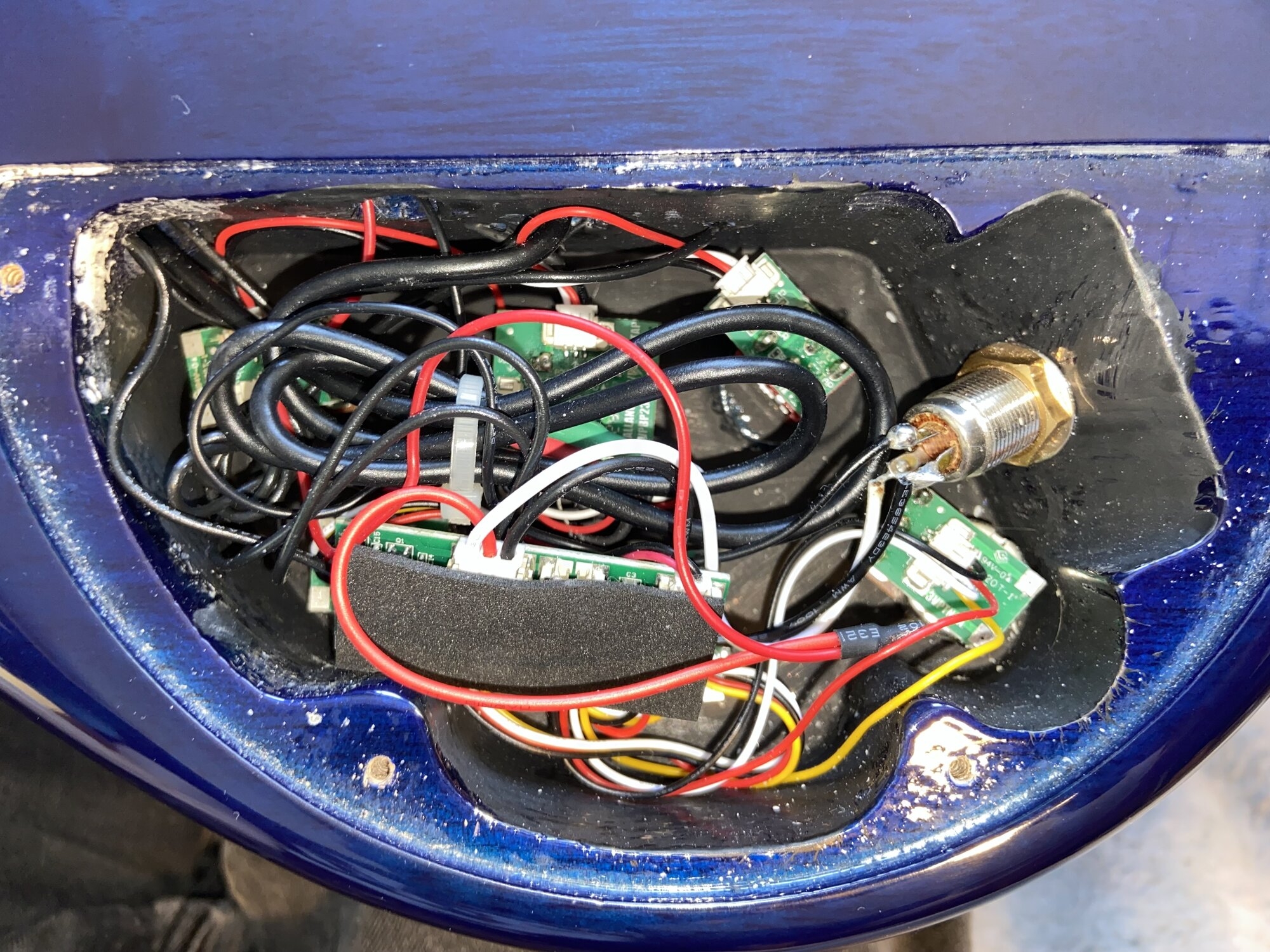
Recently I've noticed a buzz when my bass is plugged in. It is constant whether or not I'm touching the strings and I've figured out that it's not an issue from the amp or battery. It's an Ibanez SR405. My preferred tone is when the switch is in "power tap" (facing away from me) with the balance knob all the way up, but the only time the buzz goes away is when the knob set to half. I feel like at this point the only possible issue is with the wiring, which I have no experience in, but am willing to try to fix myself if you guys have any ideas.

tempImageuunxld.jpg
 
Every time I see wiring like this I get angry. Why is there so much wire in there? Not only is it totally unnecessary, it adds to the possibility of noise being picked up - it's a nest of antenna. The wires should be cut to a length that reaches where it needs to go with perhaps a but extra, but having bundles of wire all wrapped around itself makes no sense. This mess could easily be adding to the noise in this bass.
 
  • Like
Reactions: fig and Geri O
The "Power Tap" mode sends the higher frequencies through single-coil mode, so the hum/noise is 100% normal if you are only using one pickup. (Single-coil pickups cancel out their noise with each other if they are both equally on.)
It doesn't feel normal since the bass was silent up until like a month ago. I believe both are on when the balance knob is at 100%, which is my preferred tone. But I took it into a shop recently to hopefully get repaired. The guy said when he plugged it in it was completely silent until he came into the proximity of fluorescent bulbs. So it might be an EMI issue, which would make sense since I'm living in a pretty old house and maybe the electricity isn't so great anymore.
 
  • Like
Reactions: 31HZ
Every time I see wiring like this I get angry. Why is there so much wire in there? Not only is it totally unnecessary, it adds to the possibility of noise being picked up - it's a nest of antenna. The wires should be cut to a length that reaches where it needs to go with perhaps a but extra, but having bundles of wire all wrapped around itself makes no sense. This mess could easily be adding to the noise in this bass.
This is the way it came. Do you have a photo of what clean wiring should look like? I'd be willing to give it a go. I also recently took it into a shop and the technician concluded that it's probably a proximity EMI issue, so I'm thinking about shielding it to hopefully help.
 
This is the way it came. Do you have a photo of what clean wiring should look like? I'd be willing to give it a go. I also recently took it into a shop and the technician concluded that it's probably a proximity EMI issue, so I'm thinking about shielding it to hopefully help.
Looks like it is already shielded - that black paint is probably shielding paint.

Here's an example of good wiring:

1759694908082.png
 
Oh...well in that case I'm all out of ideas for eliminating the buzz😭
That looks very nice. I'll try to recreate that and hopefully not mess up anything...
Reducing the amount of wire in the cavity, adding more shielding and ensuring that the cover plate has shielding as well will give you the best chance of reducing the noise.
 
  • Like
Reactions: goaskalice
Wow... throw a can of sauce on that pile of spaghetti...

First off, I've have looked inside of alot of pretty well-known cavities and the use of circuit boards. Those tiny little circuit boards are a problem. They're cheap. They're prone to failure. It's just garbage -- compared to quality parts, i.e. quality pots, quality switches and a nice clean line of wiring and good soldering of course. Circuit board JUNK is really GARBAGE, and I have gutted more than a few guitars & basses - cleaned out the spaghetti and put in caps, pots and switches.

I might be so bold as to recommend CTS pots with solid shafts and switchcrafter jacks and switches and a good quality gauge of wire quality caps, and a good solid ground... Properly shield the cavity while you're at it. I construct a basic Faraday cage using copper foil and ensure it is all a well grounded "closed" circuit.

Overkill? Whatever... I've silenced wide open strats with that overkill.

My 2cents & much aloha!
 
  • Like
Reactions: goaskalice
Wow... throw a can of sauce on that pile of spaghetti...

First off, I've have looked inside of alot of pretty well-known cavities and the use of circuit boards. Those tiny little circuit boards are a problem. They're cheap. They're prone to failure. It's just garbage -- compared to quality parts, i.e. quality pots, quality switches and a nice clean line of wiring and good soldering of course. Circuit board JUNK is really GARBAGE, and I have gutted more than a few guitars & basses - cleaned out the spaghetti and put in caps, pots and switches.

I might be so bold as to recommend CTS pots with solid shafts and switchcrafter jacks and switches and a good quality gauge of wire quality caps, and a good solid ground... Properly shield the cavity while you're at it. I construct a basic Faraday cage using copper foil and ensure it is all a well grounded "closed" circuit.

Overkill? Whatever... I've silenced wide open strats with that overkill.

My 2cents & much aloha!
Thanks for the advice! I haven't gone into a lot of the technical/electronics side of bass so I'm not sure how I would go about that exactly with the pots and circuit board. I don't even know what solid shafts and switchcracker jacks are 🤣 . Is there a good video tutorial I should watch?
 
OP, having owned that exact model, I'll share some insights:
Like already mentioned above, that switch changes internally how each pickup works (both at the same time). You have single coil, series/humbucker, and PowerTap mode. PowerTap combines series output of a pickup (below certain x-over frequency) with single coil output (above that frequency). IMO great and very useful innovation with one caveat: since most of typical single coil hum is in high frequencies, you get most of it in PowerTap mode.
It's easy to check this yourself: If you switch back and forth from single coil to PowerTap mode, you will hear the same noise (but a little bit less with PowerTap). When pickup balance pot is in the middle, it should completely go away. If that is true, there is nothing to fix, it's the nature of this design. If I remember well, it's already well shielded.
As for your question, why you haven't noticed it earlier and now it's more noticeable, you can search this forum for "single coil noise" and read more about it, but in short: single coils do not produce that hum by themselves but are very susceptible to it. Example of source are EMI, poor grounding, ground loops, proximity to high voltage lines and so on. At my working desk, I get significant single coil noise that I can reduce if I just rotate my chair 90 degrees to my left. At one of the clubs where my band is resident, they added LED lighting around the stage last year, since then both guitar and my bass are noisy.
One more thing, again matter of opinion: I see no reason to criticize wiring of a well-made medium tier bass guitar of reputable brand, just because it "looks messy". The process of production is complex and some excess of wire (which btw doesn't interfere with any function) was surely intentional.
In short, OP you have nice bass guitar, and unless it deviates from normal functioning (like I described above) there is nothing wrong with it. Play it and enjoy it.
 
Thanks for the advice! I haven't gone into a lot of the technical/electronics side of bass so I'm not sure how I would go about that exactly with the pots and circuit board. I don't even know what solid shafts and switchcracker jacks are 🤣 . Is there a good video tutorial I should watch?

Stewmac or Elerwine or search wiring up a guitar or bass. I was an electrical worker so I had a leg up. Stewmac also has tutorial guides.

I just did a YouTube search "wiring guitar pots and jacks" watch a few but I still recommend a book. Do you know any Ham Radio operators? That group is up to date on the practical side of wiring up stuff, or know somebody who is.
 
Last edited: