Now that the heavyweights have posted in this thread, I need to up my game! 
At the end of the day, all circuits are analog.
"Digital" is just a simplification that treats an analog signal as being rounded up to 1 or down to 0
Digital engineers found this out in the early 1990s, once microprocessors got fast.
In the 1980s, with CPUs running at 1-2 MHz, all anyone had to worry about was logic and timing diagrams.
But as speeds crept higher and higher, to 10-20 MHz and beyond, analog behaviors started to spoil the party, and analog issues like PCB trace length and line termination became important.
There was very much a generation gap between the old-school digital engineers ("What do you mean, the data bus traces all have to be the same length and within 10cm of the CPU?"), and the newer engineers who went to school recently enough to learn about these issues and design with them in mind.
All that said, micguy's explanation of Class D is correct.
Here's a graph, to help visualize.
Blue is the input signal.
Black is a very high-frequency triangle wave (1MHz or greater) generated by the amplifier.
Orange is the output.
Instead of trying to amplify the input signal proportionally, as in a Class A/B/AB amplifier, the Class D amplifier simply compares the input signal with the very high frequency triangle wave it generates.
If the blue input signal is HIGHER than the triangle wave, the output switches on. If the blue input signal is LOWER, the output switches off.
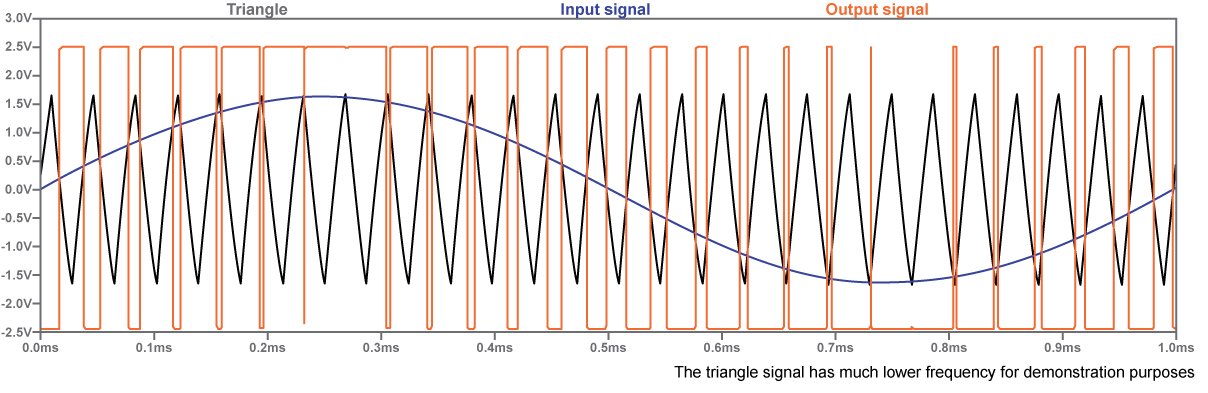
Then, the orange wave goes through a low-pass filter that strips out all the high-frequency components of the resulting pulse wave at the output...
...which leaves us with something that looks nearly exactly like the input signal, but at much higher power.
Why do things this way?
(caution to @agedhorse : layman's simplification incoming! Don't worry, I post a real reference at the end.)
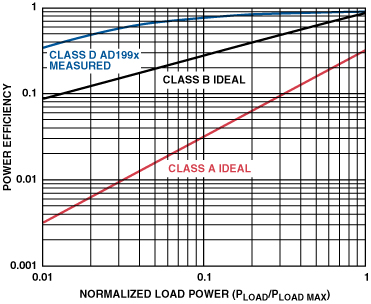
It turns out that running a transistor flat out is far more efficient than running it in the middle of its range. A Class D output stage is always being run flat out: it's either on or off, no matter how quiet or loud the signal being amplified.
This advantage grows even larger when the amp isn't run flat out, as you can see from the efficiency graph below. (Note logarithmic scale...and remember, an ideal class D amplifier is nearly 100% efficient at all volumes, and real-world Class AB amplifiers are less efficient than the ideal. This graph compares ideal Class B to real-world class D.)
Why is efficiency important?
Well, what happens to power that isn't used to move the speaker cone?
It turns into heat...which requires big, heavy heatsinks and fans to dissipate so it doesn't burn up the output transistors.
This is why Class D amplifiers can be so much smaller and lighter than the older generation of Class AB amplifiers: being substantially more efficient, they don't have to dump nearly as much waste heat.
For the technically inclined, here's the real, non-simplified explanation: "This [switching] waveform is benign for power dissipation, because the output transistors have zero current when not switching, and have low VDS when they are conducting current, thus giving smaller IDS × VDS."
Link: Link Removed
Bonus observations!
1. The theoretically inclined might notice that a switching power supply can be thought of as a Class D amplifier whose job is to "amplify" a constant voltage in the face of varying load, rather than amplifying a varying input signal.
2. Vacuum tubes are much larger than transistors, and have many times the surface area: thus, they are able to act as their own heatsink. But, as we all know, it's still quite possible to burn them up!
PS: Class-D is analog, there is no amplifier that is not analog.
At the end of the day, all circuits are analog.
"Digital" is just a simplification that treats an analog signal as being rounded up to 1 or down to 0
Digital engineers found this out in the early 1990s, once microprocessors got fast.
In the 1980s, with CPUs running at 1-2 MHz, all anyone had to worry about was logic and timing diagrams.
But as speeds crept higher and higher, to 10-20 MHz and beyond, analog behaviors started to spoil the party, and analog issues like PCB trace length and line termination became important.
There was very much a generation gap between the old-school digital engineers ("What do you mean, the data bus traces all have to be the same length and within 10cm of the CPU?"), and the newer engineers who went to school recently enough to learn about these issues and design with them in mind.
All that said, micguy's explanation of Class D is correct.
Here's a graph, to help visualize.
Blue is the input signal.
Black is a very high-frequency triangle wave (1MHz or greater) generated by the amplifier.
Orange is the output.
Instead of trying to amplify the input signal proportionally, as in a Class A/B/AB amplifier, the Class D amplifier simply compares the input signal with the very high frequency triangle wave it generates.
If the blue input signal is HIGHER than the triangle wave, the output switches on. If the blue input signal is LOWER, the output switches off.
Then, the orange wave goes through a low-pass filter that strips out all the high-frequency components of the resulting pulse wave at the output...
...which leaves us with something that looks nearly exactly like the input signal, but at much higher power.
Why do things this way?
(caution to @agedhorse : layman's simplification incoming! Don't worry, I post a real reference at the end.)
It turns out that running a transistor flat out is far more efficient than running it in the middle of its range. A Class D output stage is always being run flat out: it's either on or off, no matter how quiet or loud the signal being amplified.
This advantage grows even larger when the amp isn't run flat out, as you can see from the efficiency graph below. (Note logarithmic scale...and remember, an ideal class D amplifier is nearly 100% efficient at all volumes, and real-world Class AB amplifiers are less efficient than the ideal. This graph compares ideal Class B to real-world class D.)
Why is efficiency important?
Well, what happens to power that isn't used to move the speaker cone?
It turns into heat...which requires big, heavy heatsinks and fans to dissipate so it doesn't burn up the output transistors.
This is why Class D amplifiers can be so much smaller and lighter than the older generation of Class AB amplifiers: being substantially more efficient, they don't have to dump nearly as much waste heat.
For the technically inclined, here's the real, non-simplified explanation: "This [switching] waveform is benign for power dissipation, because the output transistors have zero current when not switching, and have low VDS when they are conducting current, thus giving smaller IDS × VDS."
Link: Link Removed
Bonus observations!
1. The theoretically inclined might notice that a switching power supply can be thought of as a Class D amplifier whose job is to "amplify" a constant voltage in the face of varying load, rather than amplifying a varying input signal.
2. Vacuum tubes are much larger than transistors, and have many times the surface area: thus, they are able to act as their own heatsink. But, as we all know, it's still quite possible to burn them up!
Last edited: