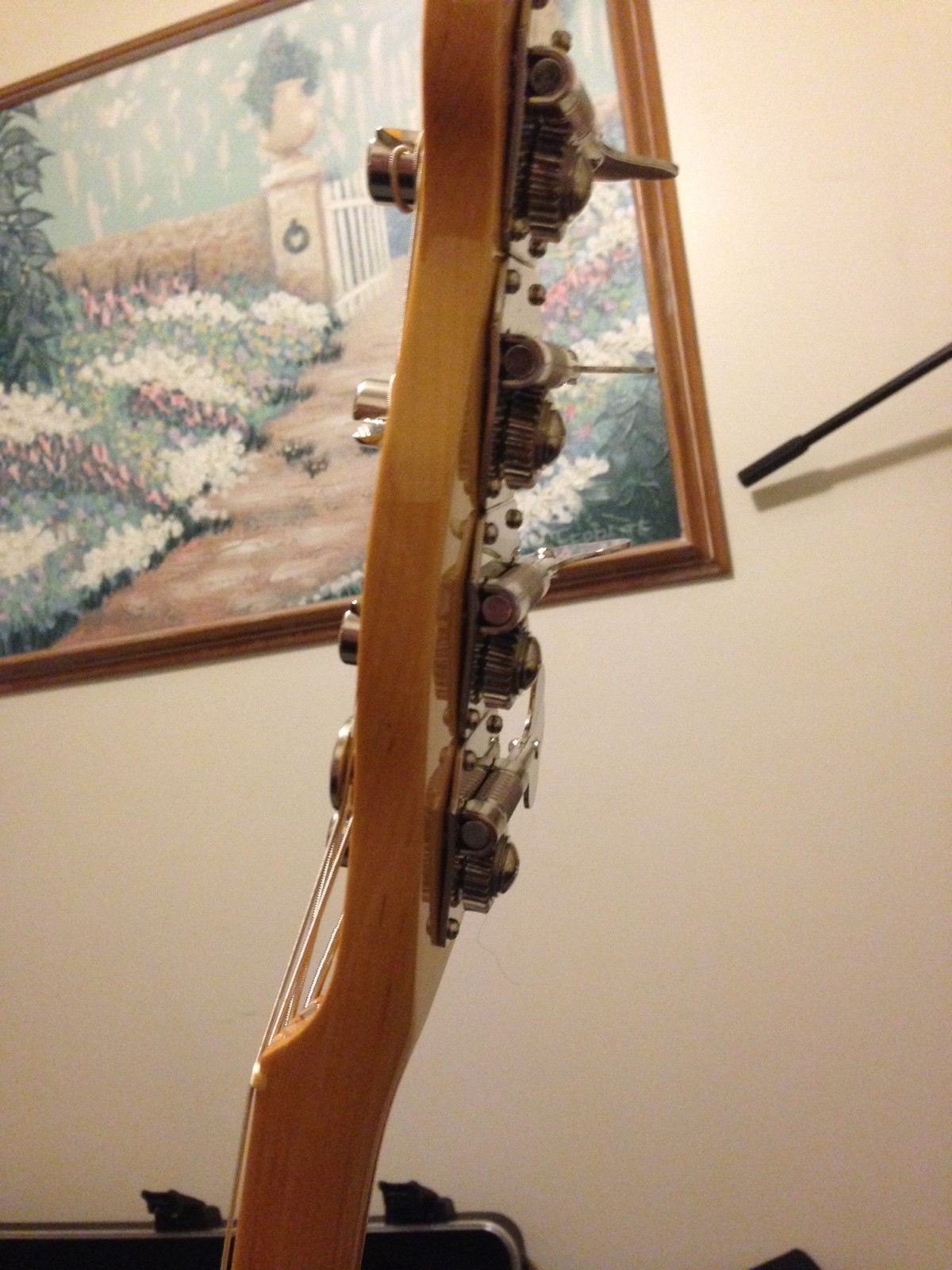
Here's what I see;
There are two straps that wrap around the tuning key shaft. These straps hold the shaft and tuning shaft gear in place against the string post gear. The ends of those straps slip through a couple slots in the tuner mounting plate and are bent over flat (as possible) to hold the straps in place. Even though they are bent flat against the back of the tuner mounting plate, they still have some thickness.
All Fender stuff I've see dating back to the late 70's have a couple small "divots" or "cups" in the back of the headstock to allow clearance for these "tabs" so the tuner mounting plates lay nice and flat against the back of the headstock. The divots appear to be made by a large drill bit that is just touched to the back of the headstock to make a 1/16" deep or so cupped area for the tabs.
Now, it appears your tuners are being held away from laying nice and flat against the back of the headstock because there are no "divots" or "cups" on the back of your headstock to allow the extra clearance for the tabs.
Here's the question; did 50's Fender basses have the divots / cups in the back of the headstock to allow for the tabs sticking through the tuner mounting plate? Since you have received two basses with this same "problem", is it an inherent design of 50's Fender basses that Fender is sticking with to keep Sting basses as close to authentic as possible?
I'd ask Fender or ask someone else with a Sting bass to see if they are ALL made like this to duplicate the original. There are other characteristics Fender has duplicated on reissue instruments in order to to remain as authentic as possible to the original, such as the exposed ground strap on early Jazz basses. The problem might be just like all mid 50's P-Basses and not a problem at all.