• TalkBass has been independent since 1998. Add your voice.
    Create a free account to reply to discussions, view embedded media, and browse with fewer display ads.
    Join freeLog in
    Want zero display ads or expanded classifieds tools? Compare plans.

Is this technically still pre-CBS?

I think blocks and binding came about in the 67-68 timeframe.
CBS wanted to put their own stamp on them with something new.
The Loilipop tuners were another change that made Fender more CBS,
but they came about more as a way to try to save production costs
by making them in house.

NOPE! The 1966 Fender Jazz Bass was the first one to use blocks instead of dots and had white binding on the neck. I know because I had just purchased a used 1965 Fender Jazz in 1966 and then I saw the '66 hanging on the wall at the local music store. Luckily I had just purchased a '66 Fender Bassman amp at that same store, so they were happy to pull it down for me (16-yrs. old at the time) As soon as I put my hands on it I thought, "OMG, what have they done?"

The neck was very fat and more of a U shaped neck than the slim, fast, C-sort of profile on my '65. The only thing I could figure out was that they used cheaper wood for the neck and needed to make it thicker to stay straight. Was very bummed because the cosmetics were very attractive but the neck was like trying to play on a tree trunk. I was so glad that I had bought my Fender Jazz before CBS ruined the necks on them. I would buy another 1965 Jazz Bass in a second if I had the opportunity (and the $$) but have no interest whatsoever in a 1966.

Interestingly, they didn't really put binding on the necks again until 1982. My current Jazz has white binding on the neck but the same feel to the neck that my '65 had. As best as I can figure out my white Jazz Bass was made in either late '82 or early '83.
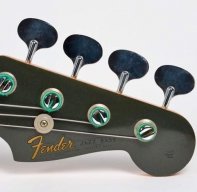
 
‘65 is still considered pre-CBS to the vast majority of people/collectors our there, as long as it still has an “L” serial number (especially P Basses), and none of the other CBS changes... lollipop tuners, binding, blocks. Clay dots changed to pearl in mid ‘64, so there are still a good number of bonafide pre-CBS ‘64s and ‘65s out there with pearl dots (although ‘64 and early ‘65 basses that still have clay dots do sell for a bit more IME).
 
Go with the neck date. The mounting plate serial numbers are not accurate at all. Plus, the plate serials were used on Strats, Teles, Js Ps, Mustangs......ahh, actually the full Fender line.

Fender was also bad for purging old inventory from time to time. There are examples of 1967 P Basses with 1962 pickups. The bass tuners are a mess too. With Klusons, Fender in house and lollipop tuners all being used from 1966 to 1968. Pre-CBS pickguards were used on CBS era basses. Fender bought a pile of 1966 pot there were used for the next 3 years.

Serial stamped slab body bridges (1951 to early 1954) are found on up to 1955 P Basses. The number sequences mean nothing. A 1951 might say 0253 and a 1952 might say 0033.
 
Go with the neck date. The mounting plate serial numbers are not accurate at all. Plus, the plate serials were used on Strats, Teles, Js Ps, Mustangs......ahh, actually the full Fender line.

Fender was also bad for purging old inventory from time to time. There are examples of 1967 P Basses with 1962 pickups. The bass tuners are a mess too. With Klusons, Fender in house and lollipop tuners all being used from 1966 to 1968. Pre-CBS pickguards were used on CBS era basses. Fender bought a pile of 1966 pot there were used for the next 3 years.

Serial stamped slab body bridges (1951 to early 1954) are found on up to 1955 P Basses. The number sequences mean nothing. A 1951 might say 0253 and a 1952 might say 0033.

You need always need go with the sum of ALL the dated parts to determine the year of a vintage guitar. You can’t just go with the neck date because if a bass has a ‘64 neck date, but ‘65 pot codes (and original solder joints), then the bass couldn’t have left the factory earlier than ‘65 - so it would not be a ‘64 even with the ‘64 neck date - Its a ‘65. The year of a guitar is always determined by the LATEST datable original part.

Although there was some overlap, the neck plates are reliable to within a year (earlier or later). There actually isn’t really any confusion with the bass tuners from that era... Klusons were used up to 1968 on P Basses, Jazzes got lollipops in late ‘65-69 (and some P and Tele basses), and the in-house Fender clovers didn’t come out till ‘68, which completely replaced the Klusons.

While there are examples of black bobbin pickups used into ‘68 and even early ‘69, the statement about ‘67 basses with ‘62s isn’t verifiable or accurate because there’s no way to know the pickups are ‘62s because they didn’t start putting dates on them until ‘64/65. Black bobbins and plain enamel windings are the only way to date a pre-CBS pickup (and black bobbins did occasionally continue to show up into the late ‘60s, although they were usually dated in wax pencil).
 
‘65 is still considered pre-CBS to the vast majority of people/collectors our there, as long as it still has an “L” serial number (especially P Basses), and none of the other CBS changes... lollipop tuners, binding, blocks. Clay dots changed to pearl in mid ‘64, so there are still a good number of bonafide pre-CBS ‘64s and ‘65s out there with pearl dots (although ‘64 and early ‘65 basses that still have clay dots do sell for a bit more IME).
Yeah, that's why for years I thought my '65 was a '64 or late '63 because of the clay dots and no binding. When I first pulled the neck off in the '80s I was totally surprised, and a little bummed that the neck date was May '65. The pots are all '65.
 
  • Like
Reactions: The Bass Clef
Heyo! I'm looking at buying a vintage J, but a couple questions are popping up re dates and value.

Neck stamp is 7Dec64A, it has an L-series plate, but the number is L97xxx which technically makes it '65. But it's still an L-series. No lollipop tuners/ binding...

So is this still considered pre-CBS? And which way does it sway the value?

Thanks very much!


Hey Magnaton,

Sorry to bump the thread so long after the last comment, but I need to ask:
Would that J bass (neck stamp 7 Dec 64 - S/N L 97***) have been by any chance an olympic white colour...?
If yes, there's a good chance that I ended up buying that same bass and it is now happily residing in Zürich, Switzerland.
Eagerly awaiting your reply.

Regards,
Rodi
 
  • Like
Reactions: mikeswals
Heyo! I'm looking at buying a vintage J, but a couple questions are popping up re dates and value.

Neck stamp is 7Dec64A, it has an L-series plate, but the number is L97xxx which technically makes it '65. But it's still an L-series. No lollipop tuners/ binding...

So is this still considered pre-CBS? And which way does it sway the value?

Thanks very much!
I have a ‘65 L series Jazz neck date May 65 but as a great example of the inconsistency of part numbers at that time it has a lower serial # than your Dec 64 plate,L89***, no blocks and binding but get this it has clay dots on the fingerboard, are the dots pearl or clay on yours?
 
  • Like
Reactions: Rodi Aravena
Go with the neck date. The mounting plate serial numbers are not accurate at all. Plus, the plate serials were used on Strats, Teles, Js Ps, Mustangs......ahh, actually the full Fender line.

Fender was also bad for purging old inventory from time to time. There are examples of 1967 P Basses with 1962 pickups. The bass tuners are a mess too. With Klusons, Fender in house and lollipop tuners all being used from 1966 to 1968. Pre-CBS pickguards were used on CBS era basses. Fender bought a pile of 1966 pot there were used for the next 3 years.

Serial stamped slab body bridges (1951 to early 1954) are found on up to 1955 P Basses. The number sequences mean nothing. A 1951 might say 0253 and a 1952 might say 0033.
Good info.
 
  • Like
Reactions: bassdude51
You need always need go with the sum of ALL the dated parts to determine the year of a vintage guitar. You can’t just go with the neck date because if a bass has a ‘64 neck date, but ‘65 pot codes (and original solder joints), then the bass couldn’t have left the factory earlier than ‘65 - so it would not be a ‘64 even with the ‘64 neck date - Its a ‘65. The year of a guitar is always determined by the LATEST datable original part.

Although there was some overlap, the neck plates are reliable to within a year (earlier or later). There actually isn’t really any confusion with the bass tuners from that era... Klusons were used up to 1968 on P Basses, Jazzes got lollipops in late ‘65-69 (and some P and Tele basses), and the in-house Fender clovers didn’t come out till ‘68, which completely replaced the Klusons.

While there are examples of black bobbin pickups used into ‘68 and even early ‘69, the statement about ‘67 basses with ‘62s isn’t verifiable or accurate because there’s no way to know the pickups are ‘62s because they didn’t start putting dates on them until ‘64/65. Black bobbins and plain enamel windings are the only way to date a pre-CBS pickup (and black bobbins did occasionally continue to show up into the late ‘60s, although they were usually dated in wax pencil).
Good info., also. That's part of why I like TalkBass - you guys and gals are a wealth of information. Nice to know that you'll help each other out. :thumbsup:
 
I have a ‘65 L series Jazz neck date May 65 but as a great example of the inconsistency of part numbers at that time it has a lower serial # than your Dec 64 plate,L89***, no blocks and binding but get this it has clay dots on the fingerboard, are the dots pearl or clay on yours?

Pearl (not clay) on it. A true transition bass it seems...
 
  • Like
Reactions: jim nolte
NOPE! The 1966 Fender Jazz Bass was the first one to use blocks instead of dots and had white binding on the neck. I know because I had just purchased a used 1965 Fender Jazz in 1966 and then I saw the '66 hanging on the wall at the local music store. Luckily I had just purchased a '66 Fender Bassman amp at that same store, so they were happy to pull it down for me (16-yrs. old at the time) As soon as I put my hands on it I thought, "OMG, what have they done?"

The neck was very fat and more of a U shaped neck than the slim, fast, C-sort of profile on my '65. The only thing I could figure out was that they used cheaper wood for the neck and needed to make it thicker to stay straight. Was very bummed because the cosmetics were very attractive but the neck was like trying to play on a tree trunk. I was so glad that I had bought my Fender Jazz before CBS ruined the necks on them. I would buy another 1965 Jazz Bass in a second if I had the opportunity (and the $$) but have no interest whatsoever in a 1966.

Interestingly, they didn't really put binding on the necks again until 1982. My current Jazz has white binding on the neck but the same feel to the neck that my '65 had. As best as I can figure out my white Jazz Bass was made in either late '82 or early '83.
My 77 Jazz has neck binding.
IMG_2836 77 Jazz.JPG
 
  • Like
Reactions: Rip Van Dan
My 77 Jazz has neck binding.
View attachment 4534221
So did my white-bound 77-78 maple-neck Jazz until I checked the pots...Check your pots. Usually the tone pot numbers are visible. First bit is usually the manufacture code that is followed by a 2-digit year it was made and then followed by a 1 or 2-digit number of the week of the year it was made (will be between 1 and 52 of course).

My tone pot number is R137824. The "R137" tells me it's a CTS pot (manufacturer). The "82" tells me it was made in 1982 and the "4" on the end means it was made in the 4th week of 1982 (late January 1982). Fender did not keep a large inventory of these on hand with shipments coming in monthly. If your controls and control wiring is original, odds are good that your bass was made within 2-months of the date on the pots.

Serial number on my Jazz is "S 866xxx", which is supposed to mean it was '77 or '78. But Fender used those 1970 serial numbers well into the 80's. And 1982 was the other year that bound necks came standard (you could custom order them other years). If your serial number is higher than mine, odds are it's really an '82 or '83 Jazz.

Does yours also have the 4" center to center pickup spacing (70's era)? Mine has that and I think it makes a pretty significant difference in the sound. My 1965 Jazz with it's 3.6" center to center pickup spacing sounded noticeably darker than my '82 does. Would not trade of sell my Jazz to anyone. I'm leaving it to my son in my will.

WhiteLadyOutside2.jpg
 
Last edited:
  • Like
Reactions: Rodi Aravena

Latest posts