• TalkBass has been independent since 1998. Add your voice.
    Create a free account to reply to discussions, view embedded media, and browse with fewer display ads.
    Join freeLog in
    Want zero display ads or expanded classifieds tools? Compare plans.

Double Bass Is this weird bow grip really, really bad?

Jul 4, 2018
38
12
66
Dunedin, New Zealand
drmarigaux.com
Disclosures
owner of 1959 Guitar Co.
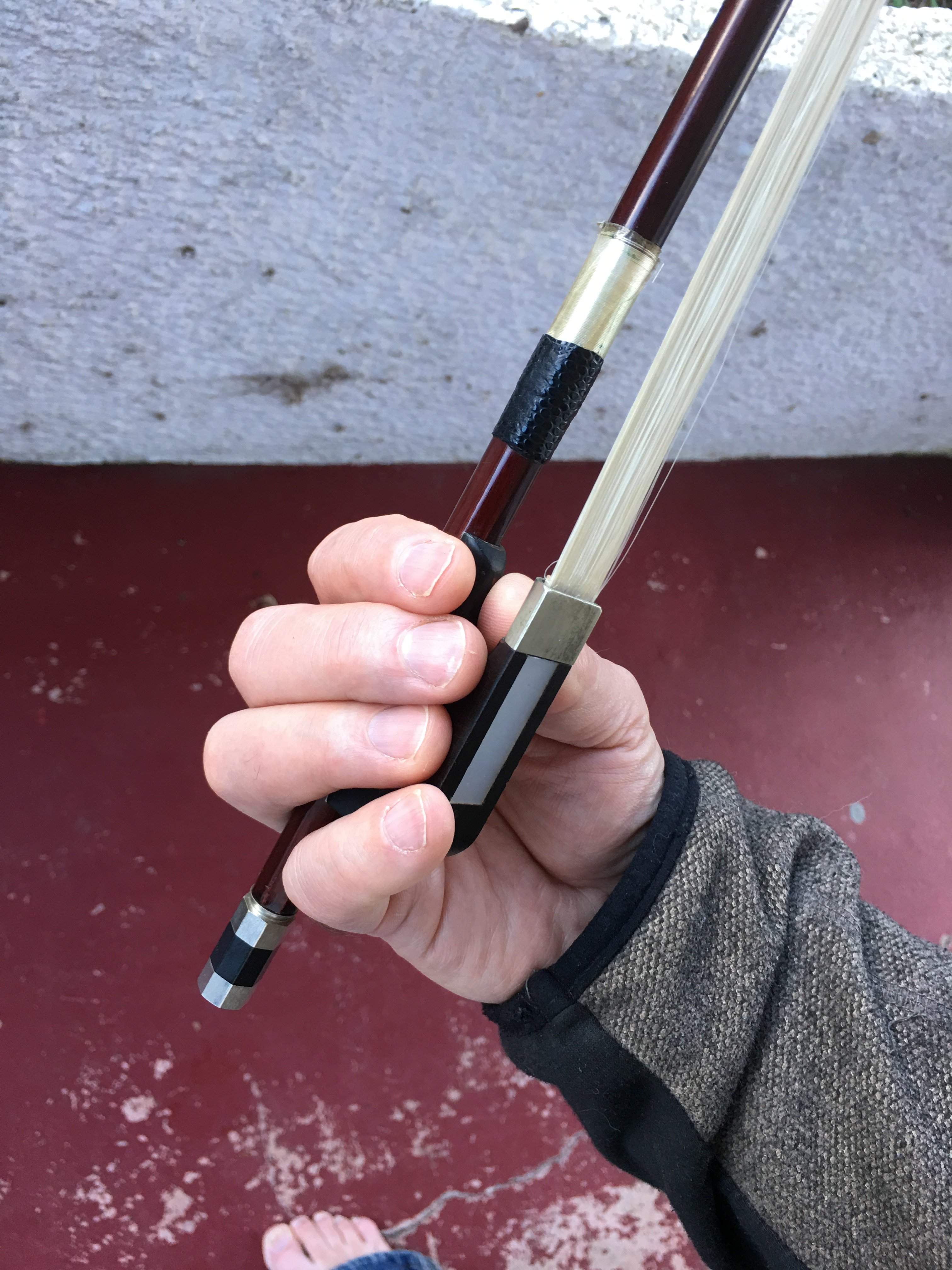
Hi there- i’m teaching myself bass (i’m A good sax player, and ok guitarist, so not a complete non-musician, but a novice on bass). When it comes to bow grip my hand falls naturally into the shape in the photo, with the end of the frog between my ring and little fingers. My hand feels more relaxed than it does in French grip (and it’s a French bow), and there seems to be more control. As a sax player I’m used to ergonomic form for playing music, and this weird grip seems good.

Now, I’m not arrogant enough to believe that in my ignorance i’ve accidentally created the perfect bow grip - so I’m guessing that you wise folk can tell me that there’s a good reason why I should not use this grip. Or is it actually ok?

(The photo looks a little odd because I had to contort myself holding camera in other hand)
03B6955C-31EC-400C-A8FB-A49552FB8F05.jpeg
 
IMG_0376.JPG
IMG_0376.JPG
IMG_0377.JPG
IMG_0378.JPG
IMG_0380.JPG
Isaac Newton devised or identified three systems of levers based on where the pivot point is placed in relation to the applied force and the work. Both the French and German holds use the third and weakest system. For a more conventional French bow hold the thumb tip is our pivot point (fulcrum) about which the bow would rotate if the hair was not resting on the string where the work is happening. For this your index finger needs to be further out in front to provide sufficient leverage and enable the hair to bend over and grip the string, helped by rosin. How far in front is a balancing act. Too far in advance will stiffen muscles, cause pain and risk squashing the freedom of movement of the vibrating string. Not far enough in advance (like your photo) gives insufficient or no leverage and again stiffens up the hand muscles if you try to make more than a whisper of sound. Regardless of French or German the principles are the same.

However, it looks as though you have made your little finger the fulcrum point. This would make some sense of the placement of the other fingers that would combine to apply ample force. If so then this is an interesting idea however there may be problems with sensitivity, flexibility and control of the bow.

When bowing we shape sounds by using three variables, Speed of movement sideways, Weight of downward pressure and Contact Point (how far away from the bridge). Convention says that weight is best applied by the whole arm resting down through a relaxed bow hold that forms a hook between the thumb and index finger which matches the elasticity of the strings, bow stick and stretched hair. The other fingers balance the the bow stick against the thumb.

I could go on and on but there are good You Tube sites demonstrating better bow holds for both French and German. There are also some good strong past threads that flesh out and debate the bow holds if you go back in TalkBass.

Good luck in your journey.
 
Last edited:
Yes. That grip is very bad. There’s much more qualified on here to say why but suffice to say it will be excrutiatingly difficult to play musically when holding the bow like that. If your goal is to play a whole note at the end of a ballad you’re probably OK. Other than that, if your serious about playing arco, get a teacher and play whatever bow grip they play.
 
Last edited:
Isaac Newton devised or identified three systems of levers based on where the pivot point is placed in relation to the applied force and the work. Both the French and German holds use the third and weakest system. For a more conventional French bow hold the thumb tip is our pivot point (fulcrum) about which the bow would rotate if the hair was not resting on the string where the work is happening. For this your index finger needs to be further out in front to provide sufficient leverage and enable the hair to bend over and grip the string, helped by rosin. How far in front is a balancing act. Too far in advance will stiffen muscles, cause pain and risk squashing the freedom of movement of the vibrating string. Not far enough in advance (like your photo) gives insufficient or no leverage and again stiffens up the hand muscles if you try to make more than a whisper of sound. Regardless of French or German the principles are the same.

However, it looks as though you have made your little finger the fulcrum point. This would make some sense of the placement of the other fingers that would combine to apply ample force. If so then this is an interesting idea however there may be problems with sensitivity, flexibility and control of the bow.

When bowing we shape sounds by using three variables, Speed of movement sideways, Weight of downward pressure and Contact Point (how far away from the bridge). Convention says that weight is best applied by the whole arm resting down through a relaxed bow hold that forms a hook between the thumb and index finger which matches the elasticity of the strings, bow stick and stretched hair. The other fingers balance the the bow stick against the thumb.

I could go on and on but there are good You Tube sites demonstrating better bow holds for both French and German. There are also some good strong past threads that flesh out and debate the bow holds if you go back in TalkBass.

Good luck in your journey.
tl;dr You can’t control the bow with that hold, particularly out at the tip.

You might prefer a German bow.
 
Last edited:
Hi Paul,

If you hold your hand exactly as it is in the photo, remove the upwards pointing French bow and insert a German bow in playing position, that image would look a lot more natural. Have you tried a German bow at all?
I’ve certainly dabbled.

The issue is getting any leverage or pronation into the tip of the bow. We use our index finger with french bow, which is replaced with the thumb on a german bow.

The OP image is exactly halfway in between, meaning there’s nothing there to do the job.
 
Oh, this is embarrassing.

I meant to address the OP (Phil) and wrote Paul instead. Senior moment.

But thank you for responding Paul. It's actually something I'm struggling with myself, switching to German after 50 years of playing French due to shoulder issues. There are varieties in French grip but they seem vastly outnumbered by the profusion of German grips employed by competent players (on one website I encountered a dozen of them, most of which felt extremely awkward to me).

You're likely right about the leverage at the tip. It just seemed that the overall hand shape Phil felt comfortable with seemed closer to German than French.

So curiosity...Phil(!), have you actually tried German bow?
 
Last edited:
And to add to the curiosity - are there more people that switch to German (speaking as recent convert..) as opposed to French?? And if so, why? Is it usually because of health reasons? (not in my case, it was more because it felt a little more intuitive).
 
I think I would prefer the German bow - but at the moment funds prohibit me buying a bow - what I have is a very cheap French bow, and I'll need to make do with that. I'm lucky enough to have a bass and a bow, and for now I need to work with what I have.

In fact I never thought I'd be interested in playing arco at all - I was really just intending to be a jazz-blues pizz. player (and my pizz plying is coming along very nicely!). But I started trying arco to help get intonation better, and found I really love the sounds the instrument makes. Or the sounds it will make once I get some skill up.
So, for now I'm trying to work with a more orthodox French grip.

The reason I experimented with my weird grip is that it felt very natural and there was much less muscular strain than the French grip requires. Your hand can be very relaxed in that grip since the bow is supported by the skeletal structure. Certainly that weird grip will never give anyone carpal tunnel problems (and might be good for someone who had already acquired carpal tunnel problems). I can see that it might be difficult to get subtlety into playing at an advanced level, so that's why I'll use the French grip for the moment. At least until I can make some kind of rational choice rather than re-inventing the wheel as a square.

However - in defence of my weird grip - there's plenty of control available. The index finger provides the fulcrum, the little and ring fingers at one end oppose the thumb at the other - the whole hand is involved in controlling the bow, including the 4th and 5th metacarpals. It's a class 1 lever (as opposed to French and German which seem to be class 3). Perhaps, as a sax player and finger picking guitarist, I'm more used to using my right hand in that way, and that's why it seemed natural?

I'll get better with the French grip, since that's the bow I have, and come back to experimenting with my weird grip when I have a better idea of what I'm doing. There's plenty of left hand technique for me to work on, regardless of bow hold!
 
I`m not like most people answering your post here, meaning that some of the folks are extremely experienced on playing the bass with a bow and are kind, tolerate, and even serious enough to post photos of their own bowholds for you as a reference. However, what were you thinking about when asking about a ghetto grip of a beginner from people with deep knowledge about how`s and why`s and the tradition and THE MUSIC behind it all? Like everybody else, I suggest you to get a teacher and dive into the reasons why there`s plenty of approaches about the bowhold. Anyway, it looks like you`re allready more into a german bow, get one and a good teacher, whatever is the price tag. It will propably save you from some physical pain and lots of time-wasting.

Anyway, as it is about traditions and such, there`s propably someone with carpal tunnel syndrome suggesting the exact technique that got them into their CTS. No-one here knows about the sound you`re aiming at, or how you feel when you`re trying to get there, or how you`re physically " constructed ". It`s not like these folks just kept on believing in how they were schooled regardless of how they felt, but it all is a process that goes on as one grows with the instrument and the culture around it, and we all get old while at it.

I try to hold my german bow the way that gets me the sound without hurting. With that said, I have two great teachers who pushes me to certain directions with very reasoned motivation. The only valuable information physically is to do ÉVERYTHING AS RELAXED AS POSSIBLE. And it`s not allways like that when you try to be as loud as possible acoustic in a ensemble with drums, horns and electric guitars, for example. Arco is a demanding MF, whatever is where you want to go musically.

A whole another story is orchestral playing, you need some kind of a reliable concept to execute all the finesse that THE MUSIC REQUIRES. It`s not about you anymore, it`s about the section, the whole band, the music. And while this has been going on for some centuries, there`s plenty of knowhow about how to execute it all, and the way it got to the point where it is now. It`s no black magic at all, it`s how to work thru the music and how to express it with that bow in your hand. We all need to know about it, regardless of what we play with the bow and if we were doing it at all at any point. That`s just where all the valuable information is coming from, the home base. It`s not like stuff wouldn`t grow without that information, but it`s 2018 and it`s all around us nowadays. You took the first step asking here, so why not go further?

Hope this makes any sense, and great luck for your journey!

R
 
image.jpeg
Another option for you to consider is the 'hybrid'. It is in between German and French and used by some very accomplished bass players. The hybrid bow is slightly different but the hold is similar to a German hold. It can be done on a French bow until you are sure where you are headed with bows. Here the great David Moore is holding his hybrid bow.

The nice thing about being a 'good saxophone player' is that once you get past the mechanicals of playing the upright you should be able to improvise melodically like a sax player. Scott LaFaro comes to mind. You will not be chained to chord based solos that restrict many beginners in the bass world.
 
Last edited:
If you're going to stick with French bow, find someone who knows what they're doing to at least get you started. This advice is from someone who did near-permanent damage playing French bow incorrectly.
 
Last edited:
I know it's not fashionable to support tradition, but as a self-confessed beginner, my advice to you would be to junk your bowhold completely, and take the advice that's been given to to you. Advice that's based on thousands of hours of teaching and practicing and playing, backed up by hundreds of years of refinement and research. An incorrect bowhold (notice NOT a grip) of either flavour will potentially do damage, quite possibly without you noticing. Get a teacher, learn to do it right.
 
  • Like
Reactions: Seanto and the_Ryan
View attachment 3123089 Another option for you to consider is the 'hybrid'. It is in between German and French and used by some very accomplished bass players. The hybrid bow is slightly different but the hold is similar to a German hold. It can be done on a French bow until you are sure where you are headed with bows. Here the great David Moore is holding his hybrid bow.

The nice thing about being a 'good saxophone player' is that once you get past the mechanicals of playing the upright you should be able to improvise melodically like a sax player. Scott LaFaro comes to mind. You will not be chained to chord based solos that restricts many beginners in the bass world.
Hybrid bows can be held using both French and German bow holds; David Allen Moore is originally a German bow player and as such primarily holds his bow that way.
 
There's no tension at all in my 'ghetto grip' - but I've been trying out CaseyVancouver's suggestion of a grip based on David Moore's - I spent a couple of hours practicing yesterday - really good control and no tension -
So thanks Casey! Very helpful post.

Regards doing damage with a poor grip - I'm sure a bad French, German or hybrid grip has the potential to cause RSI. But equally well, I think if you listen to what your body is telling you (a skill in itself) and ensure there is no tension in your grip, you are unlikely to cause RSI or carpal tunnel problems. I say this as someone with more than forty years experience as a sax player, and I'm also competent on guitar and bass guitar. I would not recommend a beginner to follow my path since often beginners are unaware of tension in their hands and forearms. That's not to say that a poor grip might limit my playing as I get better, and require a lot of un-learning.