• TalkBass has been independent since 1998. Add your voice.
    Create a free account to reply to discussions, view embedded media, and browse with fewer display ads.
    Join freeLog in
    Want zero display ads or expanded classifieds tools? Compare plans.

Double Bass Is this worth anything? (old German "blockless wonder")

Hi, I came across a bass for sale locally here in the UK - it's listed as a German instrument circa 1870.
Doing a little research it seems to be a 5/8 sized "blockless wonder". From the pictures it looks pretty beat up, but worst of all apparently some genius butchered it with some kind of polyurethane stain.

The ad says that it had "internal repairs" done 5 years ago, I don't know if that included fitting a neck block (I suspect not) or bass bar (these things tended to have integrated bass bars). It also had a neck graft.

It listed at £1,700. Assuming it's structurally sound is it actually worth anything?
Is it possible to remove the poly finish? I think I can see the original finish underneath in some areas where it got dinged.

I'm gonna go try it out to see how it sounds. If its good I'd be half tempted to make a low ball offer, with the idea of fixing it up as a project.
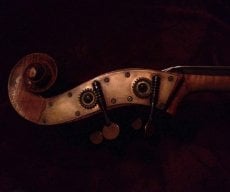
 
Sure it can be nice, and some of those come out quite well after a serious overhaul, but it will cost you and it will always be small.
Any idea how much? I'm waiting to find out who did the previous repair work/what was done (I'm guessing the answer to that is "the bare minimum" judging by the price).

I'm actually looking for a smaller instrument which is what attracted me to it in the first place.
 
I found one of these in a pawn shop ten years ago. It had a screwed on plywood back and all other kinds of abuses, but... THOUSANDS of dollars later and a three year restoration it holds its own against basses in the $20-$30K range in the orchestras I play in.

Would I do it again? I really don't know. Before and after photos attached.
Louis
 

Attachments

  • Tyrol before.jpg
    Tyrol before.jpg
    150.4 KB · Views: 117
  • Tyrol progress.jpg
    Tyrol progress.jpg
    40.9 KB · Views: 103
  • Tyrol after.jpg
    Tyrol after.jpg
    22 KB · Views: 113
  • Like
Reactions: Chris Fitzgerald
My bass is a blockless German, and it's awesome. Nothing to worry about with these by this age, although I'm not sure I'd spend a fortune restoring one. A good one can be a very fine instrument but how will you know unless you bite the bullet? It's a risk...
 
Thanks for your comments everyone. I'm thinking at the moment it might be too much work.

Guess I'll try it and decide based on how it sounds, and the extent/quality of the work already done on it.
 
Beyond KFS' well-placed skepticism regarding high investment in small-fraction basses, there's the essential nature of blockless-ness. Maybe the bass has such a great neck-angle and overstand as-is that you could leave it alone and play. Otherwise, here's the job:

. Remove the top

. Remove the neck. The neck has the sides set into it so your 'choices' are:
> Cut off the sides flush so you can save the existing neck.
> Excavate the sides from the neck, potentially trashing the neck in the process
>> Here, the existing neck is short-scale so you are evaluating converting to a 3/4 scale anyway

. Build and fit a neck block
> Cut a dovetail into the existing neck if you can
> Build a new neck if you can't
>> Scroll graft if the instrument merits that

. Set the neck

. Reassemble, replace or plane the fingerboard & full setup

If that sounds tricky, time-consuming and expensive you're hearing correctly.
 
I think that this is the bass that the OP is referring to
Invalid Link Removed

tbh I wouldn't consider it unless it sounds absolutely amazing and plays well as it is, by the looks of the photos this has a big neon "Money Pit" sign on it.