
Enjoy the benefits of a premium membership!
Upgrade Account
-
TalkBass has been independent since 1998. Add your voice.
Create a free account to reply to discussions, view embedded media, and browse with fewer display ads.
Join free Log in
Want zero display ads or expanded classifieds tools? Compare plans.
You are using an out of date browser. It may not display this or other websites correctly.
You should upgrade or use an alternative browser.
You should upgrade or use an alternative browser.
J Bass vs. P Bass
- Thread starter ToneFreak11
- Start date
More options
Who Replied?
I love the jazz bass. It's in my opinion one of the most versatile basses out there. especially an active one with 3 band EQ. I think you might be able to get any sound you like with that one.
I also like P-basses. And I've had one for about 15 years, and although I like it, I wouldn't get much use at all. I feel I just sort of does one thing. I finally sold it last year.
I also like P-basses. And I've had one for about 15 years, and although I like it, I wouldn't get much use at all. I feel I just sort of does one thing. I finally sold it last year.

Strings make a big difference on both basses.
For a change, try flats on your Jazz, and rounds on your P-bass.
Since most people like it the other way around.
I am very much debating on this... That tone family man had with flats on all those Bob Marley albums was pretty sweet. It's very present in the mix and not at all bright. Even John Paul Jones tried it in the beginning for Zeppelin later switching to rounds on "III" I believe.
P for me. Don't like bright.
Two of the brightest tones I have ever heard were on P's. Steve Harris of Iron Maiden with FLATS! Andy Rourke of the Smiths with rounds and a pick on a P. Again, family man's tone is not bright and it's a J with flats. Strings make a world of difference as well as the tone knob.
I'd love to own an MIA P too, but alas I only have an amazing MIA Jazz at the moment.


My plan is/was to have one of each. I have the P and am waiting for the J. As I've been playing the P, I find I like the tone but don't care for the neck - never have, but I thought I'd suck it up. Then it occurred to me that when my J comes, I coul stake the neck off that and put it on my P. Best of both worlds. Comfy J neck with the big sound of the P.
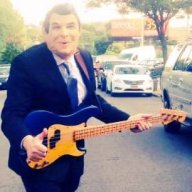
I play a P-bass with flats or rounds for almost everything. That said a P-bass wouldn't cut it at all for one of my current gigs so a Jazz it is.
I chose a P, but to be fair I haven't played a good Jazz. I started off on a jazz because it seemed to be more versatile, and although it was a decent beginner bass, the electronics were horrible, and the 60-cycle hum could be heard across the street, which clearly took away any versatility.
When I was shopping for a new bass though, I was set on a P. I went into a shop and tried it, and it felt perfect in my hands, I actually think I prefer the bigger neck. And some say the P tone doesn't sound good on its own, but the sound coming out of that P was what I had been missing. Then I did some research and found that all of my favourite bands bassists played a Fender P, and I knew it was right..... But I didn't listen to Rush at the time, and now Geddy's got me gassing for a J...
When I was shopping for a new bass though, I was set on a P. I went into a shop and tried it, and it felt perfect in my hands, I actually think I prefer the bigger neck. And some say the P tone doesn't sound good on its own, but the sound coming out of that P was what I had been missing. Then I did some research and found that all of my favourite bands bassists played a Fender P, and I knew it was right..... But I didn't listen to Rush at the time, and now Geddy's got me gassing for a J...
I have a P-J, and I took the Jazz bridge pup out! I just left it empty.
I've played it this way for 6 months or so. (I've played bass for almost 20 years though.) I usually play about 2 to 4 gigs per week, so I've gotten a lot of chances to listen in a band context.
Recently I've worked on my tone a lot, trying several pedals and amps, and I just couldn't seem to get what I wanted.
Well, I put the Jazz bridge pup back in and...
.
.
. there it was! The tone I was looking for!!
All this time I thought I was a P Bass man, but I was wrong.
I like the bridge by itself, and I like the J and P together also. And now the P by itself isn't working for me as well.
Maybe it is just that I need a change, or maybe I'm just now finding "my" sound.
Either way, I voted Jazz!
I've played it this way for 6 months or so. (I've played bass for almost 20 years though.) I usually play about 2 to 4 gigs per week, so I've gotten a lot of chances to listen in a band context.
Recently I've worked on my tone a lot, trying several pedals and amps, and I just couldn't seem to get what I wanted.
Well, I put the Jazz bridge pup back in and...
.
.
. there it was! The tone I was looking for!!
All this time I thought I was a P Bass man, but I was wrong.
I like the bridge by itself, and I like the J and P together also. And now the P by itself isn't working for me as well.
Maybe it is just that I need a change, or maybe I'm just now finding "my" sound.
Either way, I voted Jazz!
AHHHHHH! All the sweet sounds I can get out of my Jazz Basses! 
Invalid Link Removed
YouTube - Fender Jazz Bass with Flatwounds - Fingerstyle improv test
YouTube - messing with giant steps changes.MP4 (bass solo)
Invalid Link Removed
YouTube - Fender Jazz Bass with Flatwounds - Fingerstyle improv test
YouTube - messing with giant steps changes.MP4 (bass solo)

I am very much debating on this... That tone family man had with flats on all those Bob Marley albums was pretty sweet. It's very present in the mix and not at all bright. Even John Paul Jones tried it in the beginning for Zeppelin later switching to rounds on "III" I believe.
John Paul Jones never recored with flats, on his Jazz. (Always rounds)
I love Family Mans tone too. also Joe Osborn's tone.
My point was most Jazz players use rounds on there bass.
That Jaco, Marcus tone.
I to used rounds on my Jazz and flats on my P-Bass.
I just changed them around for a change.
What ever works for you?

Touché! I remember arguing with some one about that the other way around on the string forum here on talkbass. It was a flats for rock thread. I knew I was right then and was hoping I was wrong now. 
Quick google search and I found an interview confirming it.
Quick google search and I found an interview confirming it.

I have both in 5 string and the necks are identical (Laklands). If I can only take 1 of the 2, it would be the Jazz simply due to versatility of tone w/ the 2 pickups. But if I had my choice, I would always play tunes that called for the P w/flats!

I've always liked what Ed Friedland said on the subject.
Ed Friedland said:To my way of thinking, the difference between a P and J bass goes way beyond the physical. Yes, P bass - fatter neck (usually), split pickup, chunkier tone, less highs. J bass - slimmer neck, easier to play, dual pickups, more note definition, more high frequency.
But... I think P or J bass is a lifestyle choice as well. Committing to the P means taking on a set of preferences, and inherent parameters. You can't or at least shouldn't try to play a P bass like a Jazz. That would be missing the point. The P bass is a fat, chunky-butt animal that likes to take up space. It demands a high level of attention to what you play, because every note hurts - or helps. There ain't no takin' it back with a P bass. You better mean it, or be very good at making it work. You can play fast on a P, but it's not nimble like a Jackrabbit, more like a Grizzly doing 60mph to catch something to eat. Slap on a P? Sure, it's chunkfunk, think Boz Scaggs "Lowdown". The pop on a P is not as sharp as a J. It's like getting sliced with a serrated steak knife. Ouch! Use only when you gots to cut through some tough meat. Classic P guys... Jamerson, Rainey, Rocco, Bob Glaub.
The J is a sleeker machine. Being a Jazz guy means having a little more wiggle room. It takes up less space in the mix, so you can get more active without squashing people. With great power comes great responsibility. Just because you CAN move around, does that mean you should? And if so - how to, how much, and why? The J is a bit skinnier, so you have to learn how to use that texture to fill it up, and how to play it fat when it needs to be fat. Soloing? Sure. Slap? You bet. Passive it cuts like a well honed Buck knife. Active with a good pre amp, more like a barbers razor. Classic J guys... Jerry Jemmot, Larry Graham, Jaco, Marcus...
Some people make a choice early on and stick with it. Their entire style is built around that early decision, whether it was conscious or not. You may know some of these people. Players that would no sooner pick up the other axe than they would deliberately eat rotten food. There's honor in this I think, it certainly makes your life simpler when it's Friday night and you're trying to decide which bass to put in the bag.
I think it behooves (love that word) a professional bassist to have both and spend time cultivating the characteristics of each instrument. You need to make each one speak it's native language. There are some gigs that just naturally call for one or another. Not to say you couldn't switch around. You learn alot about the nature of the P and J when you try to make one do what the other does naturally.
Personally, I'm more fascinated with the P because I've always been a J guy by first nature. The J thing is in my DNA, but the P has gotten into my blood. I love chunkin out some fat ass P bass. It feels like I'm on vacation. The J still feels like home even though I've spent years getting used to the 5 string. I am definitely a confirmed 24 fret guy now. I always wished Fender would come out with a killer 24 fret J bass. I know.. the Urge bass.... Like I said.....
On most of my gigs these days, there is the expectation that I'm going to solo. If I wasn't so damned attached to what happens between frets 21 and 24, I'd bring a J, but.... Luckily I've found something with 24 that does it for me. But I still miss the opportunity to play my Fenders. I actually go out of my way to cultivate Fender gigs. No solos please!

Ed Friedland (paraphrased) said:... I think P or J bass is a lifestyle choice as well. Committing to the P means taking on a set of preferences, and inherent parameters. You can't or at least shouldn't try to play a P bass like a Jazz. That would be missing the point. The P bass is a fat, chunky-butt animal that likes to take up space. It demands a high level of attention to what you play, because every note hurts - or helps. There ain't no takin' it back with a P bass. You better mean it, or be very good at making it work. You can play fast on a P, but it's not nimble like a Jackrabbit, more like a Grizzly doing 60mph to catch something to eat. Slap on a P? Sure, it's chunkfunk, think Boz Scaggs "Lowdown". The pop on a P is not as sharp as a J. It's like getting sliced with a serrated steak knife. Ouch! Use only when you gots to cut through some tough meat. Classic P guys... Jamerson, Rainey, Rocco, Bob Glaub.
The J is a sleeker machine. Being a Jazz guy means having a little more wiggle room. It takes up less space in the mix, so you can get more active without squashing people. With great power comes great responsibility. Just because you CAN move around, does that mean you should? And if so - how to, how much, and why? The J is a bit skinnier, so you have to learn how to use that texture to fill it up, and how to play it fat when it needs to be fat. Soloing? Sure. Slap? You bet. Passive it cuts like a well honed Buck knife. Active with a good pre amp, more like a barbers razor. Classic J guys... Jerry Jemmot, Larry Graham, Jaco, Marcus...
Some people make a choice early on and stick with it. Their entire style is built around that early decision, whether it was conscious or not...
Thanks a lot for posting this. It really opens up my mind. I've always been that thumpy sort of a player. I just love the thick sound of a bass pounding through the mix, which is probably why the P felt and sounded right in my hands... A simple fact that I never realized.
And something else I'm thinking of, is that I started out with a 10 watt guitar amp, and by necessity to play along to an ipod at a decent level, I had to pound the strings to get the volume I was looking for, and therefore tried to get that thump going right off the bat.
Anyway, interesting read. I think I should give a J another chance. Ed was right, it is a different animal and should be treated as such.


