The Jackson JS1M is pretty far down on the cheaper end of the continuum of basses you can buy (new, anyway), and a few weeks ago its already-low price was further discounted when it was the Stupid Deal of the Day at Musician’s Friend. A bandmate sent me the link, thinking he was being funny (I once owned a slime green Dean Zone Custom), but I showed him: I actually bought one! It was $159. I like green guitars (lime green is my wife's favorite color), I figured the lurid color would be appropriate for my 80’s-themed band, and functionally it’s a basic P-bass, which I like.
I already have several Precision Basses and some other P-style instruments that I dearly love, so I did not need this at all and probably should have resisted the urge to make this impulse purchase. But, having bought it, I figured it could be an interesting project to see if I could make a silk purse out of this sow’s ear. Any Fender-style bass is just a collection of parts of higher or lower quality assembled with greater or lesser care. So as long as the neck is not warped or twisted it should be possible (in theory) with a little work and perhaps upgrading some parts to turn any such instrument into a decent-playing and -sounding, useable bass. So I took on that challenge with this Jackson.
On any instrument aimed at a low price point (like this one) corners are cut in production. This usually means lower quality components and less attention to setup. Both were true with this bass. But as far as the single most important part of the bass, though, I have no complaints. The neck was not warped or twisted and responded readily to adjustment of the double-action truss rod. That was good because with the strings off and no tension on the rod it had a bit of a back bow, but could be flattened with the truss rod, and easily tweaked to account for string tension. So the neck, a slab of maple with a separate maple fretboard (with black shark tooth fret markers!), was solid. I don’t know what mystery Asian wood was used for the body but it was nicely finished and not too heavy, so that’s all good.
Turning to the non-wood parts: bridge, tuners, and electronics. Bridges and tuners are two areas where, IMO, gearheads spend huge amounts of money for often illusory results. (Please note that I say this with love, having spent plenty of money on cool aftermarket tuners and bridges over the years.) Cheap tuners may not turn as smoothly or easily as higher-end tuners from name brands like Schaller or Grover or Hipshot, but it is a rare (and defective) tuner that simply doesn’t work to tune a string, or slips so badly that it can’t hold a string at pitch. Similarly, with bridges, while I believe that the overall mass of a bridge can make a difference in tone, I’m skeptical that some ooh-aah high end bridge will really be that significant, especially on something like a P-bass. I mean, a P-bass bridge, especially a top-loader, is only slightly technologically removed from a hammer. Cheap bridges are often made of zinc or some pot-metal zinc alloy, which is looked down upon, but metallurgically I don't see any reason to consider it inferior to aluminum or steel or brass, which all get respect. I suspect zinc is derided mainly because it’s inexpensive and it’s not pretty.
So sure enough, this bass has no-name tuners that take some work to operate, and what appears to be a zinc copy of a Badass-style bridge. Both do what they need to do, and I felt no strong need to change either. Ditto most of the electronic components (potentiometers, tone capacitor, jack). Many gearheads would immediately rip out the stock parts and put in Switchcraft pots and jack and an Orange Drop or similar high-end tone cap, but the cheap stock components work fine, so I went with “If it ain’t broke don’t fix it.”
But now we get into the thing that DID require work on this bass. First: pickups. I really didn’t like how it sounded. It had ceramic pickups that were pretty loud and brash---we use in-ears in my band and I found their tone fatiguing. My favorite basses have vintage-spec alnico pickups in them. Pickups are an area where I do believe it can be worthwhile to spend more to get the good stuff. It had been a while since I shopped for pickups so I asked for advice in the "Pickups and Electronics" forum and got a lot of interesting information in this thread, but in the end I took a chance on some very inexpensive pickups that appeared to have the characteristics I was looking for: I got a set of FLEOR pickups off eBay, which cost all of $18.
So that was hardware, but there were also setup issues. The bass played poorly due mainly to a badly cut nut. If it was even cut at all: it was a plastic nut and it is possible and even likely that it had slots molded into it and it was just glued on and strung up. The slots were way too shallow and the strings were way off the frets, and lowering the bridge can’t fix that. Fortunately I have a set of nut files and I was able to deepen the slots. However, here another aspect of cheap guitar production came into play: the nut was soft plastic, so an amount of filing that would have made a minimal difference on a nut made of bone or corian or a similar material took off a large amount of the plastic, resulting in a slot that was too deep, and the string buzzed against the first fret. Rather than try to fix the junky plastic nut I made a new nut from a bone blank.
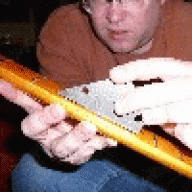
As long as the nut and strings were off (total junk strings; I put on a set of lightly played D'Addario nickel roundwounds) I leveled the frets. (Some years ago I took a fretwork class at the Chicago School of Guitar Making, and acquired the necessary tools and files.) The frets were actually in much better shape than I expected. There were a few low spots but not many and not bad. The fret leveling can only help but it was probably not absolutely necessary for basic playability.
The end result of all this was actually pretty nice. A pickup swap, a new nut, decent strings and a basic setup turned this cheapo bass into a good-playing and good-sounding instrument. And my total dollar investment in the upgrades was under $30. (I’m not counting the cost of the re-used strings, and a bone nut blank is about $10.) I was pleasantly surprised by the pickups—while they are not as sweet as Fralins they definitely were an order-of-magnitude improvement over the stock pickups.
I finished work on the bass on Saturday afternoon, which was just in time: we had a gig that night which was outdoors with potential rain in the forecast, and I didn’t want to risk one of my favorite basses getting rained on, so I figured this was the perfect time to bring out the Jackson. It performed admirably. What I didn’t know was that evidently there is a fluorescent component to the finish because it positively glowed under our lights (see pic below). We did get rained on briefly, but the bass shows no ill effects.
Only one thing still gives me pause about this bass: the neck profile. It’s got a fairly beefy “D” shape, and I prefer thinner “C” profiles. (It's also P width and I prefer J width necks.) I’ve thought about taking a rasp to it and re-shaping it, the profile anyway. But on the other hand, it was an impulse purchase that I don’t really need. I may just sell it as-is for what I've got into it, rather than do something as irreversible as changing the neck profile.
As far as making this bass decently playable, the only thing it absolutely needed was the nut slots cut to an appropriate depth, and a basic set-up. The frets were pretty good and while I didn't like the tone of it, it could certainly be used with the stock pickups and depending on the application maybe they'd even be preferable.
For years I've been advocating fixing up cheap instruments as a more cost-effective approach than buying a higher-level instrument, which may still need tweaks or upgrades to get to where you want. (Again, I say this as someone who has spent plenty going the other route.) But I have not actually done something like this for a long time, so it was interesting to try it again with this Jackson. And people say it all the time, but it reiterated to me that we are living in a golden age of cheap instruments, because it really did not need much in the way of work or parts to be something I would put up against basses costing two or three times what it did, at least. And very few of them provide the visual impact of this Jackson!


I already have several Precision Basses and some other P-style instruments that I dearly love, so I did not need this at all and probably should have resisted the urge to make this impulse purchase. But, having bought it, I figured it could be an interesting project to see if I could make a silk purse out of this sow’s ear. Any Fender-style bass is just a collection of parts of higher or lower quality assembled with greater or lesser care. So as long as the neck is not warped or twisted it should be possible (in theory) with a little work and perhaps upgrading some parts to turn any such instrument into a decent-playing and -sounding, useable bass. So I took on that challenge with this Jackson.
On any instrument aimed at a low price point (like this one) corners are cut in production. This usually means lower quality components and less attention to setup. Both were true with this bass. But as far as the single most important part of the bass, though, I have no complaints. The neck was not warped or twisted and responded readily to adjustment of the double-action truss rod. That was good because with the strings off and no tension on the rod it had a bit of a back bow, but could be flattened with the truss rod, and easily tweaked to account for string tension. So the neck, a slab of maple with a separate maple fretboard (with black shark tooth fret markers!), was solid. I don’t know what mystery Asian wood was used for the body but it was nicely finished and not too heavy, so that’s all good.
Turning to the non-wood parts: bridge, tuners, and electronics. Bridges and tuners are two areas where, IMO, gearheads spend huge amounts of money for often illusory results. (Please note that I say this with love, having spent plenty of money on cool aftermarket tuners and bridges over the years.) Cheap tuners may not turn as smoothly or easily as higher-end tuners from name brands like Schaller or Grover or Hipshot, but it is a rare (and defective) tuner that simply doesn’t work to tune a string, or slips so badly that it can’t hold a string at pitch. Similarly, with bridges, while I believe that the overall mass of a bridge can make a difference in tone, I’m skeptical that some ooh-aah high end bridge will really be that significant, especially on something like a P-bass. I mean, a P-bass bridge, especially a top-loader, is only slightly technologically removed from a hammer. Cheap bridges are often made of zinc or some pot-metal zinc alloy, which is looked down upon, but metallurgically I don't see any reason to consider it inferior to aluminum or steel or brass, which all get respect. I suspect zinc is derided mainly because it’s inexpensive and it’s not pretty.
So sure enough, this bass has no-name tuners that take some work to operate, and what appears to be a zinc copy of a Badass-style bridge. Both do what they need to do, and I felt no strong need to change either. Ditto most of the electronic components (potentiometers, tone capacitor, jack). Many gearheads would immediately rip out the stock parts and put in Switchcraft pots and jack and an Orange Drop or similar high-end tone cap, but the cheap stock components work fine, so I went with “If it ain’t broke don’t fix it.”
But now we get into the thing that DID require work on this bass. First: pickups. I really didn’t like how it sounded. It had ceramic pickups that were pretty loud and brash---we use in-ears in my band and I found their tone fatiguing. My favorite basses have vintage-spec alnico pickups in them. Pickups are an area where I do believe it can be worthwhile to spend more to get the good stuff. It had been a while since I shopped for pickups so I asked for advice in the "Pickups and Electronics" forum and got a lot of interesting information in this thread, but in the end I took a chance on some very inexpensive pickups that appeared to have the characteristics I was looking for: I got a set of FLEOR pickups off eBay, which cost all of $18.
So that was hardware, but there were also setup issues. The bass played poorly due mainly to a badly cut nut. If it was even cut at all: it was a plastic nut and it is possible and even likely that it had slots molded into it and it was just glued on and strung up. The slots were way too shallow and the strings were way off the frets, and lowering the bridge can’t fix that. Fortunately I have a set of nut files and I was able to deepen the slots. However, here another aspect of cheap guitar production came into play: the nut was soft plastic, so an amount of filing that would have made a minimal difference on a nut made of bone or corian or a similar material took off a large amount of the plastic, resulting in a slot that was too deep, and the string buzzed against the first fret. Rather than try to fix the junky plastic nut I made a new nut from a bone blank.
As long as the nut and strings were off (total junk strings; I put on a set of lightly played D'Addario nickel roundwounds) I leveled the frets. (Some years ago I took a fretwork class at the Chicago School of Guitar Making, and acquired the necessary tools and files.) The frets were actually in much better shape than I expected. There were a few low spots but not many and not bad. The fret leveling can only help but it was probably not absolutely necessary for basic playability.
The end result of all this was actually pretty nice. A pickup swap, a new nut, decent strings and a basic setup turned this cheapo bass into a good-playing and good-sounding instrument. And my total dollar investment in the upgrades was under $30. (I’m not counting the cost of the re-used strings, and a bone nut blank is about $10.) I was pleasantly surprised by the pickups—while they are not as sweet as Fralins they definitely were an order-of-magnitude improvement over the stock pickups.
I finished work on the bass on Saturday afternoon, which was just in time: we had a gig that night which was outdoors with potential rain in the forecast, and I didn’t want to risk one of my favorite basses getting rained on, so I figured this was the perfect time to bring out the Jackson. It performed admirably. What I didn’t know was that evidently there is a fluorescent component to the finish because it positively glowed under our lights (see pic below). We did get rained on briefly, but the bass shows no ill effects.
Only one thing still gives me pause about this bass: the neck profile. It’s got a fairly beefy “D” shape, and I prefer thinner “C” profiles. (It's also P width and I prefer J width necks.) I’ve thought about taking a rasp to it and re-shaping it, the profile anyway. But on the other hand, it was an impulse purchase that I don’t really need. I may just sell it as-is for what I've got into it, rather than do something as irreversible as changing the neck profile.
As far as making this bass decently playable, the only thing it absolutely needed was the nut slots cut to an appropriate depth, and a basic set-up. The frets were pretty good and while I didn't like the tone of it, it could certainly be used with the stock pickups and depending on the application maybe they'd even be preferable.
For years I've been advocating fixing up cheap instruments as a more cost-effective approach than buying a higher-level instrument, which may still need tweaks or upgrades to get to where you want. (Again, I say this as someone who has spent plenty going the other route.) But I have not actually done something like this for a long time, so it was interesting to try it again with this Jackson. And people say it all the time, but it reiterated to me that we are living in a golden age of cheap instruments, because it really did not need much in the way of work or parts to be something I would put up against basses costing two or three times what it did, at least. And very few of them provide the visual impact of this Jackson!
Last edited: