
Enjoy the benefits of a premium membership!
Upgrade Account
-
TalkBass has been independent since 1998. Add your voice.
Create a free account to reply to discussions, view embedded media, and browse with fewer display ads.
Join free Log in
Want zero display ads or expanded classifieds tools? Compare plans.
You are using an out of date browser. It may not display this or other websites correctly.
You should upgrade or use an alternative browser.
You should upgrade or use an alternative browser.
Jaco Tribute Bass Build
- Thread starter bassgod76
- Start date
More options
Who Replied?
At what point does this go from "Tribute" to "Forgery"? Seems to me that you've done a dandy job building a very fun bass - - but the color of the wire? The serial number on the neck plate? I don't see the "value add" with that stuff, unless you're going to try to pass it off as the real thing (which I don't think you intend to do, given the public attention you've given to your efforts...)
He can't pass it off as the real thing, unless he bust it into a jillion pieces then has Kevin put it all back together again with a quilt top. I think it's pretty obvious he is trying to capture and honor the spirit of Jaco at his finest, not create a forgery to pass off, which again, can't be done in this case.
See BG, I was trying not to bring up the quilt-top!

Kidding!
Why did you use all black wire in you soldering job? Is it just what you had, or is there a reason? I expected to see the usual black for the ground, white for the juice. Looks like a good job either way.
Yeah, I was thinking that too, but I didn't say anything because I didn't want it to look like I was just looking for things to complain about or something.

Usually black is the ground and white is the hot.
Yeah, I was thinking that too, but I didn't say anything because I didn't want it to look like I was just looking for things to complain about or something.
Usually black is the ground and white is the hot.
Hahaha, you guys would *hate* my wire jobs..........
I use whatever colour for whatever, I have a lot, and I mean a lot, of red wire, so yeah, lotsa red for everything.........

At what point does this go from "Tribute" to "Forgery"? Seems to me that you've done a dandy job building a very fun bass - - but the color of the wire? The serial number on the neck plate? I don't see the "value add" with that stuff, unless you're going to try to pass it off as the real thing (which I don't think you intend to do, given the public attention you've given to your efforts...)
The point of this project is the details, so the wire color and the serial number are just as important. If not, he may as well just buy the Fender tribute that's already on the market. As you mentioned, seems unlikely he's trying to scam anyone, given the public documenting going on here. It should serve as a tool not only on how to build a nice reliced bass, but how much a forger can go to mimic an original, which is always good to know.
If I had the skills and ability and bank to make a bass such as this, I would pay every attention to the most minute detail, because this would be something for me. I think that, if I am getting your mission Bassgod, this is something that you will keep forever. I mean, if I were to put so much work into something, I would want to keep it and use it and love it, not sell it for gobs of money... But that is just me, and possibly bassgod as well? Anyways, great job man, imo. Can't wait to see a finished product.
Ps- what kind of strings are you thinking of using?
Ps- what kind of strings are you thinking of using?
Ps- what kind of strings are you thinking of using?
Come on, you know what kind of strings belong on a Jaco tribute when this much detail is involved. You gotta choose the same string the man himself played.

Come on, you know what kind of strings belong on a Jaco tribute when this much detail is involved. You gotta choose the same string the man himself played.
I think I bought the correct strings??? God I hope I did.
I'm keeping this bass. I can't describe how satisfying it is to play something that you had a hand in piecing together. If I did sell this, i would totally lose my ass on the deal, and the hours of fabrication I would never get back. Anything I assemble will always be just for me. My OCD would never permit me to sell an instrument I built. I have too much to learn; especially when it's someone paying me for a product. I will just keep doing my thing so everyone (THand) can point and laugh at me for my tard-filled errors.

Can someone confirm the serial number on the actual BOD? I found a guy who will engrave my relic'd neck plate.
Hahaha, you guys would *hate* my wire jobs..........
I use whatever colour for whatever, I have a lot, and I mean a lot, of red wire, so yeah, lotsa red for everything.........
I love how Europeans add letters to words like colour. LOL! God I miss the UK!
Can someone confirm the serial number on the actual BOD? I found a guy who will engrave my relic'd neck plate.
I'm pretty sure those things are stamped and not engraved.
Any machinist(machine shop) will probably have stamps for doing this that you could borrow.
I wouldn't be surprised if you found out your dad had some in his garage considering his tools that we've seen.
Can someone confirm the serial number on the actual BOD? I found a guy who will engrave my relic'd neck plate.
I found it all over the net. From JacoPastorious.com:
Jaco must have switched the neckplates on his two main basses.
The number on the neckplate of the "bass of doom" is 57308 on the pictures, but this was the serial number on his 1960 fretted bass.
The serial number on the "bass of doom" should bee 64437.
Fenders serialnumber:
4 to 6 digit Neck Plate Serial Numbers
No other letters or markings on the neck plate, except for the rare "-" or "0" prefix, as noted.
0001 to 6000 = 1954
6000 to 9000 = 1955
9000 to 16000 = 1956
16000 to 25000 = 1957 (some numbers with a "0" or "-" prefix)
25000 to 30000 = 1958 (some numbers with a "0" or "-" prefix)
30000 to 40000 = 1959
40000 to 58000 = 1960
55000 to 72000 = 1961
72000 to 93000 = 1962
93000 to 99999 = 1963
L-Series (1963 to late 1965)
Serial number on neckplate preceded with an "L". Considered Pre-CBS (even though CBS bought Fender in January 1965). Sometimes an "L" serial number can be seen on a late 1962 model.
L00001 to L20000 = 1963
L20000 to L55000 = 1964
L55000 to L99999 = 1965
F-Series (late 1965 to mid-1976)
Big script "F" on neckplate below serial number. Known as the CBS era.
100000 to 110000 = late 1965
110000 to 200000 = 1966
This says that the bass of doom from the serial number is a 1961 model.
Jaco also said that he changed the potmeters from the stack knob to two volume and one tone.
If he did this to his famous fretless,it must be an early 1961 model because Fender went over to the three knob system in the mid of 1961
"The Fender Jazz Bass.
Collectibility Rating: 1960-1962: B+, 1962-1965: B-.
First introduced in 1960, this model had a narrow nut (1.5") compared to the Precision Bass. The most valuable models are the first two years with concentric (stacked) volume and tone knobs and felt tipped string mutes. Leo Fender felt that they gave a more accurate acoustic string bass sound, which the jazz bass player ould prefer. The pickups were designed with two pole pieces per string. This produced a mellower tone and a less percussionized signal that was more forgiving on the less-than-efficient bass speakers of the 1950s and 1960s.
Jazz Bass Peghead Decals:
Jazz Bass, 1962 to 1967.
1966 Jazzbass in original
black with matching black
peghead.
Offset waist body, 2 pickups, 34" scale, tapered fingerboard narrower at nut than Precision bass.
1960 Jbass specs:
Contoured Alder body with three color sunburst finish.
Slab Rosewood fingerboard.
Concentric (stack) volume and tone knobs.
Individual string mutes.
Tortoise grain celluloid three layer pickguard.
1961 Jbass specs:
Three knob electronics replaces concentric knobs, August 1961.
1962 Jbass specs:
Veneer Rosewood fingerboard by August 1962.
1963 Jbass specs:
Mutes removed by mid 1963.
1964 Jbass specs:
Pearl fingerboard dots replace "clay" dots, late 1964.
Tortoise plastic three layer pickguard replaces celluloid, late 1964. Note the tortoise part of the pickguard is still celluloid, but the underlying 3 W/B/W layers are no longer celluloid. This is easy to tell; the black layer is MUCH thinner, which can be seen on the beveled pickguard edge."
Is there any other information, let me know.
Regards
THand, you amaze and enrage me, simultaneously. Thanks for your help with the serial number.
I will ask my dad if he has a stamping tool. I misspoke about the Ebay vendor I found. I think his serial number process is stamping, rather than engraving. Here is his store.
http://cgi.ebay.com/Custom-engraved-neck-plate-fits-strat-tele-and-basses_W0QQitemZ260498937880QQcategoryZ7266QQcmdZViewItemQQ_trksidZp3907.m263QQ_trkparmsZalgo%3DSIC%26itu%3DUCI%252BIA%252BUA%252BFICS%252BUFI%252BDDSIC%26otn%3D12%26po%3DLVI%26ps%3D54
I guess I can call machinist shops in the area, if my dad has no such tool. I just want to be sure they use the correct-sized font. Well, I guess it's just as well. This doesn't even go to Kaufman's for another 3 weeks.
I will ask my dad if he has a stamping tool. I misspoke about the Ebay vendor I found. I think his serial number process is stamping, rather than engraving. Here is his store.
http://cgi.ebay.com/Custom-engraved-neck-plate-fits-strat-tele-and-basses_W0QQitemZ260498937880QQcategoryZ7266QQcmdZViewItemQQ_trksidZp3907.m263QQ_trkparmsZalgo%3DSIC%26itu%3DUCI%252BIA%252BUA%252BFICS%252BUFI%252BDDSIC%26otn%3D12%26po%3DLVI%26ps%3D54
I guess I can call machinist shops in the area, if my dad has no such tool. I just want to be sure they use the correct-sized font. Well, I guess it's just as well. This doesn't even go to Kaufman's for another 3 weeks.
As an eBay Associate, TalkBass may earn a commission from qualifying purchases.
My baby with her new strap.
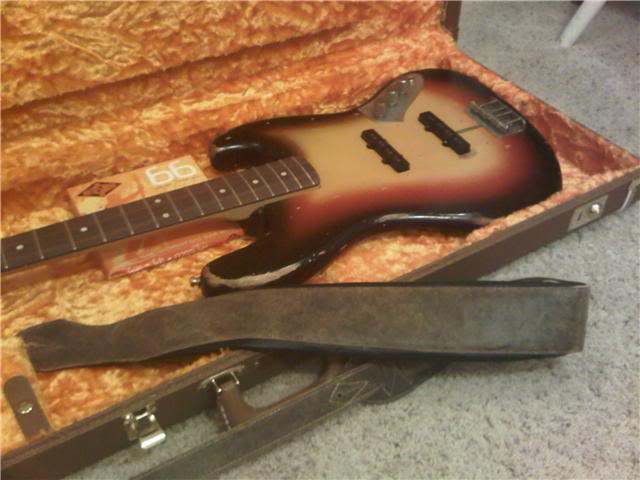
If you look closely, You can see one of the gaps in the corner of the neck pocket.
If you look closely, You can see one of the gaps in the corner of the neck pocket.
My baby with her new strap.
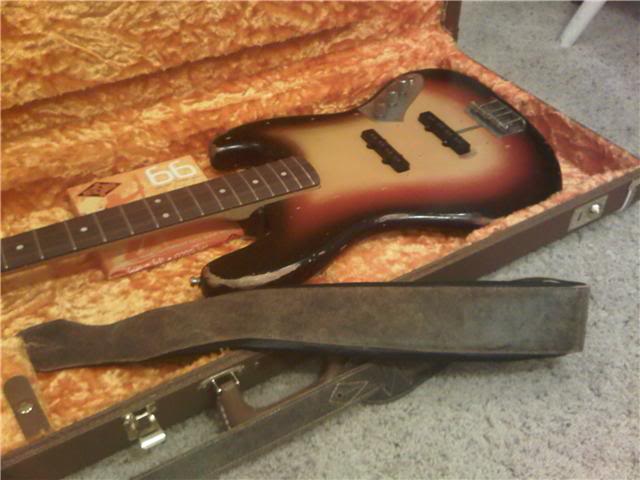
If you look closely, You can see one of the gaps in the corner of the neck pocket.
It looks better and better everyday!

That's what ya call a family heirloom, IMO.
Actually, its the Americans who removed them from the original and correct spelling...I love how Europeans add letters to words like colour. LOL! God I miss the UK!

Actually, its the Americans who removed them from the original and correct spelling...
+1


