All too few bassists know that Jaco became acquainted with Johnny Mørch's famous 5-string fretless basses as early as 1976 and immediately afterwards bought one for himself. Wearing bare toes and a pair of worn-out and drenched cowboy pants, Jaco himself appeared with a huge pile of banknotes at Thomas Puggaard's in the northern end of Copenhagen's Østerbro district. Because even though he was the bass hero above all, Jaco also had to pay for his custom-built 5-string.
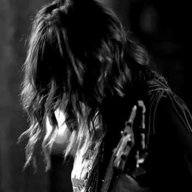
It was bassist Michael Friis and guitarist Thomas Puggaard-Müller who made the first contacts when Jaco first came to Denmark with Weather Report. And it was Sofie Johannsen who took the immortal black-and-white photo of Jaco, when a few years later he was handed his new bass in Jazzklub Montmartre in Nørregade, where Weather Report rehearsed.
Jaco was crazy happy with his new bass and used it frequently as a working tool when he recorded tracks with his own music in his own Florida home and with Greek-American Peter Yanillos as sound engineer. Yanillos drove his large college bus into the tight cottage area of Deerfield Beach near Ft. Lauderdale, and then Jaco could lay out dozens of tracks with voices he wanted to include on his future recordings – among others. the basic tracks of Holliday for Pans.
The years passed and, as many know, Jaco's later life was not exactly a play. Due to marital problems and several very diverse musical and human challenges (including manic depression, anxiety, galloping megalomania and several parallel relationships), Jaco had periodically sought residence alternately in New York, Los Angeles, San Francisco and even in hollow trees in a public park in Ft. Lauderdale. After several heated arguments with his second wife Ingrid, with whom he had fathered twins, Ingrid filed for divorce, and now the ways were still difficult for poor Jaco, who, despite his status and membership with Weather Report, had to make do with an annual income of just $20,000. At this time, Jaco was still fairly realistic about his ownb status, so he took some periods of treatment for alcoholism and drug addiction - when he wasn't escaping from his self-created nightmare and completely freaking out in the company of bums, criminals and other divided artistic souls...
At this late stage, Jaco could not, at all, see his life and his finances. This had the unfortunate consequence that several of the storage garages he had previously rented from his neighbors in Deerfield Beach were terminated and emptied. Jaco's wife Ingrid had a hard enough time feeding herself and the twins, so she had no way of paying the rent on Jaco's many small "stores" of precious instruments, recording equipment and other trinkets. So when the landlords couldn't get their rent paid, they chose to sell out of Jaco's treasures instead of getting compensation from Ingrid. And in several cases, Jaco's belongings were simply dumped on the streets of Deerfield Beach, where other drug addicts and organized gangs of thieves made quick work of the Pastorius' belongings.
In this period around the mid-eighties, Jaco's 5-string Mørch disappeared under somewhat mysterious circumstances. However, no longer than that it later appeared as a "collectors' item" and was for sale in several places and under several seller names.
Long after Jaco's death, Johnny Mørch received several inquiries via letters and emails from a guy named Curt Purplebaugh, who had allegedly been offered to buy the bass. When Purplebaugh learned through Johnny Mørch and the undersigned (Peter Rahbek) that the bass was in fact Jaco's, he - apparently for speculative purposes - offered Ingrid money as a kind of compensation for the inconvenience the Pastorius family had to suffer now that he intended to sell the bass. Ingrid accepted the donation, but never received any compensation. In return, Jaco's 5-string Mørch was sold on through several stud dealers.
Through the internet, Johnnny Mørch and the undersigned managed to make contact with the current owner, blues bassist Daniel Stanton from San Francisco. He obviously cannot dream of selling the old and noble instrument, but uses it both live and on various recordings. So the myth of the missing instrument has in a way ended now that Ingrid is also dead and gone. According to Dan Stanton, the bass is alive and playing amazingly well. He says that it is as if the instrument plays by itself – and delivers exactly the sound that the great masters, Johnny Mørch and Jaco Pastorius were looking for; an ideal cross between an electric bass and a real double bass – with saturated tone and long, lively sustain…
View attachment 7478667This Bass is from same period as Jaco's Mørch Bass/ same model

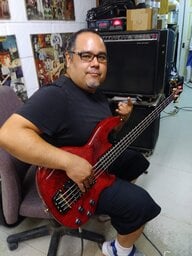








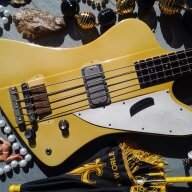





 truly amazing bass Luthier, still alive, but only doing a few custom job's a year