• TalkBass has been independent since 1998. Add your voice.
    Create a free account to reply to discussions, view embedded media, and browse with fewer display ads.
    Join freeLog in
    Want zero display ads or expanded classifieds tools? Compare plans.

Jay Ganz Straight Ahead Power Amp

Emailed Jay last night. He says that he only sells the one 500W model, with the Speakon jack the only option he offers. No different case, for instance. (You either like the aesthetic or you don't.)

He also said that the power module is not ICEpower, but he declined to reveal what brand. Have any of you owners opened yours up and know what it is?
 
Emailed Jay last night. He says that he only sells the one 500W model, with the Speakon jack the only option he offers. No different case, for instance. (You either like the aesthetic or you don't.)

He also said that the power module is not ICEpower, but he declined to reveal what brand. Have any of you owners opened yours up and know what it is?
Anyone who's upgraded the top has opened theirs. Yes, the innards are already shown in this thread. But for expediency sake, here ya' go.
IMG_9670.jpg
 
I should have been clearer. I wasn't asking for a picture of the module, I was asking for the brand name, and one is not visible in the pictures.


It looks like Jay mods the supply with more capacitors to specifically suit our application.
 
Last edited:
  • Like
Reactions: Michael Vee


It looks like Jay mods the supply with more capacitors to specifically suit our application.

I wonder what mods have to be done to make it usable as a bass power amp...
 
I wonder what mods have to be done to make it usable as a bass power amp...
For reference, the peak audio output current on the ICEPower module used in the D-350 is 20 amps and the power supply can deliver over 8 amps (~1 to 2 minutes) with significantly higher peaks if needed. Caps aren't the limiting factor and additional caps aren't needed when it comes to well designed power supply capabilities, in the example above, it's a stiff (actually reasonably tightly regulated) supply with almost no sag or losses. In fact, adding caps can create some very serious reliability problems depending on where in the circuit they are added.

It's important to understand the specs. and what they mean.
 
For reference, the peak audio output current on the ICEPower module used in the D-350 is 20 amps and the power supply can deliver over 8 amps (~1 to 2 minutes) with significantly higher peaks if needed. Caps aren't the limiting factor and additional caps aren't needed when it comes to well designed power supply capabilities, in the example above, it's a stiff (actually reasonably tightly regulated) supply with almost no sag or losses. In fact, adding caps can create some very serious reliability problems depending on where in the circuit they are added.

It's important to understand the specs. and what they mean.
I completely understand (not the math or electronics) about the safety. It would be cool if a company like Mesa made a product like this and have it be compliant, but I also understand the 10k plus it takes to have it approved by the US Electric Powers That Be, let alone designed, built, marketed, yadda yadda...but, it could be a welcome addition to guitarists' pedalboards, if they only had broad exposure to the possibilities. There are way more of them skinny-string doodlers, anyway! 😜
 
  • Like
Reactions: Michael Vee
I completely understand (not the math or electronics) about the safety. It would be cool if a company like Mesa made a product like this and have it be compliant, but I also understand the 10k plus it takes to have it approved by the US Electric Powers That Be, let alone designed, built, marketed, yadda yadda...but, it could be a welcome addition to guitarists' pedalboards, if they only had broad exposure to the possibilities. There are way more of them skinny-string doodlers, anyway! 😜
I'm just commenting on the differences between a "gold standard" type power supply/amplifier module manufacturer and an Aliexpress type manufacturer, the differences are very real.

For example, with an ICEPower module, they are designed to comply with the 500+ individual items that are addressed in the safety certification process, they all have to be correct otherwise the module won't receive it's UL/cUL/IEC 62368 safety certification. If the design and execution of the power supply, power amp and chassis layout are not correct, the amp can't be compliant, and it's the compliance that insures that the product is safe. For a simple example of only one element, there are specific clearance and creepage specifications that the power transformer on the SMPS, PCB layout and chassis layout must meet to comply. There's no way to know unless the product has been tested and this is ESPECIALLY true of Aliexpress and Alibaba and Amazon type components because nobody even knows who makes them and where (the factory) is located. There are also ongoing quarterly factory audits to maintain the component safety recognition... ie. the module manufacturer gets inspected and audited to insure that there's nothing hinkey going on during manufacturing runs.

$10k would be the deal of the century, as a general budget number, combined FCC, EU EMC, UL, CUL and IEC/CB safety certification can run between $40k and $50k assuming you don't have to go back for re-testing more than once. It's a very significant investment if you play by the rules. There has to be enough sales to cover that kind of cost, which is why you would be better with say a D-350 and just use the aux input as a power amp in. Taking the preamp out costs more than leaving it in.
 
Some years ago I investigated certification for my preamp builds. (I have an MSCIS degree so this is familiar territory for me.) I "ran the numbers" and estimated I'd be close enough to the $100K mark to be able to throw a rock at it and hit it square on. That included the overhead of creating a business entity, getting business insurance including liability, keeping legal counsel on retainer, strict record-keeping, dealing with the IRS, dealing with shipping and -- very important -- dealing with returns, and all the rest. It simply wasn't worth the money and the aggravation. Just my opinion here, but I don't see how people can ship uncertified products and not wake up in the middle of the night with stress migraines every so often.
 
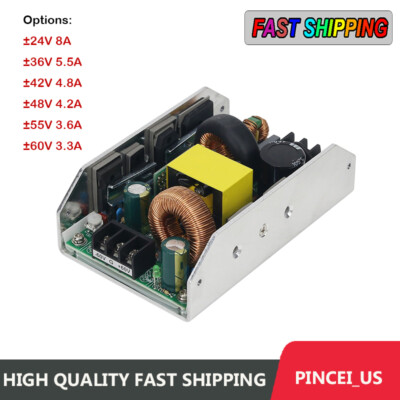
There might not be a brand name for the modules, in the traditional sense. I did some poking around on AliExpress, and found similar modules to both of the ones shown in the pictures. I've also played with power amp modules from AliExpress, but ones with a lot lower output ratings, such as 6 Watts per channel for my workshop speakers.

It gets difficult because there are often dozens of vendors for a given module, often supplying copy-pasted data of varying detail. On the other hand, once you find out what power amp chip is being used, you can look up the datasheet for the chip and learn a lot about it. Many of these modules make it look for all the world like they cloned the manufacturer's recommended application circuit. Now, whether they're using genuine parts and building it with quality is something you'd want to take up with the vendor. But it may be unknown who actually makes them.

What's not clear is how an off the shelf module, even an IcePower, becomes a bass amp. If I've learned one thing from Andy over the years, a lot of thought goes into addressing the specific issues that make a portable musical instrument amplifier different than a hi-fi amplifier.

An industrial, high volume customer may be able to track down the original designer and manufacturer, if they want a more robust supply chain. But I don't know how to do that. It may require "boots on the ground" in Shenzen.
 
There might not be a brand name for the modules, in the traditional sense. I did some poking around on AliExpress, and found similar modules to both of the ones shown in the pictures. I've also played with power amp modules from AliExpress, but ones with a lot lower output ratings, such as 6 Watts per channel for my workshop speakers.

It gets difficult because there are often dozens of vendors for a given module, often supplying copy-pasted data of varying detail. On the other hand, once you find out what power amp chip is being used, you can look up the datasheet for the chip and learn a lot about it. Many of these modules make it look for all the world like they cloned the manufacturer's recommended application circuit. Now, whether they're using genuine parts and building it with quality is something you'd want to take up with the vendor. But it may be unknown who actually makes them.

What's not clear is how an off the shelf module, even an IcePower, becomes a bass amp. If I've learned one thing from Andy over the years, a lot of thought goes into addressing the specific issues that make a portable musical instrument amplifier different than a hi-fi amplifier.

An industrial, high volume customer may be able to track down the original designer and manufacturer, if they want a more robust supply chain. But I don't know how to do that. It may require "boots on the ground" in Shenzen.
I lived in Suzhou, China for 2 years, and they had a whole street dedicated to JUST electronic components! If it was possible in the realm of electricity...it was there!

I tell people...go check out the Shanghai area for a 5-7 day vacation and go SEE STUFF! They have entire mega-malls dedicated to just furniture! Crazy prices as well. It's with the 700$ plane ticket! Not many folks can say they've been tk China...the food alone is worth every penny of your trip!