• TalkBass has been independent since 1998. Add your voice.
    Create a free account to reply to discussions, view embedded media, and browse with fewer display ads.
    Join freeLog in
    Want zero display ads or expanded classifieds tools? Compare plans.

Jazz bass hum question.

Long term Jazz bass player here but I have a question.

Over the years I've often heard folks complain about the hum Jazz basses can have when not set at the same volumes. I love the Tone of Jazz basses and frankly have never really had a problem with the hum except in VERY minor ways and even then it was not a big deal at all. I primarily use GK amps these days but it never became an issue with others I'd owned. ( Ampeg, Fender)

I just played somewhere a few days ago ( used the same amp previously with no issues) and they use an SWR 100watt combo for a monitor. I had loud buzzing with the pickups equaled and way more when I tried to vary. I just gave up and played and it dissapeared during the gig due to all the other players. I also noticed I was having a hard time hearing myself turned up quite high on the amp. No Flourescent lights nearby.

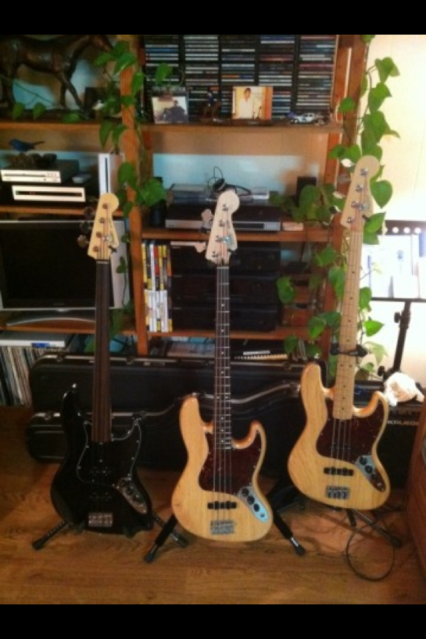
I Really like the tone of my MIA Fender Jazz even more so since the addition of a series/Parralell switch and I'm not going to consider a hum canceling set over one instance ( Dimarzio model Js on my MIM Fender Jazz already)

Any ideas about why it happened?

Thanks. :cool:
null_zpsa432dde0.png
 
Buzzing (as opposed to hum) is caused by emi which your bass' shielding should drain away. But in order to do so your bass must be grounded through the amp. My guess is they had an ac ground lift on the amp power cord or the ground was not attached in the outlet. Not good.
 
I've used my Jazz bass in many theaters and I found if my amp was plugged into a power line with a fader on it the noise came and went as light levels changed. I try to make sure my power line does not have a fader on it, and many upper quality theaters supply this line to the musicians. Also I switched the pups to humbuckers and that has solved a huge part of the problem.
 
Buzzing (as opposed to hum) is caused by emi which your bass' shielding should drain away. But in order to do so your bass must be grounded through the amp. My guess is they had an ac ground lift on the amp power cord or the ground was not attached in the outlet. Not good.

It was dark and I just plugged in. I noticed it was not the normal sound guy. It was somebody much younger and inexperienced.... :cool:

I did notice it was a bit better when I plugged my bass into the active input rather than the top passive input if that helps any?
 
Well either there was something nearby that was creating noise in the line or you had a grounding issue. Go to the hardware store and get an outlet checker. They are under $5 and can save your life. never plug in to an ungrounded outlet. make sure that the outlets all have the same polarity or you can be in for a shock.
 
Any ideas about why it happened?

Pretty much what others are saying. Even the absolutely best shielded bass ever made is only so-so shielded. It has to let the magnetic field from the pickup(s) interact with the strings and that means that external EM fields can get in. Some venues just have worse interference than others. In a dense urban environment the source of your trouble could be something the occupants next door are doing. If you need to play at this venue a lot then it is worth trying to track down what is being turned on and off when the interference comes and goes. Once you know the source someone may know a solution. If it is a one time deal then ignore it for now and hope that the source is not something that venue was an early adopter of and which is about to become hugely popular....

Shielding blocks ESI, not EMI.

I realize you are quite firm in your beliefs about this but shields are quite effective against EMI. Shields and filters are the bread and butter of EMI protection. Filters alone will not protect anything against EMI and shields alone will not protect anything that needs to have a wired connection to the outside world. Together they solve all EMI problems if used correctly. Or almost all. Neither one will protect radio gear from interference on the frequencies it is tuned to. You can neither shield nor filter out the frequencies you must transmit and receive. If you have an EMI issue and you cannot use a shield then you most likely will not be able to solve the problem. There is no substitute for a shield.

As far as ESI goes I see no professional engineering references to it. I assume you mean electrostatic interference. I find a few IEEE papers that mention it but they are referring to very exotic situations: corona discharge, orbiting spacecraft, etc. I do find this definition:

Electrostatic interference

Music Dictionary Guitar Dictionary

The undesired presence of an electrostatic hum field in signal conductors.


which is pretty much pure nonsense. I also found a nice web site from a recording studio that had a sensible discussion of shielding practices and which used the term ESI in nearly every sentence. I assume you are getting your information about ESI from a source like this. However, what they are calling ESI is a combination of two things: capacitive coupling and EMI and in fact if you drill down into Maxwell's equations in enough depth you will find that capacitive coupling is just another form of EMI. It is very convenient to think of some situations as capacitive coupling from both an analytical and a remediation standpoint but it really is all EMI at its core.

And a shield that has been properly designed for the frequency of the interference and the suppression ratio needed will be death to EMI.
 
Sometimes a building has power than just really causes problems. Could be so many causes for a little annoying buzz. Chances are, you'll have the same issue the next time you're in the same room


I agree with basswaggz... Sounds like the venues wiring. I've had all kinds of weird things happen at certain venues due to poor wiring... Buzzes, distorting amps, underpowered amps, sparks shooting from microphones -I actually witnessed a spark fly off a mic onto my guitarists mouth while he was playing!
 
Played Toby Keith's Bar and Grill in Denver a couple years ago. Took active and passive basses. Used an amp, bypassed the amp....still same buzz. Turns out from talking to more people, under the stage is lined with electrical wiring. Sometimes there's nothing you can do except wish you can kick the idiot in the read that wired the place! Electricians aren't normally musicians!
 
Pretty much what others are saying. Even the absolutely best shielded bass ever made is only so-so shielded. It has to let the magnetic field from the pickup(s) interact with the strings and that means that external EM fields can get in. Some venues just have worse interference than others. In a dense urban environment the source of your trouble could be something the occupants next door are doing. If you need to play at this venue a lot then it is worth trying to track down what is being turned on and off when the interference comes and goes. Once you know the source someone may know a solution. If it is a one time deal then ignore it for now and hope that the source is not something that venue was an early adopter of and which is about to become hugely popular....


I realize you are quite firm in your beliefs about this but shields are quite effective against EMI. Shields and filters are the bread and butter of EMI protection. Filters alone will not protect anything against EMI and shields alone will not protect anything that needs to have a wired connection to the outside world. Together they solve all EMI problems if used correctly. Or almost all. Neither one will protect radio gear from interference on the frequencies it is tuned to. You can neither shield nor filter out the frequencies you must transmit and receive. If you have an EMI issue and you cannot use a shield then you most likely will not be able to solve the problem. There is no substitute for a shield.

As far as ESI goes I see no professional engineering references to it. I assume you mean electrostatic interference. I find a few IEEE papers that mention it but they are referring to very exotic situations: corona discharge, orbiting spacecraft, etc. I do find this definition:

Electrostatic interference

Music Dictionary Guitar Dictionary

The undesired presence of an electrostatic hum field in signal conductors.


which is pretty much pure nonsense. I also found a nice web site from a recording studio that had a sensible discussion of shielding practices and which used the term ESI in nearly every sentence. I assume you are getting your information about ESI from a source like this. However, what they are calling ESI is a combination of two things: capacitive coupling and EMI and in fact if you drill down into Maxwell's equations in enough depth you will find that capacitive coupling is just another form of EMI. It is very convenient to think of some situations as capacitive coupling from both an analytical and a remediation standpoint but it really is all EMI at its core.

And a shield that has been properly designed for the frequency of the interference and the suppression ratio needed will be death to EMI.

+1. Good summary.