• TalkBass has been independent since 1998. Add your voice.
    Create a free account to reply to discussions, view embedded media, and browse with fewer display ads.
    Join freeLog in
    Want zero display ads or expanded classifieds tools? Compare plans.

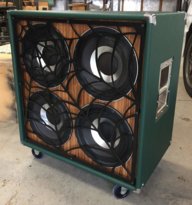
JBL E140-8 cab build

The E-series came out in late '79, so yes, your driver could easily be 40 years old. In that time the magnetic flux strength could have deteriorated some, but it seems to me that the soft parts are more likely to have deteriorated a bit and no longer have the same elasticity. It also seems possible that there may have been some error in the data acquisition. :)

It doesn't much matter if you are happy with how it sounds -- and it looks to be a great box. I'm not aware of another driver currently available that sounds much like a 140, but I'm not too hip to what all's out there. I would think there would be a market for that if there isn't already something.
 
  • Like
Reactions: 6thplanet
Personally I wouldn't be much too picky about some deviation of driver parameters that (naturally) might have happened to the device during such a long period of time.
However, I think the deviation of essential parameters in this case is very drastic.
I think I have never seen any MI driver where Qms was down that low at 1.26. According to JBL the number for Qms should be equal to 5, or at least close to 5.

Similar situation can be seen for Qes as well that should be equal to 0.18 according to published JBL specifications, while the measurment that was done by @6thplanet gives Qes a number equal to 0.55

Both the measured numbers for Qes and Qms as well are way off from the manufacturers published TS parameters.
Personally I think, either the device was heavily abused thermal wise by the previous owner or there must be an existing issue with the measurement tool.
It makes me a little bit wondering why the numbers for Vas does actually match with good accuracy.
If the suspension of the cone was worn-out then measured Vas could not match that well to the manufacturers rating number for the device.

If the voice coil was widely damaged by the previous owner due to heavy thermal abuse, about half the number for Le than rated (as is for an intact VC) would raise Qes up to about ~0.5 (give or take).

Published numbers by JBL for E140
Re 5.5 Ohm
Le 1.1 mH

measured numbers
Re 9.6 Ohm
Le 0.51 mH

edit:
for any 8 Ohm loudspeaker its valid to expect Re to be smaller than 8 Ohms
 
Last edited:
@6thplanet
If I was in your shoes, in first instance I'd try to confirm Re of the loudspeaker with a simple DC Ohm measurement.

Regarding proper cab design. For an E140 that was up to specs or at least narrow to it's manufacturer spec numbers, I'd try to design the cab a little bit different.

Here you are with a modelling what you might get for your cab that was loaded with an E140 that was not damaged.
net volume 4.2 cu ft
Tuning 40 Hz

upload_2023-1-15_0-38-26.png


Personally I think (to my personal taste) there was too much of loss in the bandwidth ~50..100Hz

net volume 4.2 cu ft
Tuning 55 Hz

upload_2023-1-15_0-41-17.png


Looks more balanced but, personally I think (respectively at least to may taste) there was too much of noticeable Tschebyscheff-alignement present (that can be obtained by the roll off shape. Its an quite underdamped design.
The underdamped characteristic can also be obtained (clearly seen) by the highish group delay that would came along with this design.
upload_2023-1-15_0-48-30.png


net volume 2.8 cu.ft
cab tuning 55 Hz

upload_2023-1-15_0-50-26.png


Roll off shape looks way better than for the above samples.
The roll off shape also predicts a better damping for the total cab system. The improved damping can also be obtained by a flattened group delay response vers. above samples.
upload_2023-1-15_0-54-44.png


If I was in your shoes, I think a TL606 cab build (2.8 cu.ft net volume) provides a pretty good fit for a e140 loudspeaker (that was up to specs, or at least narrow to it).
Regarding tuning 55Hz, it's always a good idea (and good practice) to protect any driver from overexcursion with a high steep HPF device.
 
Last edited:
  • Like
Reactions: agedhorse
when the peaks on either side of the tuning frequency are equal, you have a property tuned enclosure.
Not necessarily cause a distinct desired roll off shape and desired damping (and also group delay) may be obtained with either equal impedance peaks or just with different impedance peaks as well.
It depends almost always on the loudspeaker itself if the impedance peaks do match evenly for a desired design.
For the most part of available pro audio loudspeakers and also for the most part of MI loudspeakers as well a design goal that mainly yields on matching impedance peaks might trade off way too much of beneficial (musical sounding) design properties.
 
  • Like
Reactions: agedhorse
Ok, out of curiosity I measured the driver with my meter, 6.2 ohms. That made me reevaluate my T/S measurements. I messed up. I forgot to calibrate the DATS unit, as I just replaced my laptop and haven't used it on this one yet. :meh:
So here's what it spit out. I ran it a few times, all similar to this:
C1223430-5E02-49A1-AC4F-B1A1C3CF5EFD.jpeg
Electrical Q is definitely closer. Unfortunately looks like its has had about 40 years of severe duty. With the Qms, Fs and Vas pretty much pointing that out.

Guess it's a survivor as it still sounds really good for what it is.

I still stand by my impedance peaks statement. @ThisBass , you didn't fully quote my statement. I do appreciate the modeling you did, but it should be done with these actual measurements.
 
I would measure the response in the cabinet and evaluate the shape of the curve to see how close the real world is to your model.
 
  • Like
Reactions: ThisBass
I would measure the response in the cabinet and evaluate the shape of the curve to see how close the real world is to your model.
Andy, how would one perform a test like this at home?
Is this done in a quiet outdoor area with a sound level meter and a pink noise generator?
I'm assuming the distance between the cabinet and sound level meter would be 1 meter?
 
Near field measurements of driver and port. The port gets a correction factor (20log(port diameter/driven speaker diameter) then merge graphs in a response program of your choice.
Other method is measure driver and port down to 5Hz (still near field) then after importing them into a response program, adjust one or the other so the tails of the responses over lap.

I'm now seeing where my original T/S parameters have done me over. With the new ones I can see how a bit smaller box and higher tuning could be beneficial. All is not really lost, though. Amplifiers have EQ knobs.
 
@ThisBass makes a convincing case -- I'd still be interested in knowing how well the actual cab tracks the modeling. This much I know for sure -- in the late 70's and all through the 80's, a lot of good players in this area were playing through one or two TL-606 cabs loaded with K/E-140's or JBL 2220's. I have to admit that those rigs sounded as good as or better than anything anybody was playing at the time. A typical amp would have been an 800RB, or a rack-mount pre/power amp rig. Ah... good times. :D
 
Here you are with a couple of additional samples that may demonstrate (and I think also help to comprehend) the principles of design options with E140 driver.

Samples according to manufacturer TS parameters that are published by JBL
Normalized amplitude response in descending order from top to bottom
- balanced amplitude response
- balanced impedance peaks
- sealed chamber

Net cab volume 4.2 cu.ft
upload_2023-1-15_16-44-38.png


Net cab volume 2.8 cu.ft
upload_2023-1-15_16-45-49.png


Samples according to remeasured TS parameters that are listed in post #25
Normalized amplitude response in descending order from top to bottom
- balanced amplitude response
- balanced impedance peaks
- sealed chamber

Net cab volume 4.2 cu.ft
upload_2023-1-15_17-6-58.png


Net cab volume 2.8 cu.ft
upload_2023-1-15_16-55-6.png
 

Attachments

  • upload_2023-1-15_17-3-22.png
    upload_2023-1-15_17-3-22.png
    57.5 KB · Views: 24
  • Like
Reactions: 6thplanet
@ThisBass makes a convincing case -- I'd still be interested in knowing how well the actual cab tracks the modeling. This much I know for sure -- in the late 70's and all through the 80's, a lot of good players in this area were playing through one or two TL-606 cabs loaded with K/E-140's o20'sI have to admit that those rigs sounded as good as or better than anything anybody was playing at the time. A typical amp would have been an 800RB, or a rack-mount pre/power amp rig. Ah... good times. :D
Up until about 10 years ago, I always used JBL 15's in whatever cabinet I was using at the time, starting in the early '70's , and as you pointed out, so did a lot of other bass players in my area. I actually was on the road with a Kustom tuck n roll, 215 cab loaded with JBL E140's. I frequently would inter change 115, or 215 bass cabs with JBL E140's, obviously not knowing anything about cab design or driver parameters. It was my observation that, the smaller the cab, whether a 215 or 115, always sounded better to my ears than a more larger bass cab, loaded with those JBL drivers. My favorite JBL was the K140, which had to my ears, a sweeter tone, and I put that driver in a lot of different bass cabs also. Those two drivers seemed to always sound better than any other bass guitar,15" driver available at the time. Not much volume by today's standards obviously, but at a reasonable volume, what a tone for bass guitar.
 
With the updated T/S parameters in WinISD, Its prediction with my current box (green curve):
0B8BCF00-4B87-4855-870C-AC57DB15B802.jpeg
Measured response:
1DE656E4-FB84-44DC-B9A6-69022FF7D3AC.jpeg
Changing to 3.5cf@50Hz prediction (red trace):
AFF87B4E-2B1E-440E-AB56-A26473E781F9.jpeg
I see how that can effect it, but once again, at this point, amplifiers have EQ. The benefit is the cab is still loaded a bit lower at the expense of xmax/power handling of adding a bit of EQ to compensate.

I can still play with adding filler to reduce enclosure volume. Plenty of time for experimenting.
 
The port gets a correction factor (20log(port diameter/driven speaker diameter) then merge graphs in a response program of your choice.
It's not my aim to discourage you (nothing at all) but, a port does not work this way.
In practice its possible to enlarge or shorten port diameter respectively port area dimension and just by the same way shorten or lengthen the length of port accordingly just to get same tuning and same SPL out of it.
In rough words this means that port area dimension can be designed for a variety number of port area while tuning and generated sound/SPL remains steady.

Furthermore its not the moving/oscillating air inside that port that generates sound. The sound (alternating pressure of air) is generated inside the cab itself and then superimposed to the moving air inside the port.

And furthermore, at tuning frequency Fb the direct radiated sound by the cone itself is very small, cause the cone movement is down at very smallish cone movements at Fb. IIRC the direct radiated sound by the cone contributes roughly about +1 dB to the total sound at Fb
 
Last edited:
  • Like
Reactions: agedhorse
It's not my aim to discourage you (nothing at all) but, a port does not work this way.
In practice its possible to enlarge or shorten port diameter respectively port area dimension and just by the same way shorten or lengthen the length of port accordingly just to get same tuning and same SPL out of it.
In rough words this means that port area dimension can be designed for a variety number of port area while tuning and generated sound/SPL remains steady.

Furthermore its not the moving/oscillating air inside that port that generates sound. The sound (alternating pressure of air) is generated inside the cab itself and then superimposed to the moving air inside the port.

And furthermore, at tuning frequency Fb the direct radiated sound by the cone itself is very small, cause the cone movement is down at very smallish cone movements at Fb. IIRC the direct radiated sound by the cone contributes roughly about +1 dB to the total sound at Fb
The equation stated is for adjusting the port output to sync up to the driver output in a modeling program.
The port will apply more pressure to the mic compared to the driver at the same drive level. Simply Vd difference between the two.
 
  • Like
Reactions: Alex Xander
WinISD is well known for its quite inaccurate numbers regarding computed port dimensions.
For two ports (your cab) I'd expect computed port length (by WinISD) that was about ~50% too long.
Agreed, in this case I would recommend shortening the ports 25-50%.
 
Andy, how would one perform a test like this at home?
Is this done in a quiet outdoor area with a sound level meter and a pink noise generator?
I'm assuming the distance between the cabinet and sound level meter would be 1 meter?
A good start is with the cabinet outside on grass (good acoustic absorption) on its back, mic 1M away from the center of the driver. Calibrated mic/measurement device.

This will confirm if the predictions are in agreement.
 
  • Like
Reactions: Arjank and Jim C