• TalkBass has been independent since 1998. Add your voice.
    Create a free account to reply to discussions, view embedded media, and browse with fewer display ads.
    Join freeLog in
    Want zero display ads or expanded classifieds tools? Compare plans.

Jethro Tull

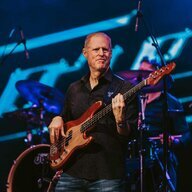
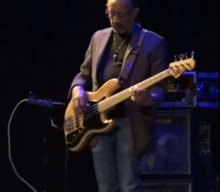
No story except I saw Tull a few nights ago. The bassist, David Goodier did an outstanding job. I've seen Tull many times over the years through several member changes. DG stands out as one of the best to have filled that slot over the years. IMHO

I saw them also with Dave Goodier last year, good player I agree.

I guess I just think of "my" Tull as scruffed- out shaggy Englishmen with boots from the Dark Ages....he was wearing a button down shirt with flowers..and a Fodera 6.

I dont know, I dont know.....I'm having a hard time ;)

But then again, I've been having a problem for about 15- 20 years now lol.

Poor Ian, his voice was shot and kind of spoke/sang to get around it. Dont get me wrong, they are still a very good band playing some of my favorite music ever.

I think I remember one guy on here years ago from England tell of a story how he put a bass neck (or something like that) up for sale in the classifieds and then Clive Bunker rang the door to pick it up!

Anyone in England have any stories?
 
  • Like
Reactions: Axstar
I don't think I've ever heard anybody here ever mention digging any of Jethro Tull's bass players. They've had a few really great ones IMO.

Glenn Cornick was the first and I really love all his work on the first few albums. It would have been really interesting to see what might have become of him if Ian hadn't kicked him out of the band (for partying too much!). After leaving Tull he played in another band, Wild Turkey, for a few years then packed it in. Some of his great highlights are Bouree and Inside which have some great melodic parts.

Jeffery Hammond was not in the same league I suppose, but he'll be the first to agree with that. He was basically handed a bass by Ian and asked to learn to play very quickly, so Aqualung was actually weeks into his bass playing carreer. Actually considering that, he did pretty well!

The next great one was John Glascock who was there from '76 to '79 when he died from heart trouble. He was a really great player though - especially some of his work on the Heavy Horses album.

Dave Pegg. Actually, Dave's a great bass player, but I never much cared for his tone (rather bright and thin). Lots of people liked Peggy though.

The new guy, Jon Noyce has done some fine work on the J-Tull.com album and it was nice to see BP Magazine write a short article on him a few months back. Finally somebody in that magazine who I've actually heard!

So, out of the bunch, I think I've come to appreciate Glen Cornick the most, with John Glascock a close second. Anybody else have an opinion (or care at all!)?

Always thought highly of all of them! Very challenging material- ...the British Frank Zappa band? and I bet Ian's more than a bit demanding of his people! Agree re: Mr Pegg's tone- probably softened a bit from his time with semi-acoustic Fairport. RIP Glenn! ...I suspect he's in large part responsible for Tull's transition from their early blues days into the world-class group they became.
 
  • Like
Reactions: bholder
My favorite Tull albums are "Stand Up" and "Benefit",
so I also love Glen Cornick's work.
He also played in a power trio with Bob Welch (ex-
Fleetwood Mac) in the mid '70s called Paris. They
only put out an album or two, which I've never heard,
but I'll bet it's cool.
I had the two Paris albums and they were good. I even bought them as CDs a few years ago. Sort of a Led Zep feel to them. You can still find them on Amazon. First one is self titled, the second is "Big Towne 2061".
 
  • Like
Reactions: sgraham
Isn't it just too damn real
One white duck on your wall...

Haven't seen much mention of Minstrel in the Gallery - another great album. I think it was my first Tull album.
 
I think I remember one guy on here years ago from England tell of a story how he put a bass neck (or something like that) up for sale in the classifieds and then Clive Bunker rang the door to pick it up!

Glenn Cornick (RIP) had a lefty neck on his Jazz bass. It could be the same neck? To quote Glenn:

The reverse neck fender was a 62 Jazz Bass and I hated the neck so I exchanged necks with someone with a Precision except it happened to be a left handed Precision. That was in late 66 I think. In the end the frets were so thrashed that it was almost unplayable.

Glenn Cornick Interview part 1: Fender Jazz bass and Gibson EBO
 
Well you must have noticed that Ian Anderson actually played bass on all the songs but 3 on Stormwatch. That was when John Glascock got really sick and couldn't continue. Ian actually sounds petty decent. In any case, it's obvious he must have supplied many of the ideas for bass parts over the years that others played (especially Jeffery Hammond!).

I guess I'm the only wacko on this board that has the entire Tull catalogue. I still think they are producing some really fine music these days and they are certainly one of the best sounding live acts I've heard.
I'd heard that most of the recorded bass parts that Cornick played were actually taught to him by Anderson. But that was from Anderson, so you never know.
 
I think in the case of Jeffrey it's more likely that Ian or someone else showed him the bass lines .....that's come up in interviews in the past and Jeffrey has admitted to really being a painter rather than a bass player (although I loved what he played too). But in the case of Glenn , other than unison lines or hooks that Ian might have wrote his style and parts were much freer and had fills and melody that sounded very much like how a bass player would think being a bassist myself. Glenn was a bass player before Tull, rooted in blues and rock and he had some formal music education and it showed imo.
Ian seems to have a knack of not giving credit where due and taking credit where it's most likely a little more "grey".
For example, I don't know how Thick as a Brick, or Passion Play could have been completely written top to bottom by Ian given all the keyboard hooks , chordal arrangements and melodies going on. Seems to me to be another "Whiter Shade Of Pale" situation if I had to guess.
No doubt or argument Ian by far is the major songwriter in that band....but .....
 
  • Like
Reactions: matthewbrown
I saw Tull in Detroit a couple times early on as a 4pc with no keys, which was my favorite line up. Actually thought adding keys was a mistake at the time. Glen M was great on bass and cemented my desire for an eb-3 and Marshall stack combo which was started by Jack Bruce. I stopped listening to Tull when aqualung came along because I felt like they were selling out. Too commercial to me at that time, as what drew me in the first place was an earthy quirkiness that i felt was slipping away. Upon finding out Glen was gone (by being surprised with it at a live show) I lost interest and went on to other obsessions.
 
  • Like
Reactions: bobyoung53
Hammond and Glascock are my faves but the bass lines in Tull have always been creative and inventive regardless of who is writing them. "Thick as a Brick" might be my desert island disc and I also rate Songs from the Wood, Heavy Horses and A Passion Play highly. Their Christmas album is about the only Christmas music I can listen to!
 
Tull from '69-'79 was the finest decade of music by anyone ever (in my opinion). John Glascock was their best bass player for sure, but Glen Cornick is probably the single biggest influence on my own playing. I just love the way his lines have such a great balance of groove and harmony.
 
For me who I like the best in this band is in part tied up with the TULL music I like best generally..although I can separate the playing too. Glenn Cornick and JHH are my favs because the parts they played were in the Tull songs that mean the most to me. I know Glenn was a better musician and player, but no matter what, those parts Jeffrey played were not that easy technically or rhythmically...I think he became much better over time and even very good. I love the bass in TAAB and Passion Play, and the rest he did . Glenn was also in the band when the rhythm section was freer, and bluesier, jazzier, etc so it gave Glenn's superior musicianship a chance to shine.
Glascock was superb technically, accurate and effortless..inventive too. I didn't care for his tone when he switched from P bass to MM...P bass was much thicker and more present, sat better too. Dave Pegg is also a superb player, very good musician, but again I didn't like his tone either when he switched from a P bass to...whatever that was....especially when he went five string Ibanez. Again, I didn't connect with TULL as hard at all when they were doing their stuff in the 80s, or 90s. Jonathan Noyce was a cool player and held his own but Goodier seems out of place to me, although a very good player.... the flower shirts and Fodera tone....naw.....so far away from my preference for the old English thing.

Although John G and Dave Pegg had the strongest command of their instrument at least technically, overall , taking in the times and the diverse types of music they were doing, the inventiveness, original style, the technical, groove and melodic content....Glenn is at the top for me. He's also the hardest one for me to cover as a bassist perfectly because he had a nuanced feel and tone, he added little things that were so stylistic, he had a lot of his own personality in his playing and all that means that he hit the deepest for me. He is one of the reasons why i play the instrument.

RIP Glenn!
 
  • Like
Reactions: JimK
I love a lot of Tull up to about 1979's Stormwatch album. I have tried numerous times over the years to dig their 80s-90s work, and I do admire the musicianship, and there are songs here and there I like, but overall the songs just aren't there for me.

Crest of a Knave is probably my fave from the post-70s era. But still...even up through '79 my fandom decreases after the first three albums...I mean, Aqualung...Minstrel in the Gallery--great albums, but nothing is really like This Was, Stand Up and Benefit to me.

All to say, Glenn Cornick is THE Tull bass man to me, as excellent as Glascock and as interesting as Hammond and some later players could be.
 
I saw Tull once in '92 at the Wiltern Theatre in Los Angeles. It was a fun show, but Ian's voice was already in trouble at that point. Apparently he had initially damaged it while singing the demanding melodies of the Under Wraps album on tour in '84 and '85 and had never fully recovered. He still sounded great in his lower range (listen to the second verse of the 1991 song "Rocks on the Road" -- when he sings "Can't sleep through the wild sound of the city", you could swear his voice was still as good as ever) but the higher part of his range, which had always been a strain for him, was shot. In this respect (and only this respect), he reminds me of Harry Nilsson, who had an amazing, choirboy-like upper range until he trashed his voice recording the album Pussy Cats with John Lennon in '74.

As for Tull bassists, far and away my favorite has always been the late Glenn Cornick. His bass lines always had an independence and nimbleness that was never matched by later Tull bass players, though John Glascock and Dave Pegg were both very good. Jeffrey Hammond, as has previously been noted, was really more of a graphic artist than a musician. It is sometimes claimed (by Glenn Cornick among others) that Jeffrey simply played what Ian told him to play. There may be some truth to this, but Jeffrey's playing doesn't really sound like the lines Ian came up with when playing bass himself. Ian's bass parts on Stormwatch lack the contrapuntal cleverness of Jeffrey's best parts, such as the 1974 B-side "Glory Row" and some sections of Thick as a Brick and A Passion Play. While I generally like Jeffrey's bass playing, the really inimitable, wonderful thing about him was his madcap sense of humor, as found in "The Story of the Hare Who Lost His Spectacles" and "Sealion 2", his own bizarre remix of the War Child song "Sealion" (not to mention many of the fake newspaper articles in the original packaging of Thick as a Brick). Tull became a little more ordinary after Jeffrey left, though the music was still great.

To me, Tull's best music was made by 1980. The A album with Eddie Jobson and Mark Craney is the last Tull album that I find entirely satisfying. Later albums usually had some good stuff, but were mostly mixed bags. Once Ian started creating albums with the CD format in mind, he seemed to feel obliged to make each one an hour long, resulting in albums that might have been really good if he had left out about a third of the songs. And I was never fond of keyboardist Andrew Giddings, who played with the group from the early '90s into the 2000s. He had an irritating tendency towards cocktail jazz stylings and thin-sounding digital samples. Ian once snarkily commented that Andrew took way too much time deciding which of his tacky keyboard sounds to use; maybe he would have been better off if, like John Evans in Tull's early years, he had had only an acoustic piano and a Hammond organ instead of racks full of digital gear.

As for the band touring as Jethro Tull now... Ian is on record as having said years ago that there could never be a Tull without Martin Barre; and in 2014 Ian announced that Tull was over and done with and that henceforth he would record and tour only under his own name. I thought both of those were sensible statements, so to me the current band is really just the Ian Anderson Band using the Tull name because it helps to sell more tickets. There's no question that Ian owns the name and can use it if he likes, but I wish he wouldn't. The last Ian Anderson album I bought was Thick as a Brick 2; I wasn't much impressed with the songs, but I was really turned off by lead guitarist Florian Opahle's constant imitation of Martin's tone and style.
 

Latest posts