I'm a bluegrass guitar picker who's thinking about buying a used upright bass to fool around with. It seems that in bluegrass circles where I am, old Kay basses from the 60s or before are held in high regard, and seem to command a decent price. On the other hand, as a guitar player I'm aware that Kay acoustic guitars from that era are viewed as cheap down-market instruments that are not particularly good. Since I know next to nothing about basses, I was wondering if someone could clue me in about what makes old Kay basses desirable for playing bluegrass. My theory is that if their guitars were cheap and not particularly good (which has been the case with the few Kay guitars I've played at flea markets and garage sales) then it stands to reason that their other instrument lines would be similar. And I don't feel qualified to judge how good a bass is by plucking a few of its strings.

Enjoy the benefits of a premium membership!
Upgrade Account
-
TalkBass has been independent since 1998. Add your voice.
Create a free account to reply to discussions, view embedded media, and browse with fewer display ads.
Join free Log in
Want zero display ads or expanded classifieds tools? Compare plans.
You are using an out of date browser. It may not display this or other websites correctly.
You should upgrade or use an alternative browser.
You should upgrade or use an alternative browser.
Double Bass Kay basses
- Thread starter shfpho
- Start date
More options
Who Replied?Kays were a real work horse plywood bass back in their day, could take a beating w/tours etc.
Two good resources for more info on them would be Steve Swan Guitars, who also is a TBer, and
Invalid Link Removed
Had one myself but lost it in a car accident, nice instrument, I miss it
Two good resources for more info on them would be Steve Swan Guitars, who also is a TBer, and
Invalid Link Removed
Had one myself but lost it in a car accident, nice instrument, I miss it

Some of the basses were really good plywood basses, some were decent, some were crummy. I've played Kays of all kinds, but they were easily accessible back through the history of this music and could withstand alot of punishment. A big part is tradition. You will see many bass players through the history of this music playing Kays, and you'll still see people playing them. I used to play one, but now I play bluegrass on a huge 7/8 carved hungarian bass. You do what you gotta do. Right now if you're in the market for a plywood bass, there of plenty of good new ones (Upton, Christopher, Englehardt, Shen, Thompson, etc) and plenty of old ones. Play as many as you can and buy whichever one you can afford that sounds good.
Thanks guys, for your input. I had suspected that tradition and history played a big part in their popularity today, and I admit that, without knowing the first thing about how to tell a good bass from a piece of junk, I feel somehow drawn toward that brand. I'm sure a lot of Kays rode for thousands of miles strapped to the roof of Bill Monroe's car, and that gives me a warm fuzzy feeling about owning one. But I'm going to check out some of the ones Max mentioned too. The Kay sightings are few and far between on my local Craigslist, so I'm not going to close the door on other good deals that might present themselves.
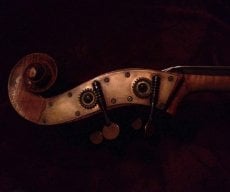
I have a '51 Kay that I have a love-hate relationship with. If mine is a decent or good example of the breed, which it seems to be, Kays do two things very well -- project low frequencies, and don't break easily. Except for the goofy flatsawn necks, of course. If you put 100 Kays in a room, I doubt you could find 10 with original unbroken necks. And because they were the Bic disposable lighter of basses back in the day, a lot of them have been poorly repaired. If little old me can undo a bad repair and make it better, you know the work was pretty awful.
After reworking the bridge and moving the soundpost my bass sounds strong and plays well. It's so ugly it's cool. The neck profile gives me hand cramps and is hard to play in tune in the first position, but after 60 years the neck is worn in like an old well-loved baseball glove. It has very little going on in the middle and high frequencies, and sustain is so-so. But it puts out a colossal WHUMPF especially strung with gut. In other words, it has THE SOUND, and nothing else sounds like it.
If you want a relatively tough bass to pound out root-fifths on, a Kay should be adequate but if you aspire to more lofty heights than BOOM-chick-BOOM-chick all night long there are lots of other brands out there that might suit you better.
After reworking the bridge and moving the soundpost my bass sounds strong and plays well. It's so ugly it's cool. The neck profile gives me hand cramps and is hard to play in tune in the first position, but after 60 years the neck is worn in like an old well-loved baseball glove. It has very little going on in the middle and high frequencies, and sustain is so-so. But it puts out a colossal WHUMPF especially strung with gut. In other words, it has THE SOUND, and nothing else sounds like it.
If you want a relatively tough bass to pound out root-fifths on, a Kay should be adequate but if you aspire to more lofty heights than BOOM-chick-BOOM-chick all night long there are lots of other brands out there that might suit you better.

I've played some Kays that I liked, but by and large I think they are way overrated. They were made by an older USA company, and so I guess they have a "collectable" mystique, but a lot of them sound pretty crappy. There are German ply and hybrid "shop" basses from the 30s, 40s, 50s and 50s that are much better instruments but don't command as high a price. When I got my 1930's Jacobus Hornsteiner hybrid bass for $800, the same dealer was selling a 50's Kay for $3500. The bass I bought was in rougher condition, but sounded and played 100 times better than the Kay.
Musical instrument value has little relation to utility. (in my opinion )
)
Musical instrument value has little relation to utility. (in my opinion
)
shfpho,
Go here, here, here, here, here, and here.
We've been down this road many times before.
Go here, here, here, here, here, and here.
We've been down this road many times before.
That's especially true for Kays. Most of the time, though, I think the correlation between market value and quality is quite good.Musical instrument value has little relation to utility. (in my opinion
Thanks also to the rest of you guys for your feedback. Drurb, those links you posted had some really good information. Although I wouldn't rule out buying one, my feeling about Kay basses is no longer as warm and fuzzy as it was before. At this point, I'd rather that every dollar I spend on an instrument give me a return in terms of sound, playability, and condition, rather than collectability and mystique.
That's especially true for Kays. Most of the time, though, I think the correlation between market value and quality is quite good.
Maybe that's more so with uprights, but for instance, with electric basses and guitars -- there are some very well made instruments out there by lesser known companies, or you can make a great custom bass from parts, and certain Mexican and Asian instruments are very well made these days, but the $$ value and resale is not good. Whereas, anything that says Fender, Gibson, Martin, etc, will hold it's value. On Ebay, I've always been able to sell any piece-of-crap Fender quickly as long as it says "Fender" on the headstock, whereas a really nicely made "Frankenstein" Fender-style is a lot harder. Of course, there are some great old Fenders, but there are plenty of dogs too.

Speaking as a Kay owner: I love 'em, but there's a sort of circular logic behind their mystique. They have that "old-time" sound, because they were what most old-time musicians could find and/or afford. That doesn't make them excellent instruments, just instruments owned by excellent players. They have thin (and fragile) necks. Most have non-ebony fingerboards. Old plywood can develop delamination issues.
If you love that muffled, thumpy sound, there are plenty of ways to get it out of a contemporary bass--padding, mic mix, etc--all the while keeping your options open for more tonal subtleties and coloration, should you desire. I mention all this not against Kays themselves, but again the idea of paying a premium for them.
(If you really want an old ply bass with maximum old-school mojo, I recommend an American Standard, strung with guts. Those are sonic time machines!)
If you love that muffled, thumpy sound, there are plenty of ways to get it out of a contemporary bass--padding, mic mix, etc--all the while keeping your options open for more tonal subtleties and coloration, should you desire. I mention all this not against Kays themselves, but again the idea of paying a premium for them.
(If you really want an old ply bass with maximum old-school mojo, I recommend an American Standard, strung with guts. Those are sonic time machines!)
Maybe that's more so with uprights, but for instance, with electric basses and guitars --
Well, this is a DB forum. Those are the only musical instruments to which I was referring.
(If you really want an old ply bass with maximum old-school mojo, I recommend an American Standard, strung with guts. Those are sonic time machines!)
I'll agree with you there. Of the "collectable" American plywood basses, those are the ones to go after. (But - I've played some American Standard dogs too.) The 43.5" string scale can be a bitch for us smaller people though.
 In Nashville, among the country/bluegrass/rockabilly crowd, a good Standard is the Holy Grail.
Those New Standard Cleveland basses are awesome! 42" scale. Gets that great old-school thump 'n boom too. Vintage Kay for $3500 vs. New Standard Cleveland for $4500? No contest (if I had the $$)
- Oct 12, 2004
- 1,327
- 587
- 72
- Disclosures
- Retailer: Shen, Sun, older European

If my Kay had any "collector" value, I'd sell it. I'm not saying it's a bad bass, but the setup is so radically different than my new bass, that it's hard for me to play it any more. But I'm hanging onto it in case either of my kids gets interested in the bass.
Also, Lemur Music sells a nice plywood bass called the "Jupiter" for around $2600. It's sort of an imitation of the Standard Cleveland (an imitation of an imitation ) Chinese-made, big-bodied 7/8 size, designed to be loud and boomy, a good bass for guts. I played one of these at the summer NAMM show and I liked it a lot. I'd get that before most Kays, too.
But, I will admit, that a good Kay, like one of those S-9 Swingmasters w/ guts, can be a really nice bass to play. If you got a great deal... but otherwise I'd spend my money on something else.
) Chinese-made, big-bodied 7/8 size, designed to be loud and boomy, a good bass for guts. I played one of these at the summer NAMM show and I liked it a lot. I'd get that before most Kays, too.But, I will admit, that a good Kay, like one of those S-9 Swingmasters w/ guts, can be a really nice bass to play. If you got a great deal... but otherwise I'd spend my money on something else.

Also, Lemur Music sells a nice plywood bass called the "Jupiter" for around $2600. It's sort of an imitation of the Standard Cleveland (an imitation of an imitation
Bobby, I played that same bass at the summer NAMM show. In fact, Jerry Buffa let me use it while my daughter and I were performing at the Kiwaya/LoPrinzi booth (see pic). It was a fun bass to play, although the plain gut E was a bit of a challenge.
Link Removed
- Steve
Cool Steve!
I want to create and manage a band called the Ukeladies Ask your daughter if she's interested. (just kidding)
I want to create and manage a band called the Ukeladies
Ask your daughter if she's interested. (just kidding)
Also, Lemur Music sells a nice plywood bass called the "Jupiter" for around $2600. It's sort of an imitation of the Standard Cleveland (an imitation of an imitation
I agree that the Jupiter is an excellent instrument for the price. But I hope we can put to rest the old misapprehension that it's a "copy of a copy," i.e., a knockoff of the New Standard Cleveland. That impression was probably created when Lemur used the phrase "a new standard of excellence" in their catalog description--language promptly changed when the resonance of the phrase was pointed out to them.
The Jupiter and the Cleveland aren't clones; cousins at best, in that they both derive their general shape from the old American Standard model. But that's where the similarities end. The New Standard costs twice as much, and is carefully designed to be a bargain at that price. The Jupiter is a value at its own price point. The New Standard, you'll note, is being marketed as a versatile instrument, good for all genres of music. The Jupiter is being marketed as loud, and good for that old-timey sound.
Other than a twenty-minute visit to their showroom last year, I have no connection with Lemur. But one of my takeaways from that visit was the perception that, in the Kay/AS/King old-timey ply tradition, I'd recommend a Jupiter over an Englehart any day.
Bobby, I played that same bass at the summer NAMM show.
Link Removed
- Steve
Hi Steve,
that's my actual, personal Jupiter you are playing here. Glad you enjoyed playing it!
Since I got that bass a year ago, my '51 Kay gets no love anymore. Still a beautiful sounding bass (the Kay).... but not as beautiful AND boomy as the jupiter.
I didn't mean to imply that they were copying the Cleveland -- just that it was another American Standard inspired bass.


