• TalkBass has been independent since 1998. Add your voice.
    Create a free account to reply to discussions, view embedded media, and browse with fewer display ads.
    Join freeLog in
    Want zero display ads or expanded classifieds tools? Compare plans.

Keeping the string tension up on short scale basses?

It is that simple, right? Tension goes up as string mass goes up. And I'm sure to a certain extent string construction. I keep reading about string through, angled heads, etc, but it seems to me all that can add is bridge and nut pressure, not tension.
 
String through the body adding tension is a MYTH
Reversing the bass side tuners position is a Myth
The correct amount of tension will give you the proper playability and sound. A slightly heavier gauge on a short scale can help in the feel and tension department. Also look at balanced tension strings like Circle K makes for an even feel.
 
Hi.

Choose the right set of strings.

D'Addario : String Tension Guide

^This.

Nothing more to it.

With skinny guitar strings, there's an obvious feel difference when bending the strings between, say a roller TOM with a Bigsby and a wrap-around stop bar of a LP junior. But there we talk about overhang/string thickness ratios that I for one, have never seen in a bass instrument. I doubt there's even over-the-counter strings that would allow that.

Regards
Sam
 
Choose the right set of strings.

D'Addario : String Tension Guide

The article also mentions these factors as factors that determine "the actual and perceived string tenstion".

• The flexibility of the instrument top and neck.

• The string break-angle at the nut and saddle/bridge.

• String height or “action” as adjusted at the saddle.

• Truss rod adjustment (neck relief).

Can anybody ellaborate on this?
 
As an Amazon Associate, TalkBass may receive commissions from qualifying purchases made via links on this site.
I'm going to take a guess at the 'perceived' tension thing. Imagine a bass with like foot high action. Clamp the strings at the nut and bridge so they can't slide over. Press the string down, feel some tension of the speaking length of the string. Grunt. Now unclamp the strings and make sure the nut and bridge are all slipperly-like. Push down again and now you're feeling the tension of the string from the tuner to the tailpiece. Longer string, less tension.. Of course I'm assuming that the string stretch is significant. If not, not much difference in perceived tension.
For the other factors (neck stiffness, etc) do the same experiment with a rubber headstock. As you push down it pulls up.

I'm not bright, so extreme examples help. Now how much of this is actually present in a playable bass?
 
The strings make it. The last bass I finished is a 30.75" scale 4 string and I put Alembic CX-3 compression wound strings on it. They are actually a bit lighter than a lot of the long scale strings out there, but they feel great and there are NO issues with the tension not being high enough. They feel great and they sound great.

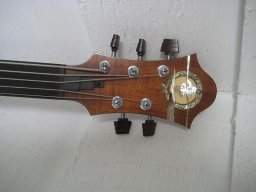
The bass also has a 13° angle on the headstock and a Hipshot B style bridge if that's worth anything at all. The point is that I don't think that you need to worry about it if everything is put together well and you use the right strings.
 
I'm going to take a guess at the 'perceived' tension thing. Imagine a bass with like foot high action. Clamp the strings at the nut and bridge so they can't slide over. Press the string down, feel some tension of the speaking length of the string. Grunt. Now unclamp the strings and make sure the nut and bridge are all slipperly-like. Push down again and now you're feeling the tension of the string from the tuner to the tailpiece. Longer string, less tension.. Of course I'm assuming that the string stretch is significant. If not, not much difference in perceived tension.
For the other factors (neck stiffness, etc) do the same experiment with a rubber headstock. As you push down it pulls up.

I'm not bright, so extreme examples help. Now how much of this is actually present in a playable bass?


What you just described is pretty much right on the money. What the string is doing outside of the speaking length of the string may change the way a bass feels to play, but it can't change the tension of the speaking length of the string, provided the string is tuned to pitch. The speaking length needs a certain tension to reach pitch for any given guage of string and that can't change.

In other words, if you don't actually play the instrument, the string tension will be identical throughout the speaking length of the string, regardless of construction. As soon as things get dynamic (boy, that sounds really action-packed, doesn't it?), the other factors come into play. String-through, tailpieces, string trees, action, headstock angle - those things will all affect the feel of the instrument and how it plays, but, technically, they will not affect string tension. String tension has to be exactly what it is in order to tune any specific string to pitch. As long as the string's in tune, it's at that tension.

How much 'percieved' tension is present in a playable bass? Well, that's all up to the perception of the player in question. Some players really notice that stuff and others couldn't care less (some really notice it and still couldn't care less!). There's no generic answer to that question.
 
The strings make it. The last bass I finished is a 30.75" scale 4 string and I put Alembic CX-3 compression wound strings on it. They are actually a bit lighter than a lot of the long scale strings out there, but they feel great and there are NO issues with the tension not being high enough. They feel great and they sound great.

The bass also has a 13° angle on the headstock and a Hipshot B style bridge if that's worth anything at all. The point is that I don't think that you need to worry about it if everything is put together well and you use the right strings.

that's cool, helped a lot. thanks!
 
Core size affects the degree to which a string goes sharp on plucking, and the force to pluck to a given deflection. It does not affect the basic string tension. A string with a given unit weight, speaking length, and pitch will be at a given tension, regardless of core size. With a heavier core it should feel stiffer, as it is harder to pluck.


One slight misuse in statements here is use of the word "gauge." The true factor in the equation is Unit Weight, which is the mass per unit of length - as in grams per centimeter of length, or ounces per foot. This is closely related to gauge, but different strings are constructed differently. The gauge is just the outside diameter measurement of the whole string assembly. Depending on the metals used, the wire form, and the construction, there can be higher or lower mass with the same OD. For example, the compression wound strings mentioned previously use a non-circular outer wrap, and may be heavier than standard strings of the same OD - which would explain them coming to a higher tension despite their being the same gauge.
 
This thread is a fine example of why I continue to come back to this forum - the capacity for high order meaningful conversation about a variety of aspects of this favored topic of mine is second to none. Anybody wanna group hug? :)
 

Latest posts