• TalkBass has been independent since 1998. Add your voice.
    Create a free account to reply to discussions, view embedded media, and browse with fewer display ads.
    Join freeLog in
    Want zero display ads or expanded classifieds tools? Compare plans.

lacking presence

Thanks for that, I must have missed it.

But pulling off the bridge pickup entirely and running only the neck pickup is not going clear up any mud perceived or otherwise. If the sound is too "harsh" running the neck pickup off entirely, there's a lot of room for adjustment between having the neck pickup on all the way and off all the way.

I still think he should dime both volumes and the tone and then adjust his EQ at the amp. "If" his amp runs flat when the dials are at noon, he should make slow adjustments one Knob at a time from there.

This kind of thing would be a lot easier if we could stand there next to him and show him what we mean!
 
There is no "boost" in a passive instrument. With both pickups of the interaction of the pickups cancels (aka "scoops") some of the mids.

I beg to differ. When you turn an America Fender P-Bass, more than 3/4 of the way open, there is a decidedly different tone, very heavy treble, and nowhere near as much low end, or low mids for that matter. A pretty neat trick for a volume control indeed.
 
Lots of good stuff in this thread for all of us. My experience is similar with a Thunderbird. Compression caused all kinds of problems, so I ditched it. I was using a ToneHammer for a while, and oddly enough, it also caused problems. The end of my signal chain is now a DI box that has both XLR and 1/4" outputs, but doesn't add or subtract anything. A HPF also gets rid of mud and amp power getting burned on signal that doesn't matter. Flats vs. rounds isn't necessarily the issue if you have the rest of the signal chain figured out.
 
I beg to differ. When you turn an America Fender P-Bass, more than 3/4 of the way open, there is a decidedly different tone, very heavy treble, and nowhere near as much low end, or low mids for that matter. A pretty neat trick for a volume control indeed.

There is no "boost" in a passive circuit. An active circuit is required for boost.

A volume control can attenuate highs differentially as they're turned down. Increasing the volume removes the high end attenuation.
 
Last edited:
  • Like
Reactions: SLO Surfer
That's what he started out doing.
My point with that, since that's how I've primarily used my Jazz Basses since 1966, is that the problem is probably NOT with his bass control knobs, but with his EQ settings on his amp. Presuming he doesn't have some strange aftermarket pickups on his bass, it's not the pickups causing his problem.

Plus, when you use the pickups to set your sound instead of your amp, you really limit your ability to make changes on-the-go with your bass. If you run them both of them open all the way and the tone all the way up (remember these are passive controls that only cut - you cannot boost anything), you have lots of choices for changing your sound without going back to the amp in the middle of the song.

Also, if he hasn't already figured it out, hand position on your plucking hand makes a big difference without even touching the control knobs. Pluck the strings back by the bridge pickup for a more treble sound. Too trebly, move your hand forward a bit. Need a smooth mellow sound, play up to or even above the neck joint. Too mellow? - move your hand back towards the neck pickup a bit. Too mellow of a sound still, move it farther back.

Can't make the adjustment you need by changing hand position, then try rolling off some of the volume on the neck pickup and try again. And just because he turned it all the way off and didn't like it doesn't mean it won't sound good with the knobs set somewhere in between. These control knobs are not just on or off, there are a lot of positions in between the two extremes.
 
Different strings, 3 band active electronics, a preamp pedal like a sansamp or an EP booster... There could be a lot of solutions.

You might want to look at a sweepable mid, either in your amp or in a 3 band active preamp. It helps me to picture graphic EQ like an old 80s stereo to explain it. The mid control lets you boost or cut the mids and the mid sweep control lets you move that left or right on that graphic EQ.

Here's an example of sweepable mids:


Nice video, too bad he doesn't tell you what frequency and level he's setting at each step ....
 
  • Like
Reactions: 48thStreetCustom
I play a 2002 Fender Jazz ...
Let'stop there.

I had the exact same problem with my '92 American Std Jazz. I changed strings, but to no avail. Thought about changing pickups, moving pickups, etc., but why would it just affect the certain notes?
I put it down to a bad fret job or a dead area in the neck wood. Got rid of the bass and moved on to another JB. Problem solved.
 
Last edited:
Let the sound guy take a DI off your bass before it goes into the amp, or take a line out before you do the EQ, and he can add the "presence" from there.

Are you happy with your bass sound? What does the rest of the band think? Have someone else play your bass at a sound check and listen to it from a distance - it sounds different at a distance to being up close.
If you or the band don't like the sound then it might be time for some round wounds or brighter sounding pickups?
 
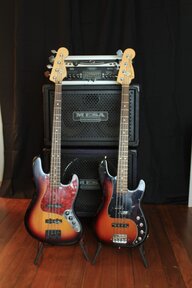
I play a 2002 Fender Jazz with flat wounds. I use an Ampeg 2x10 combo with an Aguilar compression pedal.

The sound guy for my wedding/bar/cover band has been complaining that my bass lacks "presence". Low end is no problem, but anything over the D/D#/E on the A string loses punch. I can hear it myself... there's not a lot of attack and it just kinda dies in the mix.

I know some of it is a result of my flat wounds, and my amp only has a 3-band EQ. Wondering if anyone has any advice for this problem?

Thanks!
After reading all the reply's, firstly what sound are you chasing? I would suggest you dump the compressor as most people don't fully understand them, then buy a two notes bass pre amp le bass pedal, which has all the tones, presence, distortion, sweep, etc then go into the wall of sound, (Free withe pedal) play, experiment with cab simulators microphones, and Mike positions Amps a lot of fun,
find what tone or tones you like, then see how YOU fit into the mix, especially with the rytham guitar guy, as he has added Bass frequiantcies and the kick drum this is basic studio practice, then look at the compression and EQ in a graph wave form not guessing from a floor pedal.
then tell , not ask your FoH man to do his job! and stop whining. Lol good luck
 
I play a 2002 Fender Jazz with flat wounds. I use an Ampeg 2x10 combo with an Aguilar compression pedal.

The sound guy for my wedding/bar/cover band has been complaining that my bass lacks "presence". Low end is no problem, but anything over the D/D#/E on the A string loses punch. I can hear it myself... there's not a lot of attack and it just kinda dies in the mix.

I know some of it is a result of my flat wounds, and my amp only has a 3-band EQ. Wondering if anyone has any advice for this problem?

Thanks!
Just for Laughs, borrow a P bass and try it with the band!
 
"Low end is no problem, but anything over the D/D#/E on the A string loses punch. I can hear it myself..."

That sounds weird as usually higher notes are louder. I think. You want punch in the higher bass region:

Fundamentals: E 41 Hz, G string 97 Hz, G high 196 Hz, D# 311 Hz.
 
I'd take out the compression pedal as an initial troubleshooting step.
May I suggest you start by checking the distance between your (open) strings and the pick-ups? E 6mm, G 4mm. Then give the engineer a full sound to work with. Use the shortest guitar cable (to your amp or DI box) you can live with (the longer it is the more top end you lose). Turn both pick-ups and your tone control up full. If you don't like the sound on stage adjust your amp's EQ, but if the DI is coming from your amp make sure the output is pre-EQ. If he's still not happy ask him to share his expertise by helping you sort it (they love that).
 
  • Like
Reactions: Nevada Pete
I don't think he's missing top end but rather the upper bass region. I looked up presence on Wikipedia. Said it referred to boosting upper mids on voice to make it louder. But that's just growl and ring overtones on a bass. I think he wants more the 90 to 200 Hz. Fundamentals higher than the open d string.
 
Hey
I tried what one poster was suggesting, having the neck pickup on full, bridge pickup rolled down maybe to 75%.

Wow! Really a good setting for playing on flats.

Is this the secret P bass sound embedded in the Jazz bass? That everybody should know?

It really is a fat full sound, and makes the fundamentals on the G string louder. I'm using flats (chromes).
In contrast both pickups 100% is more scooped. Neck pickup solo is similar to a p bass but thinner and sharper.
 
  • Like
Reactions: EatS1stBassist
Well for starters you've got a punchy amp set up so in theory cant go wrong. But if it dont sound right then you have to look at either the bass or your technique.

I only play P's with flats and can get punch for days with just fingers and amp, no effects. Seems to me you need to dial a bit more bridge PU into the bass, cut ur bass on the amp and play with a lighter but positive touch...just the very tips of the fingers

Would be surprised if that combo doesn't work.
 
If you have a problem with your sound, take it all back to basics and fix the problem. You won't get anywhere trying to add anything to try to cover up a bad sound.

Start with the simple stuff. I'd suggest flats on a Jazz are not the best way to go. I've tried that and I pretty much thought the same as your sound guy. IMO a bassist in a cover band needs a dynamic and flexible sound, one that can be moulded into different genres and that means round wound strings to me.

My Jazz basses are active with rounds. You probably don't need to go active but rounds are probably your answer. You can add a preamp and change the pickups, but throwing money at the problem and modifying the bass should not be your first thought.