
• TalkBass has been independent since 1998. Add your voice.
    Create a free account to reply to discussions, view embedded media, and browse with fewer display ads.
    Join freeLog in
    Want zero display ads or expanded classifieds tools? Compare plans.

Lady 5Jane - Headless, Fretless 5 String Prototype (With Piano Pins)

michaelwayneharwood

Builder of the Wastelands
In Memoriam
Commercial User
May 1, 2014
2,494
2,341
56
Colorado
michaelwayneharwood.blogspot.com
Disclosures
Owner Melodious Resonance Constructs
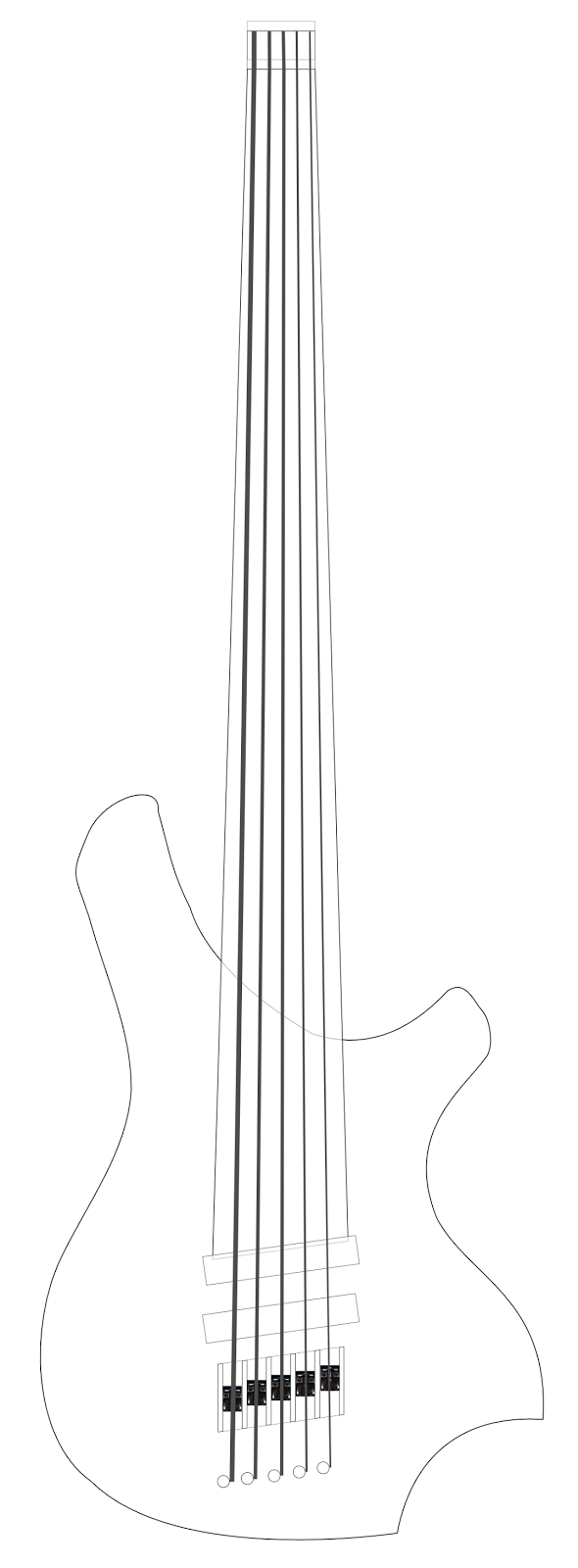
Initial experiments with utilizing piano tuning pins as an option for headless bass design were hugely successful, and this has motivated the build of a more refined version in hopes the process will cement the design elements for the eventual 7 string I desire to build. What better way to work out any kinks in my instrument construction processes than to build an instrument from start to finish. This pastiche will be as much about exploring the jigs and techniques employed as the bass itself. The prototype has been dubbed Lady 5Jane in memorial to the Tessier-Ashpool clan.

Here are the main specs:
- 34" scale
- Six piece laminated oak neck
- Fretless oak fingerboard
- 5/0 Piano pins used as tuners for the headless design
- Aluminum headpiece
lady-5jane.png
 
  • Like
Reactions: eukatheude
A 36" x 3.5" x 1" neck blank was created from unfinished oak flooring. The boards were planed down to a thickness of approximately 5/8", cut on the table saw into six 1" strips, and then glued together into a "quartersawn" configuration to provide maximum stiffness. The grain on the strips was aligned as much as possible to provide a cancellation of natural bending. Once the glue dried the blank edges were trimmed, and it was thickness planed to 3/4". A 3.5" wide fingerboard blank was then fashioned from another oak floor board. The planed thickness of 3/8" should be more than adequate for a 12" or greater fingerboard radius.

DSC_0360.jpg


DSC_0362.jpg
 
  • Like
Reactions: av500
The sounds of Horace Andy's "Zion Dub" accompanied the setting of a 1/2" steel square tube into the neck. A 1/2" wide and deep channel was routed down the center of the neck blank, and the tube was epoxied into place. It was a good tight fit, and the tube should not rattle in the channel during playing of the instrument.

DSC_0372.jpg
 
This prototype will be pushing the boundaries of "accepted best practices" on a number of fronts. Piano tuning pins, non-adjustable neck reinforcement, re-purposed oak floorboards, etc. I am hoping to learn a great deal through this process, and end up with a number of useful jigs.
 
  • Like
Reactions: SBassman
The neck was shaped to the hypnotic strains of a dub playlist, and the fingerboard was attached. The end of the neck is right at the end of the 34" scale length, and the fingerboard will flow all the way down to the edge of the bridge assembly providing a built in finger ramp. Tomorrow when the glue has dried the fingerboard will be trimmed down to match the neck, and the back profile will be etched in.

DSC_0513_zps338c1002.jpg
DSC_0515_zps18fca5e4.jpg
 
Like the neck so far...
was checking out steel square tubing also, the other day, and 1/2" seemed a good size for weight vs rigidity.
It'll be interesting to see how everything balances when strung. Are you going to use a fairly thick neck profile as well?
 
This morning saw some more work, but first to address the queries:

The neck is 1" thick including the fingerboard, and I will be profiling the back in a trapezoidal shape to research the oft extolled advantages. The 1/2" square steel tube seems like it will provide the necessary reinforcement, but I agree with JustForSport in that the proof will be in the stringing and playing. I found that the 1 1/2" thick pine neck from my original prototype has proven to be quite stable over the short term, and have every hope that I will not be faced with long term issues. I have not chosen to pursue double ball ends for a variety of reasons, and am also avoiding a compression style string retainer system for this build, but thanks for the info! I like learning new things!

I have also decided to stay with a flat fingerboard radius. I have found that my original prototype feels more natural to me overall. I have noticed more comfort and ease when using my plucking hand with this profile, though my "fretting" hand has had to adjust slightly. Bar chords are more difficult, but I have not seem any issues with a feeling of having to "dig in" to get to notes at all.

In any case here are the results so far:

DSC_0517_zpse3d93e8e.jpg
 
You machinist types probably already know this, but I found out today that using a disc grinder on aluminum is more trouble than it's worth. The metal is soft, so the disc gets gummed up and needs to be cleaned often enough to make it more work than it's worth. On the up side I have relatives on my wife's side of the family that have a full shop setup for aluminum (e.g. CNC, computer controlled lathes, etc.) and I may be able to get my headpiece machined to spec for little or no financial outlay.
 
I made an oak sandwich for breakfast, and now am officially out of my widest oak floorboards. I may either have to put in a pair of quatersawn strips in between the body thirds to make it wide enough, or slim up the body to make it fit. I did a quick gut test on the weight, and although a lot will be sawn off it's damned heavy. I am pondering the efficacy of chambering from the back, but the body is already 2 inches thick and a quarter inch "back cap" might be too much.

I had dreams about piezo transducers last night, and I am considering dropping in a pair I have laying around into the neck pocket before I glue in the set neck. Worst case scenario they sound terrible, but I won't have the option to add them in that location after things are assembled.

DSC_0529_zps5172a088.jpg