• TalkBass has been independent since 1998. Add your voice.
    Create a free account to reply to discussions, view embedded media, and browse with fewer display ads.
    Join freeLog in
    Want zero display ads or expanded classifieds tools? Compare plans.

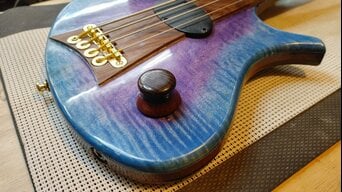
Laguna burger build

The Alumitones have intrigued me and I try to take note of opinions people have on them. That some people like them and some people complain that they can't get a good sound out of them makes me wonder whether they work optimally with some particular tone stack and (for passive harnesses) the values aren't the same as the usual Fender-ish ones.
According to the makers the Alumitones are designed to work in combination with standard passive pickups and normal controls.

Often when people don't like something on a guitar they say its bad instead of saying they don't like it. Then the masses simply repeat it's bad. So I ignore reports of sounding bad that don't explain why. That said I haven't liked many alumitones I've heard, same for the lace sensors. But I'm still drawn to them as the tech intrigues me.

I tend to like lo-fi narrow range pickups with a strong mid character. So this may be the wrong design for me.
 
  • Like
Reactions: TerribleTim68
I tend to like lo-fi narrow range pickups with a strong mid character. So this may be the wrong design for me.

Yes, I would say it is almost by definition the wrong design if that's what you like! :laugh: Of course, you can always EQ out the stuff you don't want, but it's harder than it sounds IME to try to recreate the mid or upper mid hump/bump that some famous designs have. Lo-fi with strong mid bump to me sounds like it would call for a humbucker with magnets on the weaker side and lots of wire to compensate for the lower output. Lots of ways to skin the cat though.

Personally, in my own basses, I usually prefer a hi-fi wide range pickup with a fairly flat response, but even given that I just can't get my head around how the alumitones sound most of the time. You can get a "more pleasant" hi fi response IME by using stronger magnets, a little less wire, and a coil shape that's really efficient. You end up with a normal passive pickup that behaves like a passive pickup but it has a fairly flat response.
 
A sidewinder has the coils laying on their sides, so they point sideways - towards the bridge and neck, instead of both pointing up towards the strings.

Most sidewinders have very typical coil dimensions. The coil is fairly "square" in that it's more or less as tall as it is wide, or within a 2:1 factor or so. But some cigar box sidewinders have very narrow, very tall coils - such that when they're laid sideways, they form a very thin, but very wide pickup:

View attachment 4351934

But again, I don't think that's what the Lace pickup is. Lace does the whole alumitone thing as their signature style. An alumitone pickup is essentially a very low impedance pickup that uses a transformer to boost the voltage of the signal and match impedance to what the controls and amp can handle.

Consider that a normal bass pickup might have 5,000 - 10,000 turns of wire on each coil, and the wire is very fine (usually around 42 gauge) and fairly high resistance - so, the pickup's DC resistance is somewhere in the 5 - 15k ohm range, and the signal produced is usually in the couple-hundred millivolt range, or even above a volt or two. This combination of voltage and impedance is what amps are designed to work with so you can wire the pickup and passive controls directly to the jack.

By contrast, a low impedance pickup often has one "turn" of "wire," or sometimes just a few turns. And often the wire isn't even actual wire. The "wire" is much, much heavier gauge and the resistance is close enough to zero that it might as well be zero. The lace pickups literally use the aluminum frame as the coil wire - it's just an aluminum plate with a hole in it. The voltage in the signal produced by this style of pickup is several orders of magnitude lower than a conventional pickup, so a transformer coil is used, offline from the sensing "coil" to boost the voltage and get the impedance up from near-zero to the several-k ohm range that'll work with an amp.

The main difference in terms of the signal is that a low impedance pickup doesn't have any coloring from the resistance of the coil wire. The sensing is done in a circuit that is closer to "perfect" than a conventional coil, and then that "perfect" signal is boosted afterwards. Typical passive pickups get some treble roll off and then a hump of a resonant peak in the high mids, as a result of the loading on the coil. A low impedance coil boosted by a transformer doesn't end up with that same filtering. It is, in a sense, a similar concept as using a conventional pickup with an active preamp. The thing is, an actual "perfect" signal with no tonal coloring at all is not what people are used to, so to a lot of people, it sounds unusual and undesirable. Most pickups of this design have elements in the design that are basically a bandaid at adding some color back in to keep the signal from sounding too sterile, so it's kind of hard to see the "it's a perfect signal" thing as an advantage.

Anyways, I hope that helps in terms of understanding, without having to rip one apart. But on the other hand, if you do rip one apart I hope you show us all what you find.
This is a fantastic explanation :thumbsup:
 
Yes, I would say it is almost by definition the wrong design if that's what you like! :laugh: Of course, you can always EQ out the stuff you don't want, but it's harder than it sounds IME to try to recreate the mid or upper mid hump/bump that some famous designs have.
I'm thinking some kind of bandpass filter could get what I want. I don't care about matching an existing design so I have that in my favor. When I mix a recording I use a parametric EQ to lop off the highs and lows leaving just the juicy innards. Maybe a passive high pass + low pass on board could do what I want? With a flat pickup signal a cut only bass and treble control might be the cats pajamas.

What I do like about these designs is they look like something I can build. A few thousand wraps of wire and some kind of machine to do that seems like a lot of work. This design looks very DIY friendly for my skillset and available tools.
 
And now the whole,....-everyone here is so supportive, friendly and helpful- thing is starting to make sense.
"Join us,...join us...."
download.jpg
 
I have 2 single coils I saved from an old epi strat. I was fiddling with them and realized they were potted in wax. Cool. Innards came out no problem. The magnet cracked in half on one of them, but I figure I can get magnets fairly easily and still have the one for experimenting.
So, I have these 2 coils to play with. The bobbins are soft clear plastic, so easy to cut and shape the inner part where the poles were. I marked where the stings would be at 17 mm spacing (4 string) and it seems like it would work as far as covering the outer strings (looking to do 1 or both pups side by side, closer to the bridge).
So, what can I do with these things?
Can I get a single coil sound without tons of noise?
FWIW, they measured in at 7.9k ohm.
That sound right?
KIMG2103~2.JPG
 
7.9k on a strat sized single coil is probably about right. You could just leave the slugs and magnets as they are. Trying to cut a slot in an already built pickup seems risky to make but if there's a good thick plastic center and you can make the change without disturbing the coil it could work fine.

The thing with reusing a coil like that is you get what you get. My curiosity would kill me wondering what it would sound like with a little more wire or a little different shape or some other change. Coil winders can be really cheap and easy to make!
 
What I do like about these designs is they look like something I can build. A few thousand wraps of wire and some kind of machine to do that seems like a lot of work. This design looks very DIY friendly for my skillset and available tools.

I can understand that but from my perspective you are ultimately just shifting the work isntesd of avoiding it. You will still need a transformer and/or some kind of active circuit to boost the signal. I haven't ever made a low impedance pickup like that so I'm not really sure how easy it would be to find a transformer that sounds good, or if you would have to make your own, at which point you're winding anyways. The small number of of people I know who have tried to diy an alumitone style pickup have all given up without a result they liked. Typical pickups on the other hand are a known entity, you can follow or tweak known "recipes" and have a very high chance of success with a lot of flexibility. I don't mean this as a discouragement though if you are really interested in that style.
 
I tried my best to get a pic that shows it, but it's hard to tell in a pic because the plastic is clear. But there's just a thin molded section for the poles and enough room on the sides that I could cut out the section with the holes, if I wanted to use a blade or different poles/pole spacing. I think a blade would be easiest in this case(?)
As long as use my Magoo goggles and a new exacto blade.
KIMG2106.JPG
KIMG2107.JPG


So, I just checked them again and both coils are reading 7.8k.
15.7k in series,
3.9k in parallel.
I kinda get the whole ohm thing with speakers, but pickups are going the other direction. How do these numbers translate to affecting sound?
I watch vids of people playing and switching their pups from series, parallel, single, etc and never really hear much difference, if any. Granted, that's highly compressed and on a phone, but still.
Doubling and halving the resistance seems like it would have a much bigger effect on at least volume, maybe tone. But I don't know enough to make assumptions.
 
  • Like
Reactions: BBassBassington
You could probably safely forget everything you've been told about the DC resistance value in terms of pickup performance. The resistance of the coil doesn't really mean anything out of context. The signal strength (i.e. volume) more or less comes from the magnet strength, the number of turns of wire in the coil, and the relationship (spacing, distance, etc) between the coil, the magnet, and the strings.

A coil with more turns will have a higher resistance, so people seem to assume a relationship between resistance and output, in the sense that higher resistance means more output. In a sense, if you had two coils that were totally identical, except one had more turns, the one with more turns would have more output - and, also, a higher resistance. But the output comes from the turns, not the resistance. Resistance is impacted by the length of wire (the number of turns times the size of the bobbin, more or less) and the gauge of wire used. A pickup with finer wire will have higher resistance. If you're following, you'll see why resistance is a bad indicator of output. You could make two coils with 5,000 turns of wire, one with 42 gauge wire and one with 43. The output would be similar, but the coil with 43 gauge wire would read about 20% higher in resistance.

Unfortunately, most pickup makers don't tell us how many turns of wire are on their coils. If you have two coils with different resistance readings and you know for a fact that all else is the same - wire gauge, coil size and shape, etc - then you can infer that the one with higher resistance has more turns of wire and hence more output. But if you don't know the coils are identical, you can't really make that inference.

Resistance has a similar relationship to tone. In general, a lower resistance pickup will sound brighter and will have a flatter response curve. As resistance increases, the treble starts to get rolled off and the typical "passive pickup resonant peak hump" generally starts getting bigger and lower in frequency. Pickups with higher resistance tend to sound less bright and a little more middy. Pickups with REALLY high resistance (think: Gibson mudbucker, at something like 30k resistance) will be very thick and muddy. Most bass pickups are in the 6k - 12k range. But just like output, there are a lot of other factors that impact tone, so it's dangerous to make too many assumptions.

Series/parallel/single will definitely make an impact. At least, series vs either of the other two will. IME, parallel is often fairly close to parallel. Series will have a fairly different tone and also a much higher ouput. If you're not sure what you want you can always hard wire in each option and then either just pick your favorite, or add a push/pull pot and switch between your two favorites.
 
Thanks for posting all that.
I doubt I will try to make my own for the next build. Maybe not for a few builds. Maybe never. Not really sure.
But I have the carcass of a cheap P bass copy that I'm considering making a mule with. Not sure what will become of these strat pup parts, but I'm going to get some magnets and experiment with them until I get bored, break them or make a universe altering discovery. My prediction is that whatever I come up with will "work" and I'll hear the strings, but it will sound crappy. It would be cool if I get lucky with the right magnet and blade/poles combo with these coils and they sound awesome.
 
Pickup making is about constant iteration (for me, at least). It's actually really easy to make a pickup that sounds really good. Like, trivially easy. Easier than any other part of making a bass. The harder part is getting a specific exact tone. Think of it like going to a fancy restaurant. If you just randomly pick off the menu, you're going to get a good meal. But it might take you some time experimenting to figure out which one of those great meals you, personally, like the best.

When they make double coil pups (side by side singles, strat style), do they flip the magnet in one?
I notice they repel each other unless one magnet is flipped.

The signal produced by a pickup has a phase (i.e. a direction relative to zero). In general, you want all of the pickups on a bass to be in phase with each other.

Two things impact phase - the direction the coil is wound (think: clockwise vs counterclockwise) and the polarity of the magnet (usually expressed as "north up" or "south up"). You can "fake" the wind direction by flipping the coil leads.

Changing either the magnetic polarity or the coil wind direction will reverse the phase. So, for two coils to be in phase, they either need to have the same wind direction and the same magnet polarity, or opposite wind directions and opposite polarities. Those are the only two possible combinations that will be in phase.

The magic happens when you decide you want the two coils to be humbucking. The phase of noise picked up by the pickup only depends on the coil wind direction - the polarity of the magnet does NOT impact the phase of the noise signal, only the phase of the string signal.

So - if you use two coils with opposite wind directions and opposite magnetic polarities, the string signal will be in phase. But the noise signals from the two coils will be out of phase, and hence they'll cancel each other out.

If you were to use those pickups together, ideally you would flip the magnet in one vs the other, and then also swap the coil leads on one of the coils. That way, they'll be reverse wound and reverse polarity and they'll be humbucking when used together.

If you leave them as-is, they'll be in phase but they'll also be noisy!
 
I guess the smartest way for me to go about this is to say what it is I'm imagining/want to achieve, what my idea is and then let everyone advise me.
In my head, I'm picturing 1-2 single coils. I'm picturing a really punchy, raw tone, like a Ric or Jazz. Not over driven and dirty, just punchy and middy.
I like my tone about 70% over to the bridge pup. So I was thinking of doing a single pup location, closer to the bridge. I thought maybe trying 2 singles stacked side by side, but it sounds like that's not really doable unless you make it a hum bucker. I wanted to try single coil and just try to do a really good job of shielding to help with noise.
Then I thought, just do 2 singles separated like a jazz and wire them either in just series, or have a switch to go series/parallel. Do you still have to worry about phase and magnet orientation when they are physically separated?
 
  • Like
Reactions: BBassBassington
Do you still have to worry about phase and magnet orientation when they are physically separated?

If you want them to reject noise then yes. But if you have the magnets out, it's pretty easy to set them up as a humbucking pair.

For what it's worth, two single coil pickups put right next to each other are effectively the same thing as a humbucker with two coils. The coils don't know if they're in the same case or in separate cases. Two coils spread far apart are still in many ways like a humbucker, except of course the tone and output will be different on account of them being further apart. There are some other more minor differences as you spread them apart (the magnetic fields interact when they're close).

What most people tend to think of as "single coil tone" versus "humbucker tone" seems to come more from the shape of the pickup and it's position than the actual type of pickup, if that makes sense. A humbucker can be really narrow with tall coils, which will help it sound like a single coil. Or a single coil can be wound fat with a wider sensing area and it'll sound like what most people think of as a humbucker. And so on.
 
So, if I were to get these pups working and put them in the mule, in the standard Jazz bass positions, one in the middle and one near the bridge, should I still reverse the coil leads and flip the magnet on one?
Is that what they typically do on basses with 2 singles to help with noise?
Basically, just wired like a double coil humbucker that has the coils spread apart?
 
  • Like
Reactions: BBassBassington

Latest posts