I'm doing some work on a 5-stringed Jazz style Skyline Lakland for a friend, his tone knob doesn't work. Is it a standard Jazz V/V/T scheme or have they done something weird in terms of wiring and component values?

Enjoy the benefits of a premium membership!
Upgrade Account
-
TalkBass has been independent since 1998. Add your voice.
Create a free account to reply to discussions, view embedded media, and browse with fewer display ads.
Join free Log in
Want zero display ads or expanded classifieds tools? Compare plans.
You are using an out of date browser. It may not display this or other websites correctly.
You should upgrade or use an alternative browser.
You should upgrade or use an alternative browser.
Lakland Skyline "Jazz Style" Wiring
- Thread starter Stuggi
- Start date
More options
Who Replied?
If the tone control ain't working then you need to check all connections/solder joints to see if something has come adrift. Then you can worry about component values!!.
I know, I know, not my first repair.  The guy who owns it and another bassist with tons of experience (at least as a player) already checked it out and found no loose connections, so I'm guessing a faulty capacitor or pot since it came from the factory this way.
The guy who owns it and another bassist with tons of experience (at least as a player) already checked it out and found no loose connections, so I'm guessing a faulty capacitor or pot since it came from the factory this way.
Clean the pot with F5 Fader lube and compressed air cans first. There might be buffing compound in there.
Ok, would standard electrical cleaner do the trick (basically degreaser in a can)? Don't think I can get hold of fader cleaner that easy in this town (16k population), and I'm not so sure about Finland either. 
Ok, no cleaner necessary I think, cause I just found the problem, and also my faith in both my bassist friends' understanding of electronics just plummeted to the ground. Pics in a minute or two, so you guys can play "what's wrong with this picture?".
Pics in a minute or two, so you guys can play "what's wrong with this picture?". The bass:
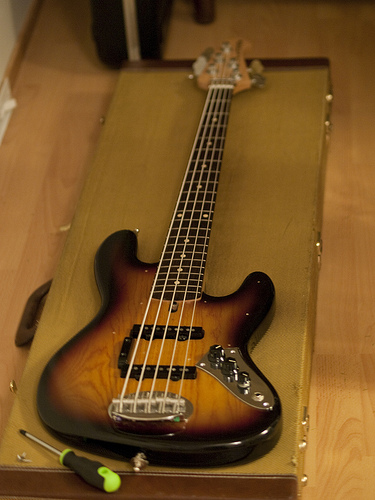
Can anyone identify the exact model?
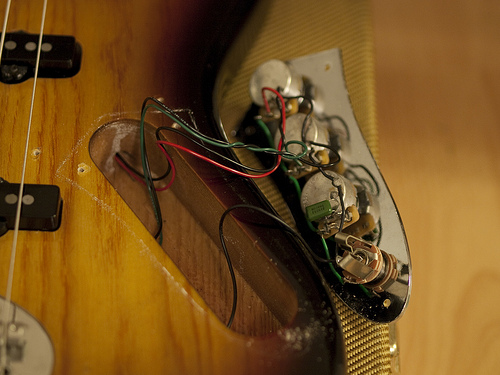
Can you spot the reason for why the tone control doesn't work? And why it has never worked?
Can anyone identify the exact model?
Can you spot the reason for why the tone control doesn't work? And why it has never worked?
Okay, time's up, here's the short answer.
The tone cap is wired between the 3'rd lug and ground. And the hot signal is wired to lug 1.
The long answer;
They wired the cap between the ends of the carbon track, which means that it's hardwired as if the pot were on full all the time, i.e. no treble roll-off.
And they even didn't bother wiring it as most manufacturers would, i.e. the cap between the wiper and ground, and the leaving lug 1 unconnected and wiring the hot signal to lug 3. That way you see that the pot is working backwards, and all is well.
Luckily for me, an high end audio grade cap (0.1uF I might add) and a bit of wire was all that this bass needed. I also connected the bridge ground while I was at it, it had broken of the solder joint (they probably stripped the cable with wire-cutters).
A couple other things that bothered me;
1. The cap they used stock is one of those green ones, I've never liked them, but everyone from Squire to Yamaha to Lakland Skyline seems to use them. I've always had great success with changing them.
2. NO SHIELDING? Even Yamaha bothers painting the cavities with shielding paint on their cheapest basses, you would think Lakland would as well.
3. Back-of-the-pots-grounding. Why can manufacturers stop this nonsense? You risk ground loops in the control plate, damaging the pots from overheating them, and repair work turns out 10 times harder since you need a blow torch or 200W soldering iron to loosen the solder that's on them. And you risk damage again. Personally I just cut of the leads leading to the blobs and chisel of the solder with a flat screwdriver these days and proceed to PTP solder the ground wires to the output jack.
4. For some reason this passive bass had a stereo jack. I can't see any point with it, maybe it's cheaper to put stereo jacks on all basses than just using them on the active ones. Still, this is pretty much a non-issue but still interesting.
The tone cap is wired between the 3'rd lug and ground. And the hot signal is wired to lug 1.
The long answer;
They wired the cap between the ends of the carbon track, which means that it's hardwired as if the pot were on full all the time, i.e. no treble roll-off.
And they even didn't bother wiring it as most manufacturers would, i.e. the cap between the wiper and ground, and the leaving lug 1 unconnected and wiring the hot signal to lug 3. That way you see that the pot is working backwards, and all is well.
Luckily for me, an high end audio grade cap (0.1uF I might add) and a bit of wire was all that this bass needed. I also connected the bridge ground while I was at it, it had broken of the solder joint (they probably stripped the cable with wire-cutters).
A couple other things that bothered me;
1. The cap they used stock is one of those green ones, I've never liked them, but everyone from Squire to Yamaha to Lakland Skyline seems to use them. I've always had great success with changing them.
2. NO SHIELDING? Even Yamaha bothers painting the cavities with shielding paint on their cheapest basses, you would think Lakland would as well.
3. Back-of-the-pots-grounding. Why can manufacturers stop this nonsense? You risk ground loops in the control plate, damaging the pots from overheating them, and repair work turns out 10 times harder since you need a blow torch or 200W soldering iron to loosen the solder that's on them. And you risk damage again. Personally I just cut of the leads leading to the blobs and chisel of the solder with a flat screwdriver these days and proceed to PTP solder the ground wires to the output jack.
4. For some reason this passive bass had a stereo jack. I can't see any point with it, maybe it's cheaper to put stereo jacks on all basses than just using them on the active ones. Still, this is pretty much a non-issue but still interesting.


I've just dismantled my new DJ4 in order to spray-shield the electronics cavities and here's what I've found:

see that green bridge pickup wire soldered at the back of the pot? is this normal or just another fault?
see that green bridge pickup wire soldered at the back of the pot? is this normal or just another fault?

3. Back-of-the-pots-grounding. Why can manufacturers stop this nonsense? You risk ground loops in the control plate
 Please explain.
- Aug 21, 2008
- 10,386
- 252
- 68
- Disclosures
- Owner, SGD Music Products
1. The cap they used stock is one of those green ones, I've never liked them, but everyone from Squire to Yamaha to Lakland Skyline seems to use them. I've always had great success with changing them.
That's a polyester film cap. There's nothing wrong with them, and you will not hear any difference with any other cap of the same value. Also, the cap has little affect until the tone control is on 5 or below.
3. Back-of-the-pots-grounding. Why can manufacturers stop this nonsense? You risk ground loops in the control plate, damaging the pots from overheating them...
No, you don't. You can't have a ground loop in a bass because it only has a single ground, at the output jack. So there can't be a loop. The pot cans and plate are all at the same ground potential.
You should never rely on the control plate as a ground because it's a mechanical connection and can, and will, oxidize over time.
There's very little chance of damaging a pot by soldering to the can, because the can doesn't touch anything but the phenolic wafer. You can damage a pot by overheating the terminals however. I use a soldering station set at about 700°F.
Here's how Bourns shows to ground a guitar. Note, they show the daisy chain grounds, and they mention that for metal can pots it's common to solder your ground to the can.
Actually, you can, because even if the plate is at the same potential as the signal ground at the jack, bad soldering, resistance in the plate, etc. can cause voltage differences. This is the reason for why you normally would use a star ground in amplifiers.
But, even if that isn't a real world problem, I don't see any point in wiring anything to the back of potentiometers since it's a lot harder to solder than just running the extra wires. And if you pre-wire the controls outside the instrument, and then just hook up the rest, the few extra wires are usually not a problem.
But, even if that isn't a real world problem, I don't see any point in wiring anything to the back of potentiometers since it's a lot harder to solder than just running the extra wires. And if you pre-wire the controls outside the instrument, and then just hook up the rest, the few extra wires are usually not a problem.
- Aug 21, 2008
- 10,386
- 252
- 68
- Disclosures
- Owner, SGD Music Products
Actually, you can, because even if the plate is at the same potential as the signal ground at the jack, bad soldering, resistance in the plate, etc. can cause voltage differences. This is the reason for why you normally would use a star ground in amplifiers.
Amplifiers have high voltages and high impedances. Basses don't. Ground loops are caused by two ground paths. You do not have two ground paths, only the ground at the jack.
If you solder wires to all the pots the resistance across a control plate is nullified. It all becomes one big ground plane.
You will be hard pressed to detent any current flowing in a bass from a ground loop. The potentials are too small.
But, even if that isn't a real world problem, I don't see any point in wiring anything to the back of potentiometers since it's a lot harder to solder than just running the extra wires. And if you pre-wire the controls outside the instrument, and then just hook up the rest, the few extra wires are usually not a problem.
Soldering on the back of a pot is easy. Extra wires create multiple paths to ground. Isn't that what you are trying to avoid? You also end up with extra resistance.
Think of an effects pedal. The whole thing is enclosed in a metal case. Generally all the jacks also ground to that case. There are no ground loops because the entire case is at ground potential.
Then you have circuit boards with a ground plane. You don't have star grounding.
If you do a search in the forum, most of the people who have done star grounding in their instrument are posting complaining about noise and other issues. When they undo the star grounding the problems go away.
It's just too many wires and that leads to problems. It's been doing this way be people who know what they are doing since the 30s. There must be a reason for that, right? because it works, and does not create ground loops.

I've just dismantled my new DJ4 in order to spray-shield the electronics cavities and here's what I've found:

see that green bridge pickup wire soldered at the back of the pot? is this normal or just another fault?
normal. they dont reverse wind their pickups. if you wire green as hot and black to ground itll be out of phase.


