
• TalkBass has been independent since 1998. Add your voice.
    Create a free account to reply to discussions, view embedded media, and browse with fewer display ads.
    Join freeLog in
    Want zero display ads or expanded classifieds tools? Compare plans.

late 70's fender's

One other thing, I suspect there are more than a few TBers who are pissed that they sold their 70s basses for $300.00 back in the 90s and make themselves feel better by constantly criticizing an entire population of basses based on a few cliches from the same drugged brainwashed counterculture that thought it was a good idea to strip the finish off of preCBS Fenders!
Then why can't we judge instruments as individuals rather than from cliches?

That's a good philosophy that people seem to have trouble applying with consistency.
 
Nope, the players did. When they started noticing that the new ones weren't better than the old ones they started looking for older ones. Now there was (and still is) a lot of bad logic and conjecture about exactly WHAT made the older ones good, but it was people playing them that started the vintage market.

Yeah, so? And the following post about Marcus doing well with his also misses the point. There were good ones. There were a lot of not very good ones, and way too many just plain bad ones, especially in light of Fender's position at the time as THE leading bass company. There really wasn't much competition, real serious market competition for Fender in that period. When Music Man came out it was the first real hit at them. Gibson didn't have much that appealed to Fender players. Ibanez and Yamaha were still trying to figure how to get out of the cheap copy league. Rick was there but appealed to a much smaller market and never tried to go against Fender really. And Alembic was just way out there with a totally different product. For 90% of the bass market, Fender was the standard. And that standard was getting lower each year.

It's not simply set-up. We set up everything that came in, but set-up doesn't make a dull dead instrument with a shifting neck/body joint come alive and stay stable. And that was a common problem with Fender instruments made in the '70s when I was selling them new.

John

I disagree. Show of hands on how many TBers buy numbers of pre-CBS or CBS era Fenders just to play them? Allot are are bought up by guitar brokers/collecters to drive up the market. Simple supply and demand.

Again, I like mine and the other I owned.There is allot of good and bad in those years as there is today with any production bass. Play before you buy. I like what I like and nobody will change my mind...dont need to crawl up and cry..I'm good!
 
I think it's a function of good:bad ratio.

Let's abandon our positions for a moment and consider the questionable (for the purposes of this post) reputation of pre-CBS Fenders as fine, consistent instruments and late 70s Fenders as sub-par, inconsistent instruments.

Is it at all possible that the pre-CBS era produced Fenders are 80:20 good while the late-70s produced Fenders are 40:60 good? Add that due to the passage of time inferior pre-CBS examples have been winnowed out, while late-70s examples exist largely intact.

My experience: New 1977 Mustang: good bass; new 1979 Precision: terrible bass. Used 1962 Precision: great bass; used 1966 'transition' Precision: great bass; used 1965 Precision: great bass. This is how reputations become reputations.

the ratio impossible to speculate. even assuming the ratio was the same, there were are a lot more 1979 p basses made than say 1962 p's so you are more likely to play a "bad" 70's bass.

im curious, what made the 62,65, and 66 great basses and the 79 terrible? ive owned 3 late 70's jazzes (2 of them bought without playing first), and played quite a few more that were owned by friends or in shops. they were consistent in that if they werent completely neglected, all of them could take a set up and sound just like a late 70's jazz should. lots of attack and sustain without the bloom and warmth of alder/rosewood. all of them had gaps in the neck pocket just like me precbs stuff does and all of them were great basses for what they do.
 
That's a good philosophy that people seem to have trouble applying with consistency.

I know my statement about the lice infested counterculture got to you a bit :), but those two statement you quoted are not inconsistent and in fact really support each other. Please tell me you never stripped the paint off of an old Jazz bass :)
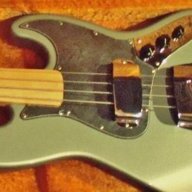

Edit: btw, as I'm the first person on TB, to my knowledge, to state that the hippies who couldn't afford 60s preCBS back in the day are now getting pissy because the 70s stuff they had was let go of before it gained vintage cache, is an original thought and not a cliche!
 
The quality did vary considerably in the 70s - one thing you want to look for is how the neck sits in the neck pocket. You want that fit to be nice and snug with no gaps. I have a '76 P fretless with a maple board that weighs 12 lbs and has fantastic tone. So be sure to try this one out. The price seems pretty good is it's well made, clean and original. Not a killer deal, but not a bad deal.
 
One other thing that ALWAYS gets lost in these discussions is the sociological/psychological aspect of a collector market. People are not just buying vintage instruments for their utility as musical instruments -- no one in there right mind could believe that a 60 stack knob is 20k better than a new American reissue strictly as a player! Just like no one could believe that an original first issue of Batman will read 60k better than a new reprint! By comparison 70s Fenders are still super deals, because they can had for the same or a little more than new ones, and are generally just as useful as actual musical instruments!

That is my example of collectors keeping the market up and keeping 70's Fender collectable. Players just want a good bass..collectors want to make a profit down the line form the bass.
 
I know my statement about the lice infested counterculture got to you a bit :), but those two statement you quoted are not inconsistent and in fact really support each other. Please tell me you never stripped the paint off of an old Jazz bass :)


Edit: btw, as I'm the first person on TB, to my knowledge, to state that the hippies who couldn't afford 60s preCBS back in the day are now getting pissy because the 70s stuff they had was let go of before it gained vintage cache, is an original thought and not a cliche!
So, your phrase slagging an opinion you attribute to a "drugged brainwashed counterculture" is consistent with judging ANYTHING as an individual rather than a cliche? Please.
 
Players and collectors are not necessarily mutually exclusive! In fact, most of the collectors I know and have known also play.

Very true. A local dealer here knows a few national dealers he has done some show's with sitting on 100's of Fenders waiting on the market. They sell a few and buy a few all the time and they watch the market...trust me.
 
So, your phrase slagging an opinion you attribute to a "drugged brainwashed counterculture" is consistent with judging ANYTHING as an individual rather than a cliche? Please.

Yes. My opinion about hippies is an original thought and not a cliche -- think about it. Are we off topic yet? I guess it doesn't matter because the OP hasn't posted since early in the first page -- he has either given up or doesn't care about this thread :)
 
See above. Fact or self-generated myth...?

Cliche:

An expression, idea, or element . . . which has been overused to the point of losing its original meaning or effect, rendering it a stereotype, especially when at some earlier time it was considered meaningful or novel. Most phrases now considered clichéd were originally regarded as striking, but lost their force through overuse.
 
Are we off topic yet?

Yes. And I think your point was that late 70s Fenders are great and that any of us who had bad experiences with same must have been deluded or somehow incapable of making a sound assessment. Or angry and resentful because we sold ours cheap (an ORIGINAL thought!). And some other stuff as the argument shifted. Done here, bye!
 
Yes. And I think your point was that late 70s Fenders are great and that any of us who had bad experiences with same must have been deluded or somehow incapable of making a sound assessment. Or angry and resentful because we sold ours cheap (an ORIGINAL thought!). And some other stuff as the argument shifted. Done here, bye!

My problem is with the generalizations (based on stereotypes) and I have stated that many times in this thread and in others like it. I'm sorry you didn't like a particular bass or two, but that doesn't mean that all or most 70s Fenders are bad.
 
My problem is with the generalizations (based on stereotypes) and I have stated that many times in this thread and in others like it. I'm sorry you didn't like a particular bass or two, but that doesn't mean that all or most 70s Fenders are bad.

TBers: The majority of posters who knocked 70s Fenders in this thread - myself included - were folks who themselves had contact with these instruments; further, many went on to qualify their statements by saying that good (or even great) examples exist. That's how adults construct an argument: Here's something I know for a fact, but I don't know everything and so I leave room for alternate possibilities.

They don't ALL suck. They're not ALL great. It was, though, a period in Fender's history that has a reputation for producing inconsistent and often sub-par instruments - or else it would not have that reputation. This judgment was not formed due to lack of information.

AND there is every less place for posts that make blanket personal attacks than there is for posts that make blanket attacks on instruments.
So we're agreed. Who'd a thunk it?
 
I saw a 73 fretless p bass in oldtown music downtown portland yesterday. I picked it up it was my first fretless i have ever wanted to try and i loved it. They wanted 1400$ for it which seemed a bit high with how bad it was beat to hell but it played like a dream. If i had the extra cash i probably would have bought it. it was alittle on the heavy side but that doesnt bother me my mim j bass weighs a good 12 to 13 pounds ha
 
Yes. And I think your point was that late 70s Fenders are great and that any of us who had bad experiences with same must have been deluded or somehow incapable of making a sound assessment. Or angry and resentful because we sold ours cheap (an ORIGINAL thought!). And some other stuff as the argument shifted. Done here, bye!

That sums it up. I opt to pay him no mind.
 
im curious, what made the 62,65, and 66 great basses and the 79 terrible?

Sorry I missed your question earlier.

First let me say that I had a 77 Mustang that played, sounded, and recorded just fine. As for the the 79 P, we can throw out the fact that it weighed 10.5 lbs as that can be seen as a preference issue. It had awful fretwork, two of the pickup screws spontaneously ejected at one point, the overall tone of the instrument was flat and dull. This bass was banished from the recording studio on two occasions that I remember - once replaced by a 70s Jazz (great bass, BTW!). I bought a new Squier CV 60s Precision about a month ago and one of my first reactions was how much better the affordable Squier was than that 79 P.

When I said that I'm glad it got stolen, I really mean it - I then had the excuse to buy another - a new 1982 G&L L1000, which was so far superior in fit, finish, playability, and sound as to make comparison irrelevant. I was a youngster and didn't really know how much better things could be - what an awakening! I still own the G&L. That's pretty much my experience with the 62, 65, and 66 basses: Played well, sounded good, solid construction, as well as more reasonable weight (for me).

It may be that the issues I cite with my 79 P are things that could be have been repaired. But they are things that should not have to be repaired on a new, top-of-the-line instrument made by a reputable company.