Do any of you play drums? Don't have to worry about breaking strings. I might want to pick it up sometime.

Enjoy the benefits of a premium membership!
Upgrade Account
-
TalkBass has been independent since 1998. Add your voice.
Create a free account to reply to discussions, view embedded media, and browse with fewer display ads.
Join free Log in
Want zero display ads or expanded classifieds tools? Compare plans.
You are using an out of date browser. It may not display this or other websites correctly.
You should upgrade or use an alternative browser.
You should upgrade or use an alternative browser.
Learning drums
- Thread starter GC34
- Start date
More options
Who Replied?
Yup, I do. True, you don’t have to worry about breaking strings but you have to worry about a truckload of other things. As I get older bass is definitely becoming the more practical choice. Loading drums in and out of gigs and rehearsals can get tiresome pretty quick.

I started as a drummer. Played for 3 years before I switched over to bass.
I recommend this book

I recommend this book

Studies drums and percussion in college and spent over 30 years of my pro career playing primarily drums.
Honestly at this point I find drums to be too easy and somewhat boring. 90% of what I play is groove… and I like it… and when the band grooves it’s awesome. But bass (and guitar) are more of a challenge for me and I like that.
Honestly at this point I find drums to be too easy and somewhat boring. 90% of what I play is groove… and I like it… and when the band grooves it’s awesome. But bass (and guitar) are more of a challenge for me and I like that.

I bought a it so I could host without drummers having to load in my house. I fool around on it a bit and have actually sat behind a kit at a private jam (when the host was passed out in his room) and held my own. But I don't claim to "play" them. If I was forced to quit bass and pick up another instrument, it would probably be drums though.

It's not for the fainthearted, drumming. A while back, like fifty or so years, I was taught to play by an excellent old drummer. Short stint — life got in the way — but I never gave it away. Taught myself, just because rhythm really got under my skin in a big way. It was decades later that I got back into it, in the orthodox sense. (You don't need a drum to be a drummer
 ) Rhythm's the key, with everything. You take it wherever you venture. Drumming, timing, rhythmic flow, is always worthwhile and always helpful. Don't hesitate

Drums can be a space- and cash-intensive hobby, ask me how I know
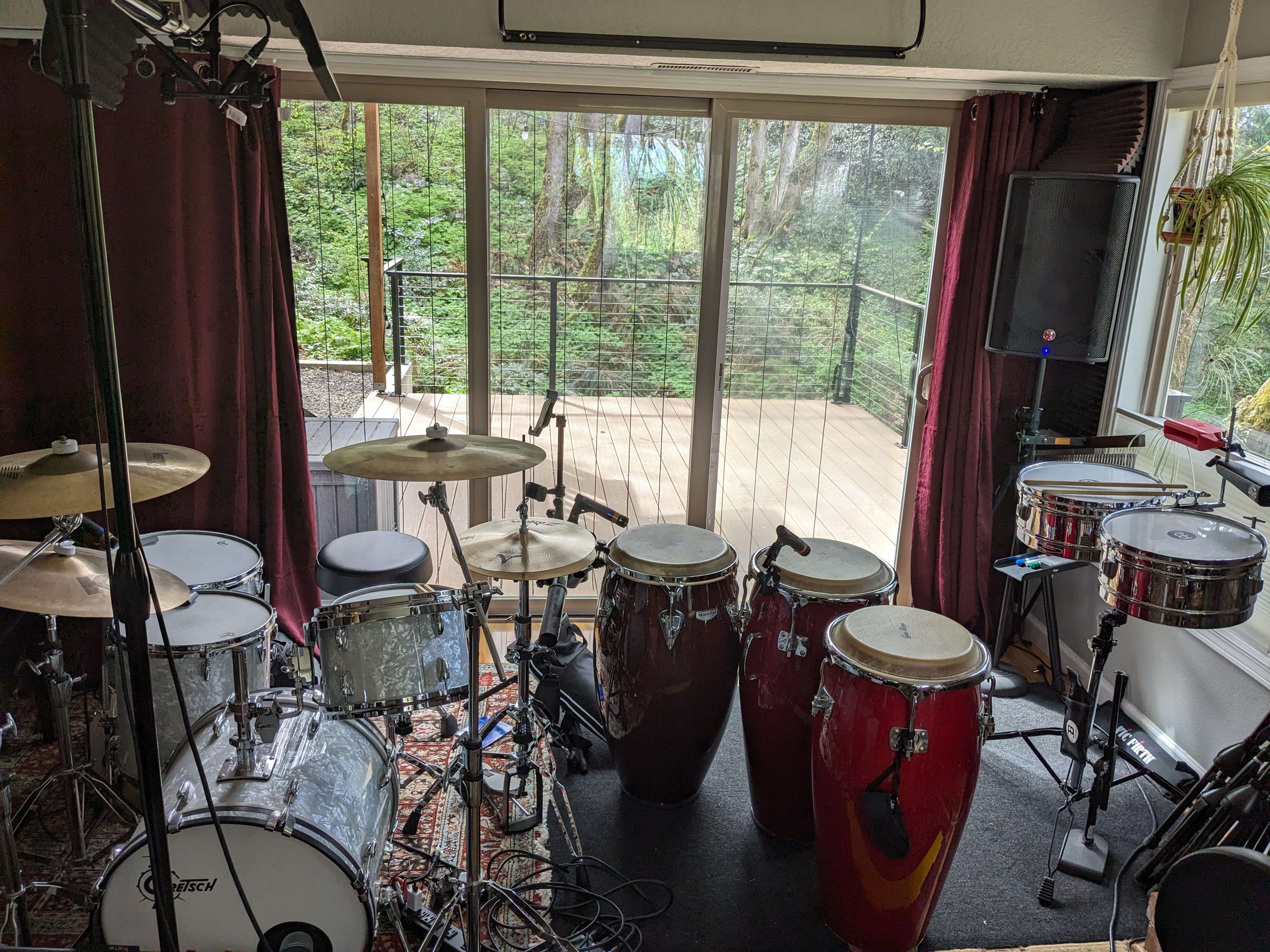
I just recently bought a Roland V-drums electronic kit, used. Had to replace a few of the piezo foams on the mesh heads, but after that they work like new. But now comes the hard part: practice.
I had a set of acoustic drums in the early 2000’s and tried learning. I definitely had a better feel for the real thing over this electronic set. Hi-hat control especially.
I do appreciate being able to practice at low volumes - as the acoustic set was just too loud. My hearing is seriously messed up (constant 24/7 ringing, can’t hear conversations in crowded rooms, etc) from standing near the drummer in my bands without earplugs. So yeah, really liking the electric set for low volume.
I think it has a built in trainer mode. And there’s videos on youtube about how to properly hold the sticks. I ised to mess around on my drummer’s kit back in the 90’s, so I have a general feel for it but I’m really really really bad. Just got to put in the seat time to get adequate.
I had a set of acoustic drums in the early 2000’s and tried learning. I definitely had a better feel for the real thing over this electronic set. Hi-hat control especially.
I do appreciate being able to practice at low volumes - as the acoustic set was just too loud. My hearing is seriously messed up (constant 24/7 ringing, can’t hear conversations in crowded rooms, etc) from standing near the drummer in my bands without earplugs. So yeah, really liking the electric set for low volume.
I think it has a built in trainer mode. And there’s videos on youtube about how to properly hold the sticks. I ised to mess around on my drummer’s kit back in the 90’s, so I have a general feel for it but I’m really really really bad. Just got to put in the seat time to get adequate.
If you do decide to pursue it might I suggest this will be an invaluable resource … everything you need to actually play and nothing you don’t.
https://www.amazon.com/Funky-Primer-Rock-Drummer/dp/0739006630
https://www.amazon.com/Funky-Primer-Rock-Drummer/dp/0739006630
As an Amazon Associate, TalkBass may receive commissions from qualifying purchases made via links on this site.
I probably should have been a drummer as my uncle and step-father were both Jazz drummers. I’ve always been more rhythm oriented than melodic. I play guitar, bass, and mandolin, as well as cajon, congas and djembe. Many times when I’m playing strings, I daydream about what percussion part I would also play. But I really would dislike toting and setting up a full kit.
I concur, I have a lot of good rides, hi-hats and snares, a bit pricey. To OP, you also have to tune them if you want the kit to sound the best/to your likings.Drums can be a space- and cash-intensive hobby, ask me how I know
View attachment 5436193
**You have a Gretsch too! Mine is a lower tier (but really good sounding) Catalina Jazz with the little 18 inches BD and only two toms. I only use two rides, one as a crash and the other… as a ride!
Last edited:
I do, poorly, but I can tune and dampen a kit like a real player. If you are troubled by the dangers and questions regarding random but extremely rare incidents of bass string breakage, you will be overwhelmed by the tuning options in pitch, methodology, damping and head selection owning drums, outside of finding good examples to start with...also the fact that each drum in a kit is an instrument in of itself to be tuned using a minimum of 12 manual lugs to control 2 interconnected, reactive surfaces the work together to make a pleasing "bonk" noise that subtly degrades each time you strike it. One cheap head can cost the price of a set of cheap bass strings and the average kit has perhaps ten.
For all the talk of firing drummers...anyone can beat on a bucket, but being able to play the drums expressively and match/tune components when every speaker nearby causes trouble is truly an art and a lifetime pursuit like any instrument. I won't say what I have tied up in a rack, drums, cymbals, percussion tidbits and head library, but I'd be surprised if I haven't surpassed my bass investment twice over...and
I have expensive tastes in basses, not as much in amps and cabs.
TL;DR: Bass is cheaper with less problems to worry about. A crummy bass played by a pro can sound better than a crummy, poorly tuned kit played by a competent percussionist.
For all the talk of firing drummers...anyone can beat on a bucket, but being able to play the drums expressively and match/tune components when every speaker nearby causes trouble is truly an art and a lifetime pursuit like any instrument. I won't say what I have tied up in a rack, drums, cymbals, percussion tidbits and head library, but I'd be surprised if I haven't surpassed my bass investment twice over...and
I have expensive tastes in basses, not as much in amps and cabs.
TL;DR: Bass is cheaper with less problems to worry about. A crummy bass played by a pro can sound better than a crummy, poorly tuned kit played by a competent percussionist.

I do, poorly, but I can tune and dampen a kit like a real player. If you are troubled by the dangers and questions regarding random but extremely rare incidents of bass string breakage, you will be overwhelmed by the tuning options in pitch, methodology, damping and head selection owning drums, outside of finding good examples to start with...also the fact that each drum in a kit is an instrument in of itself to be tuned using a minimum of 12 manual lugs to control 2 interconnected, reactive surfaces the work together to make a pleasing "bonk" noise that subtly degrades each time you strike it. One cheap head can cost the price of a set of cheap bass strings and the average kit has perhaps ten.
For all the talk of firing drummers...anyone can beat on a bucket, but being able to play the drums expressively and match/tune components when every speaker nearby causes trouble is truly an art and a lifetime pursuit like any instrument. I won't say what I have tied up in a rack, drums, cymbals, percussion tidbits and head library, but I'd be surprised if I haven't surpassed my bass investment twice over...and
I have expensive tastes in basses, not as much in amps and cabs.
TL;DR: Bass is cheaper with less problems to worry about. A crummy bass played by a pro can sound better than a crummy, poorly tuned kit played by a competent percussionist.
Awesome explanation and he hasn't even started on cymbals yet. Expensive too. You can buy many Squires for just an entry level bronze cymbal set. Yep drum tuning even with these new tuning aids is an art. Hardware like bass drum pedals are equally expensive and adjusting them so you can play effectively is also not an easy task.


At the most, it’s two trips from the car to the venue on bass. At minimum with drums, it’s three and that’s three incredibly heavy and uncomfortable trips.Yup, I do. True, you don’t have to worry about breaking strings but you have to worry about a truckload of other things. As I get older bass is definitely becoming the more practical choice. Loading drums in and out of gigs and rehearsals can get tiresome pretty quick.
Drumming requires a lot of things to go right that you can work through on bass. Back injuries, flu, and general exhaustion are much easier to navigate on bass than drums.
Yes... but it's really fun when you are half decent at drumming. Worth the hassle!At the most, it’s two trips from the car to the venue on bass. At minimum with drums, it’s three and that’s three incredibly heavy and uncomfortable trips.
Drumming requires a lot of things to go right that you can work through on bass. Back injuries, flu, and general exhaustion are much easier to navigate on bass than drums.
Don't have to worry about breaking strings..
But, you do have to worry about breaking sticks and, if you tune up too high, breaking heads.
I’ve found the gigs where I take everything and have to make five trips are way more fun than the ones I’m just getting through with a minimalist kit for the easy money. I will never drum with the flu again though lolYes... but it's really fun when you are half decent at drumming. Worth the hassle!

Yes, learning to play drums (good or...) can only enrich your musical experience. I play guitar, bass, and drums, enjoy all 3, win!
I watched a Rick Beato interview with Warren Haynes today, Warren even said he plays drums, he thinks it always helps to understand how musical instruments work, for him any ole how.
Enjoy, have fun!