

Enjoy the benefits of a premium membership!
Upgrade Account
-
TalkBass has been independent since 1998. Add your voice.
Create a free account to reply to discussions, view embedded media, and browse with fewer display ads.
Join free Log in
Want zero display ads or expanded classifieds tools? Compare plans.
You are using an out of date browser. It may not display this or other websites correctly.
You should upgrade or use an alternative browser.
You should upgrade or use an alternative browser.
Leave those necks on!
- Thread starter LowRick
- Start date
More options
Who Replied?
Let’s say that guitar manufacturers bolted the neck to the body instead of using wood screws. Torque would then become an issue because if a bolt is overtightened, it could crack and splinter the wood. Most of the wood joinery that I’ve seen and done, its screws, nails, brads, and glue that do the connecting.
There was a topic similar to this one awhile back concerning wall hooks. The poster was concerned that hanging a bass on a wall hook could loosen up the wood screws that hold the neck to the body.
There was a topic similar to this one awhile back concerning wall hooks. The poster was concerned that hanging a bass on a wall hook could loosen up the wood screws that hold the neck to the body.

Dingwall’s earlier basses used threaded inserts, but their newer basses that I’ve seen have 1/4”-20 threads tapped into the maple — and tapping threads into the wood is a REALLY reliable way to attach them.I think Dingwall uses the metal inserts. I had them installed in a couple of my Warmoth necks so I can swap them to my heart's content!
He attaches the bridges and pickup screws the same way...

Turnaround
Commercial User
I'm surprised that he wasn't concerned about the neck stretching under the weight of the bass, thus causing intonation issues. Equally possible.There was a topic similar to this one awhile back concerning wall hooks. The poster was concerned that hanging a bass on a wall hook could loosen up the wood screws that hold the neck to the body.

i take the necks off of my axes after each use...don't tell me i'm the only one....

Why not just use threaded metal inserts, and then get smaller screws? Imo, the "problem" is now solved.
This is how I build all of my bolt-on necks. It works really well.
Can we do that when/if the problem occurs? I've also thought of that possible problem although I've removed/installed many necks (some very old) w/ out problems. I think if the threaded metal inserts can be installed at a later stage, we'd be fine.
I honestly think removing/installing the bridge too many times is more risky.. I've seen basses w/ bridges pulled out by the strings. I like the string-through bridges for that reason. May be I worry too much..

- Apr 18, 2008
- 16,003
- 1
- 31,694
- Disclosures
- I'm highly opinionated and extremely self-assured


If it indeed matters (it doesn't) then I'm just now finding out and had absolutely no indication until now that I've inadvertently ruined nearly every guitar I've ever owned.

Looking around on Reverb and other (local) used stuff sites, i see a lot of basses with the necks removed to show whats underneath.
I'm a technician and also a pretty curious guy... but this always rustles my jimmies. A lot of basses have what is called a "bolt-on" construction. In fact no bolt ever comes near it (wish they did). It is "screwed on" and everyone who ever used screws knows that it's in some way a destructive process. As a screw is turned in, the "thread" is being cut. This is not neat and nice thread like when a bolt is used, but crude and actually different for each screw. It's a very secure connection and solid and ridgid etc, but when you loosen the screws to remove the neck, you can, in some cases, see wood come out of the hole. meaning, the next time you reinstall it, the screws will have lost some power, tightening wise. worst thing that can happen is not the same screw in the same hole. No screw is exactly the same as an other one.
I know i'm a Nitpick right now, but i've been thinking about this for quite a while and find myself looking at awesome J-Basses that are and look great, but i hit the little cross as soon as i see a picture with the neck removed or a clearly damaged neck-joint.
Am i alone in this? am i going too far with it? Should i go to therapy?
I have replaced some of my screw on necks with a threaded insert, 1/4-28.
Now exactly how many times a week are you taking the neck off your instrument.
Things properly screwed together, stay togeather, even with wood screws.
"And my time is a piece of wax falling on a termite choking on a splinter"
Find something else to worry about of fix it, but don't obsess.

This reminds me of the thing going around in the 80's about not getting back into your car when pumping gas because when you get back out your clothes could create static electricity which could cause a spark so when you touch the metal nozzle to remove it from your tank the spark could fly down the gas tank and cause an explosion. Yea
In 1969, I did watch a helicopter completely burn to the ground (including the bright white flame of its magnesium engine support) because of a static spark from a nylon flight jacket while it was being fueled. That was 115/145 octane aircraft gasoline, though, which is much more volatile than automotive pump gas. That's why ground crews are not supposed to wear nylon.

"And my time is a piece of wax falling on a termite choking on a splinter"
Someone quoting Beck always gets a thumbs up!
Anyway, i'm not obsessed, thanks for your concern, and I've never taken a neck off a bass so far. Won't do it either unless I really have to for maintenance or damage repair (and for adjusting if it is required) I'm just pointing out that it seems to be a hype on reverb. And I don't like it at all

I kind of sit on both sides of the fence here. Just because a neck CAN be removed, does not mean it should. And if it is removed, it should be done with the upmost care and detail. But I would not pass up on an awesome instrument just because of it.

That's why I cannot deal with a vintage truss rod. That's partially removing the neck every season for adjustments or even worse if you tour.
I can't even listen to old albums knowing those classic fenders didn't have structurally perfect neck to body attachment. I can hear the loss of mojo.
I can't even listen to old albums knowing those classic fenders didn't have structurally perfect neck to body attachment. I can hear the loss of mojo.
Last edited:

Post of the month!!
Please tell us how to prevent pickguard mojo leaks!!
Well okay, but don’t say I didn’t warn you.
First of all, the best way to prevent pickguard mojo leaks is to never, ever loosen a pickguard screw for any reason. However, what if your adopted daughter sneaks into your music room at night with a jeweler’s screwdriver that she stole from your brother-in-law who sells fake Rolex watches on the side, and unscrews the pickguard screws on your 1969 Precision bass? What do you do then?
The first thing to understand is that the mojo released by unscrewing pickguard screws will be much more diffuse than the mojo released by unscrewing neck screws. Obviously, this is because it’s distributed over so many different screws. Think of it – thirteen screws for a standard Precision pickguard, as opposed to only four for the neck mounting plate! If you also have the tug bar and the pickup cover screws, you might as well just shoot yourself in the head. Let’s not think about such things. We’ll just pretend, for the sake of sanity, that there was no tug bar and your pickguard only had thirteen screws, or fewer.
Still, your adopted daughter, who let’s face it isn’t really related to you and shouldn’t have free run of the house, at least until she reaches the age of reason, which might be never, has now released thirteen separate portions of mojo, which means each discrete piece of mojo is much smaller than if you had only released four separate portions. Are you following this? And being so small, there’s no way you’re going to keep them in the house. They’ll get out. They can slip through the smallest cracks and crevices. And once they’re out, they might go in different directions. Imagine, there are now thirteen little clouds of mojo wandering lost through the world, instead of just four (or five, if you’re one of those people who favor unbalanced neck plates which lead to neck dive and bald spots but that’s another story altogether). How to get them back?
To put it bluntly – you’re going to need supernatural assistance. Which means you’re going to need a chicken.
Not one of those $4.99 Costco rotisserie chickens. Don’t be a putz. You need a real, live chicken (well, it won’t be live for long, but it has to start out that way). And it should be a stolen chicken. The best thing is to steal a chicken from a bad man. The worse, the better, if you get my meaning. If you can arrange to steal a chicken from a horse thief, that’s ideal. Or a grave robber. Stealing a live chicken from a grave robber will practically guarantee the return of all your lost pickguard mojo. If you can’t find a horse thief or a grave robber, then someone in advertising. Try to be creative.
Now, take the chicken and your pickguard and one of the strings off your bass – I recommend the G string – and go out to the graveyard. You do this at night, of course. About 1:00 a.m. You’re going to kill the chicken (the easiest way to do this is just grab it by the neck and crank it around over your head a couple or three times) and send its spirit to recover your lost pickguard mojo. But first, you need to build a fire. Find a flat gravestone under a tree, and make a small pile of plastic shavings from the edge of your pickguard (you’ll need a knife or a vegetable peeler for this). Light the plastic shavings on fire. Now, while the fire is burning, quickly kill the chicken and hang it from a branch of the tree using the G string. Hang it by the feet, and then slice open its neck so the chicken’s blood drips down onto the plastic fire. The smoke from the burning plastic pickguard shavings will mingle with the steam from the chicken’s blood, and this is when you have to forcefully say these words: “Spirit of this bad man’s chick, go get my pickguard mojo, quick!” Say it thirteen times (or however many pickguard screws have been removed) and then throw graveyard dirt on the fire to extinguish it. Go home and eat the chicken.
The next day, reinstall your pickguard screws, making sure to put each screw back into the same hole it was removed from (God help you if you don’t know which one was in which hole). You should also use a new pickguard, the old one is no longer any good and should be disposed of. Actually you should have buried it in the graveyard, but you didn’t, and it's too late now. But not to worry, you can always leave it on the doorstep of the bad man you stole the chicken from.
I hope this is helpful. By no means will this work twice for the same bass, so make sure you kick your no-good brother-in-law’s butt and inform your adopted daughter that if she keeps playing with screwdrivers, her ears will fall off.

Also, seems like a good idea when reinstalling the screws: turn them counter-clockwise by hand for just a bit until you feel it "click" into the pre-cut threads in the wood. Then tighten. That way the screw won't be tempted to cut new threads in the wood.
This! I've removed screws from wood, plastic, and metal tens of times (for the same screw) and have never stripped threads using this technique. Not using this technique or using power tools for removable screws is an "accident" waiting to happen.
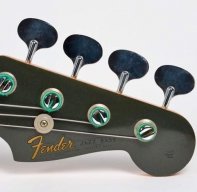
It’s absolutely necessary to remove the neck on a vintage Fender bass or guitar to verify the neck date stamp and also the “paint stick” mark in the neck pocket (of mid 1960s thru 1970s Fenders) to help verify an original finish. The finish can affect the value sometimes by thousands of dollars. If the OP would rather take a chance on paying full value for a refinished vintage bass, than risk widening a screw hole which can be repaired/filled in quickly and easily (and still function perfectly afterwards), then that’s up to him, but that’s silly when there is a good amount of money at stake. As a guy who has been buying/selling/collecting vintage Fenders for decades, I can tell you I’d have a much harder time selling basses if I did not take the necks off to photograph and verify for my potential buyers... and I would never spend big money on a vintage bass that I could not fully verify by seeing the neck removed (unless the seller guarantees it to be original with a return policy AND is a trusted seller with experience).
Care to share the right and wrong ways to do it? Thanks.
Good question and answered via bits and pieces throughout this thread. The highlight (IMO) is to actually turn the screw CCW slowly when re-introducing...you'll feel it drop into place when the threads align. Some addt'l tidbits which fall under the umbrella of conventional wisdom:
*Remove the strings before removing the neck....d'oh!!
*Okay, if you just need to loosen the screws to access the truss rod, a capo will keep the strings in place.
*The screws should pass through the body / pocket freely.
* A scant amount of paraffin, Ivory bar soap, etc. can be used to lube the screws.
*Nothing wrong with replacing the wood screws with inserts & machine bolts. Those-in-the-know (...and smarter than I!) advocate this mod to optimize contact between the neck and body.
*Once the neck has been re-installed and strings tuned to pitch, slightly loosen the screws so the neck can firmly butt-up against the end of the pocket.
That's a start.
Riis

My Warmoth strat requires a neck removal to adjust the truss rod. It's probably had the neck off of it 20 times now, and continues to be fine

Ric5
Inactive
- Jan 29, 2008
- 29,772
- 30,452
- Disclosures
- I like 5, 8, 10, and 12 string basses

I feel ya. I personally don’t touch basses that pictures show they clearly have been taken apart because I don’t know the competency of the seller. I get some people want to know for example if a vintage fender is legit. But I never felt the need to spend a fortune on super old gear.
Frankly, I’m not about to shell out bunch for any instrument I haven’t played first. Secondly, I’m with you on not paying big buck for something just because it’s old. I sure their are lot of good instruments that were made in this century that will fill the bill, and not break the bank.
If you are building a collection for your retirement like, buying the bass once owned by the roadie for Herman Pustuitneck, bassist for the “Raging Liver Bile” death metal group, instead of contributing to your IRA or some other retirement account for instance, you're likely going to be in for a shock...


