• TalkBass has been independent since 1998. Add your voice.
    Create a free account to reply to discussions, view embedded media, and browse with fewer display ads.
    Join freeLog in
    Want zero display ads or expanded classifieds tools? Compare plans.

Left hand position

Hi all,

I'm after some advice on left hand position.. when playing fast runs, my hand always ends up at an angle like this:
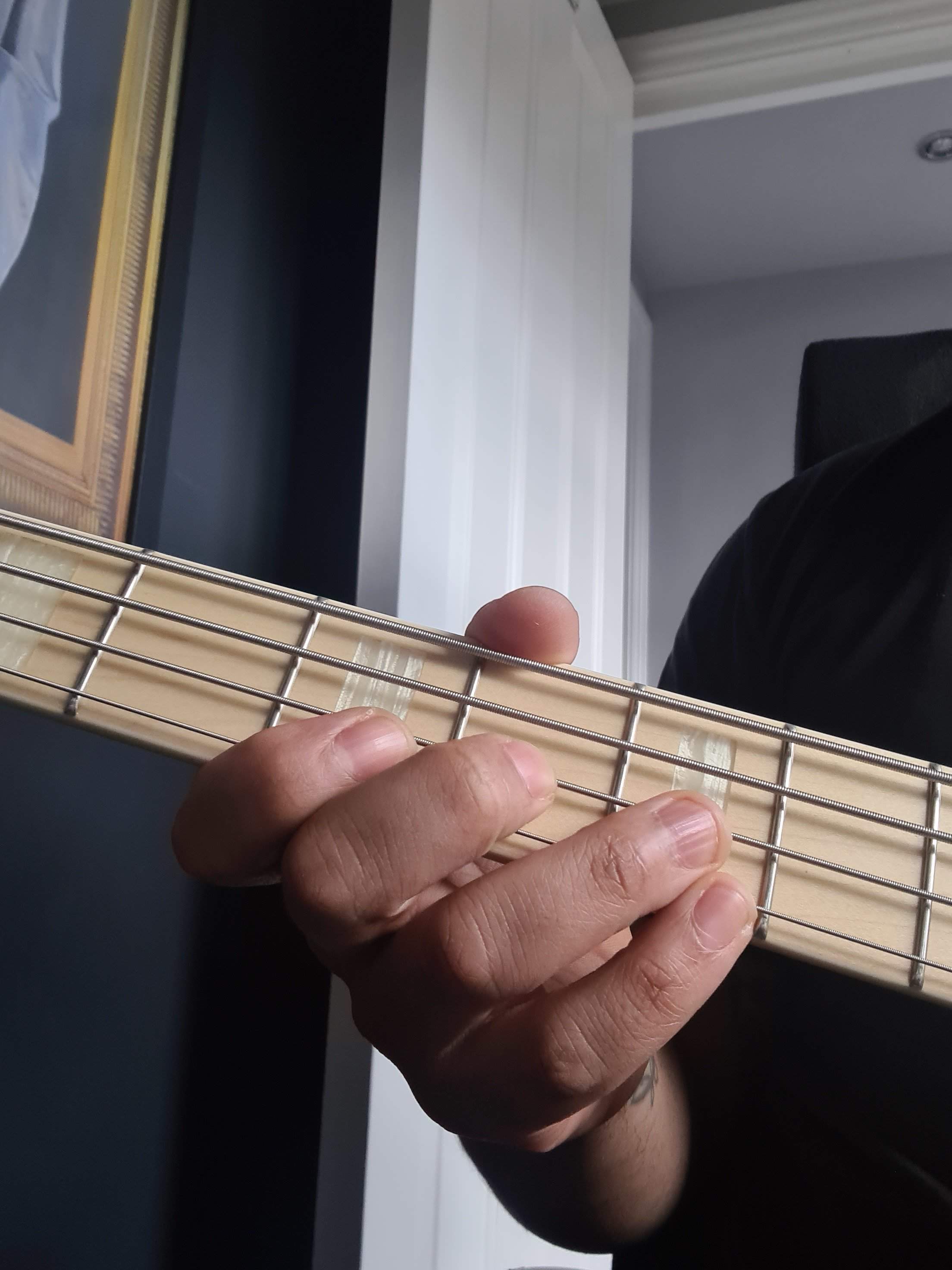
20210313_095026.jpg


Normal playing I do tend to stick a straighter hand position like this:
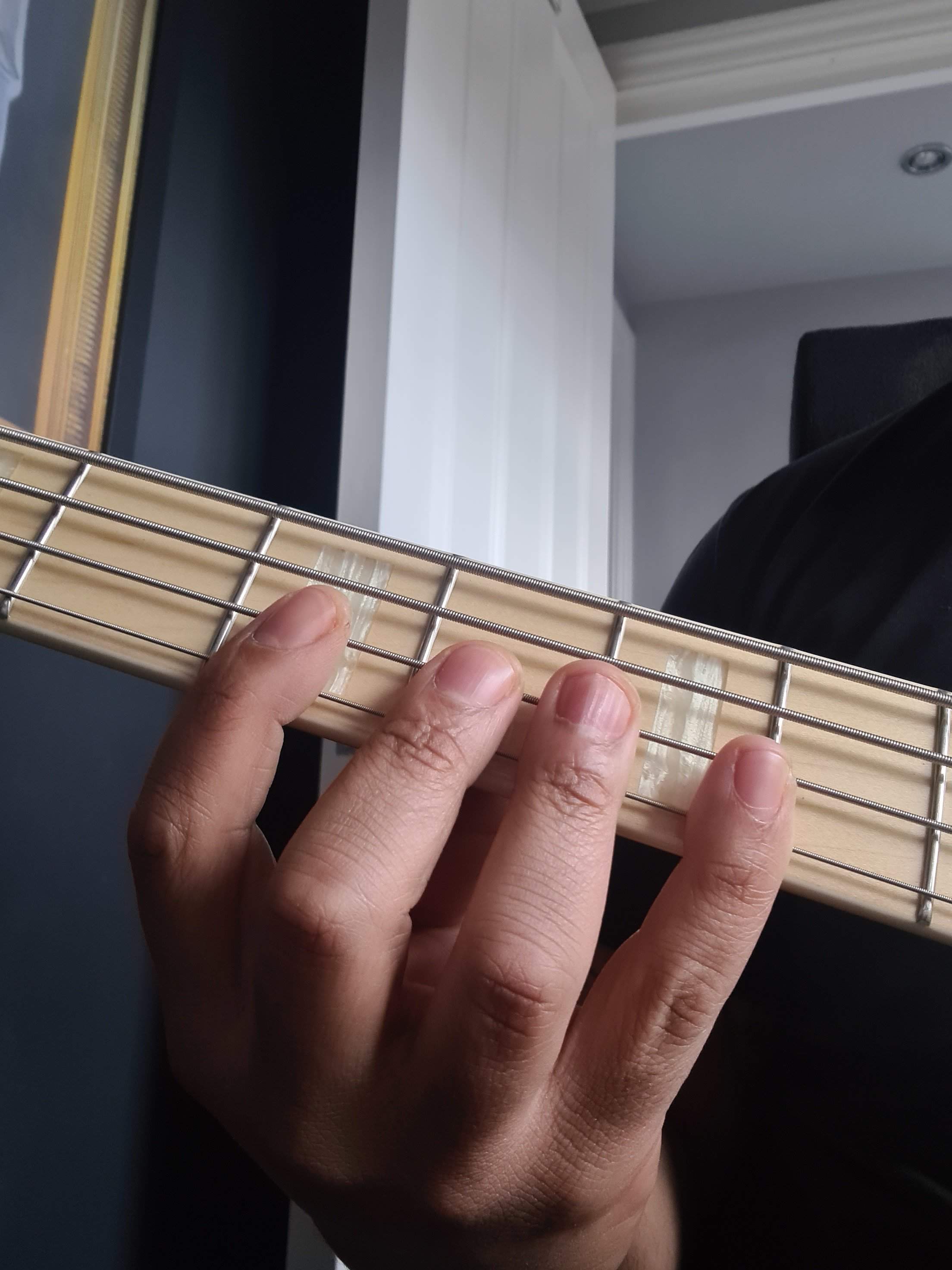
20210313_095036.jpg


I notice it's more on the d and g strings on fast sections where my hand starts to angle...

Should I spend time correcting this or is this fairly normal? It feels easier to play slightly angled, but I wonder if that may be just a practice thing and ultimately a straighter hand would provide more control and allow me to play at a faster speed.

Looking around YouTube videos, everyone has their own style, but wondering what the group here thinks and what would be the "correct" way...

Cheers!

Wrap
 
  • Like
Reactions: 31HZ
Should I spend time correcting this or is this fairly normal? It feels easier to play slightly angled, but I wonder if that may be just a practice thing and ultimately a straighter hand would provide more control and allow me to play at a faster speed.

This is a question of 'posture' - how you shape you hand and move it as a unit. Your posture should remain the same regardless of tempo or position. If your posture is being lost at tempo then you need to ingrain it more with exercises that target the deficiencies.

I can see from the pictures that your basic posture is flawed. Although the spatial relationship of your fingertips to the frets looks radically different between the two images, the basic flaw is present in both positions.

It is difficult to identify what your intended fingering 'method' is, but it is not important as the basic flaw will be present in both, for now, but I will assume 1-2-4. If so, then your first and second fingers are way too far behind the target frets. This means that you will be using far more fretting pressure in your left hand than is necessary. At tempo there will be insufficient time to get your fingers down with the force necessary to play a clean note. I suspect that your hand quickly gets tired? It is my suspicion that you are creating the additional force/pressure by contorting your hand in an attempt to get all the notes in. For the 1-2-4 fingering, your posture should position the 1st, 2nd and third fingers on the back edges of the frets, like this...
upload_2021-3-13_12-4-39.png

For one-finger-per-fret, the posture should also position the fingertips at the back edges of the frets, like this...
upload_2021-3-13_12-12-40.png

Try to practice this at slow tempo and only increase tempo once it is second nature. I would suggest putting the fingers in position, then releasing the pressure slowly until the string comes off the fret. Playing on the wire you will be surprised at how little force/pressure is required, compared to playing between the frets asyou currently are.

YMMV
 
Hey thanks for the reply!

I was really just concerned about the angle of the hand in those pics... I wasn't actually trying to fret a note...

Now, that said, I do think your analysis about hand contortion to get pressure is accurate. I've always played just before the fret but never touching the frets like your pics...

Hmmm :)
 
  • Like
Reactions: SteveCS
Now, that said, I do think your analysis about hand contortion to get pressure is accurate. I've always played just before the fret but never touching the frets like your pics...

Believe it or not I'm not actually touching the fret there, which shows how little pressure is required. But yes, something about playing at tempo is causing you to lose whatever posture you have at slower tempo. On a more general note I think, from the pictures, that your posture might benefit from getting you elbow away from your body. If your elbow is lodged into your body the way it appears to be you are losing your upper arm/shoulder from the system that maintains your hand posture. Your forearm is coming away from the neck at quite some angle - it should be more or less perpendicular, give or take a few degrees. With the longest lever gone, the angles in your wrist will also be changing all of the time as you move up and down the neck. Maybe that is also a factor leading to inconsistent posture?

It is difficult to tell from a couple of pictures, but if you have a large mirror I would use it to take a closer look at how your hands move - see if you can find any other small details that might be problems. Usually, IME, these things are a combination of several small problems, not one single issue.
 
Oh there is definitely no space between my arm and my body... I just let it sit in its natural position, which is obviously next to the body. Do you mean i should purposefully make space? I do wonder how much of this is caused by playing while sitting down, too...?
 
Do you mean i should purposefully make space? I do wonder how much of this is caused by playing while sitting down, too...?

Yes. As @James Collins noted above, the whole of the arm should be used to maintain posture through all positions. Planting your elbow at your side takes away the longest lever in that system.

Sitting down presents it's own problems. My guess is that the plane of the bass is not parallel with the plane of your body, that the neck is pointing away out in front of you and that you are either reaching forwards to play near the nut or hunching your shoulders to play up in higher positions above the octave, and that your back is twisted.

Try to find a sitting position where your hips and shoulders are as square as possible with each other, i.e.no torsion in your spine, and get the bass neck sitting in a plane roughly in line with your shoulders. Move your hand around by raising/lowering your your upper arm from the shoulder to push your elbow in and out, which will shift your hand around whilst all the time keeping your hand in the same basic shape with respect to the neck.

Think about which thigh you rest the bass on, and whether or not you might be better using a strap.

YMMV.
 
@WrapRough

It may seem that this discussion on posture etc. is drifting away from your question about getting out of shape when playing at higher tempo. But it is not. The point is that good, well developed posture learned and 'grooved' deliberately at 'conscious' tempo* can be scaled to operate at any tempo.

* by which I mean a tempo at which you can think.

YMMV
 
I remember when I first joined a band and I'd only really played sitting down before that... It felt very strange and took time to adjust. As you say the plane is all wrong and I'm obviously doing weird posturing to work around that. The knock on effect being that my technique not optimal. Im going to practice standing in front of the mirror to figure out where it's going wrong, but I'd imagine that is a big part of it!
 
@WrapRough

It may seem that this discussion on posture etc. is drifting away from your question about getting out of shape when playing at higher tempo. But it is not. The point is that good, well developed posture learned and 'grooved' deliberately at 'conscious' tempo* can be scaled to operate at any tempo.

* by which I mean a tempo at which you can think.

YMMV

No it's all good dude, I'm in full listening mode ;)
 
  • Like
Reactions: SteveCS
Hi all,

I'm after some advice on left hand position.. when playing fast runs, my hand always ends up at an angle like this:

View attachment 4201230

Normal playing I do tend to stick a straighter hand position like this:

View attachment 4201232

I notice it's more on the d and g strings on fast sections where my hand starts to angle...

Should I spend time correcting this or is this fairly normal? It feels easier to play slightly angled, but I wonder if that may be just a practice thing and ultimately a straighter hand would provide more control and allow me to play at a faster speed.

Looking around YouTube videos, everyone has their own style, but wondering what the group here thinks and what would be the "correct" way...

Cheers!

Wrap

Pretend there's a ping-pong ball glued into the palm of your fretting hand as you're playing...that'll help keep it in good shape. Works for me, anyway! :thumbsup:
 
  • Like
Reactions: Bushmaster
Check your thumb position. What happens if you focus on keeping your thumb on the back of the neck during fast runs? Looks like you’re letting the thumb creep over the top, in turn changing the angle of your fingers.

Yeah that definitely happens. I feel like I have much less control on the d and g strings when playing in the "classic" position, so my brain is obviously trying to work around that by doing this weird thing to make it easier.

It's going to have to be a very slow and deliberate change to get out of that bad habit ingrained over years
 
Hi all,

I'm after some advice on left hand position.. when playing fast runs, my hand always ends up at an angle like this:

View attachment 4201230

Normal playing I do tend to stick a straighter hand position like this:

View attachment 4201232

I notice it's more on the d and g strings on fast sections where my hand starts to angle...

Should I spend time correcting this or is this fairly normal? It feels easier to play slightly angled, but I wonder if that may be just a practice thing and ultimately a straighter hand would provide more control and allow me to play at a faster speed.

Looking around YouTube videos, everyone has their own style, but wondering what the group here thinks and what would be the "correct" way...

Cheers!

Wrap


I suspect something else may be occurring. When you play something that is at or beyond your ability, there is a tendency to clench. What I mean by clench is tension in your hand, rather than playing with just the minimal effort required to get a good tone.

The muscles work in pairs. One muscle in the pair closes the joint and one muscle in the pair opens the joint. When you clench, both muscles are heavily engaged, so you are wasting a lot of effort with the muscles fighting. This prevents the muscles from moving the fingers around efficiently and also is likely to cause pain as the muscles become fatiqued.

As you get more and more experienced, you learn to develop independence between the fingers and also the individual muscles so this clenching does not occur.

The hand posture you use when you play fast, may be a result of clenching or an unconscious strategy you have developed to avoid clenching.

My suggestion is slow down and rework material up while focusing on playing with a light touch and maintaining the proper hand posture. This is something that will take time for you to master, so don't expect it happen in one sitting. You will probably need to strengthen new muscles and develop new ways of controlling them. You will have to think mindfully about what you are doing until the process becomes automatic.

I would also suggest finding exercises that develop finger independence. Start slow and then work them up to speed with a focus of using a light touch and maintaining good hand posture.
 
I have recently changed where I put my thumb and that has helped my position greatly. I used to be a mid back to high back kind of thumb guy. sometimes even over the top. I read bunny brunels bass book and he stated to keep your thumb on the very bottom of the back on the neck. Once I started doing this and the ping pong ball trick mentioned above, my positioning and fretting was much improved. I still slip back into old habits sometimes, but It has made a vast improvement in my playing.