• TalkBass has been independent since 1998. Add your voice.
    Create a free account to reply to discussions, view embedded media, and browse with fewer display ads.
    Join freeLog in
    Want zero display ads or expanded classifieds tools? Compare plans.

Length of your 'B' String

What Length 'B' String would be best for your Bass


  • Total voters
    146
  • Poll closed .
I also need to measure properly before I vote, but I know that the D'Addario EXL170-5 set in Long Scale is too short; the taper happens right at the nut, whereas the factory strings (which are ostensibly the same ones) taper at least an inch behind.

D'Addario's "Long Scale" is for basses needing strings from 34" to 36" from ball to taper, so I would reason that my bass probably needs a 37". There's about an inch and a half of headstock between the nut and B post, so I would say my bass would take a string between 37" and 38". I will measure and vote accordingly.
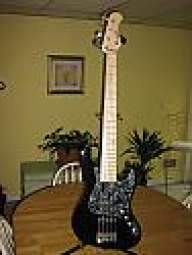
 
Zon Sonus RT 39" from ball to Bstring tuning key.

The winding length is measured from the ball to the nut/headstock side. To the post is a secondary measurement if breakage is a problem for overly long wound strings. This is not a common problem for roundwounds but does happen with other types of windings.
 
With all of the different scale lengths out there as well as the possibility of stringing through the body or the bridge, winding length is a complicated issue.

The good folks at D'Addario have a very simple way of measuring to insure that you get the set of strings with the proper winding length. Check out this link:

http://daddario.com/DADFaqAnswer.aspx?ID=762

D'Addario also has a nice selection of string lengths. It would be nice if all of the string companies did.

Also, all of the string makers should come up with standards for winding length. They should at the very least, state the winding length on the outside of the package.

Maybe even include the definition of "winding length" and how to measure for it on the outside of the package for those that are ignorant.
 
I have been preaching this winding length business for over a decade if not two. Did D'Addario just catch on or have thay had that info for awhile?

Remember now guys, we made our first 6 string back in 1981 for Anthony Jackson so I have been at this game for quite some time. There were no 'B' Strings on the market back then as I recall. It took a few years but soon after we advertised out 'B' string sizes, every other company suddenly had one.

We do have the winding length marked in the String Catalog, inside the String Package and on the Website. We just can't get people to read it!

"You can lead a Horse to water but you can't make him Drink it"!

On the 4-winding question, we only go up to 3, I think. I don't recall seeing any 4th winding models in our designs but I will go back about 20 years and look up my notes on the specs. Our Tuners are the smaller Post ones made by Gotoh and we have never had a breakage problem on the 'B's.

We have made various lengths available over the years but then someone somewhere makes a Bass that falls between the other numbers. Most of our Lengths for long scale Basses have been 36.5", 38" and 40". The 40s were made originally for 35" and 36" scale Basses but who makes a 36" scale Bass today in any volume? I think that 35" thru the body needs a little extra but most people have done just fine with our 38" lengths. We don't move all that much in 40" length anymore because most have gotten by with the 38" models in which we offer more gauges as well.

I have played the Double Bass for almost 45 years and never have I seen any instructions about Strings or winding lengths. The rule usually is "Don't' wind the thick part around the Post or it MIGHT break"! Usually it doesn't and this also goes for the Bass Guitar round wounds. The stiffer type winding strings like Flats and Ground/Pressed models are more prone to breakage on the lower E and Bs than on the rest of the strings.

Round wounds being the bulk of the industry today doesn't allow every company to offer a variety of lengths in the other winding styles simply because of demand. It eventually becomes a number$ game with most brands.
 
Dear all,
I do not know if this is the right place to post this question.
(I've also posted it on the Aria pro II thread)

I have trouble with Labella 760FS length on my 1982 SB1000
(This is a 4 string restrung in BEAD instead of EADG)
My problem is in the WOUND length at the ball end on the B string.

I recently installed LaBella 760FS-B deep talking flats.
However, the low B string (gauge .128 also sold alone under ref 765FS) is too long on the ball side.
More specifically, the portion of non-wound core is too long and extends over the saddle into the playing length:
(here on left both .128B's, the first one modified and 'frayed", the new one placed besides)
[Invalid or Expired Link Removed]

I stupidly decided to modify the ball-end of the string, and despite being carefull I screwed up the string and it now feels wrong in many respects. (photos and details upon request)

Is anyone using the same strings (in low B that is!) on a SB1000?
If yes, how do you fare ?
Should I :
- install the new 128B as shipped and have a skinny portion vibrating at the saddle end,
- do a different modif to the string (ball side),
- or (God forbid!!!) drill a hole in the SB1000 to insert the string from the back, (I.e. lengthen the string path before the saddle)

What would you advise ?
Thanks for your kind help,
Orphée, Grenoble, France
 
Thanks for this reply.
By "nut side " I mean that between the ball and the full thickness string, there is a portion of "naked" core (tapered) that is long enough to go further than the saddle.
This means that the vibrating string is not fully homogeneous all the way, and therefore the resonance frequency when you fret high might be slightly higher (because lighter).
On the photo, the new non modified string (on the far left, not mounted) shows this. The previous Labella, the exact same, is mounted. I have modified the ball end to shorten the naked core so that it is a full diameter portion that sits on the saddle. But unfortunately in so doing I didnt tighten the outermost wound layer properly and it started unwinding a bit, which can be seen higher up the string. The winding is lose and that give a dud sound...
I hope this is a little clearer ?
Thanks again
Orphee
 
With taper-core and exposed-core strings, the skinny section is supposed to rest on the saddle.
However, there is varying opinion as to how close the full windings should be to the point of contact for optimal tone.
 
Regarding to original post subject-
any B string longer that 37 3/8" on some 34" basses with 3 x 2 tuners puts the full winding size on the tuner post with top mounted strings.
And 38" is too long for most of what I've measured.
2 x 3 tuners on 34" scale puts the full windings right to the post, before stretching to tune.
I guess no Ken Smiths for my 34"s.
 
Thanks-
Always in the know about these things...and more info than the mnf'rs sites divulge, also.

That's good to know- have seen good reports on K S strings, and they're on my 'to try' list, but the B length is an issue, often.

35 3/4" gets them just over the nut on most 34" scales (top mount), and then some tuners are 1 3/4" or less from the nut.
 
Yeah, you really should measure each of your instruments to see the minimum and maximum winding length it will accept.

I wish strings were sold by winding length rather than scale length, it will make things less complicated. Too many users buy based on their Scale length rather than the actual winding length they need.
 
Regarding to original post subject-
any B string longer that 37 3/8" on some 34" basses with 3 x 2 tuners puts the full winding size on the tuner post with top mounted strings.
And 38" is too long for most of what I've measured.
2 x 3 tuners on 34" scale puts the full windings right to the post, before stretching to tune.
I guess no Ken Smiths for my 34"s.
This is the main reason that all 5-string basses should be 2(B&E)+3(ADG), to get the B string tuner higher up on the headstock, and not any other configuration. It allows more B strings to fit without binding.

On my Ibby SRA305, it has the 2+3, top load bridge. I can use anything from GHS regular long, which is made for top load plate bridges 34 inch scale to the tuner right next to the nut, to 36-inch scale string-through strings, which still do not wrap around the tuner post. Close on the silk, yes, but they don't bind.

Again, EVERY 5-string bass should use the 2(B&E)+3(ADG) tuner configuration, because the B string can't bind, and the G string doesn't matter (remember, most G strings are 40, 45 or 50, and that is the diameter of a lot of low E strings on a guitar that wraps around the smaller guitar tuner posts with no issues.)